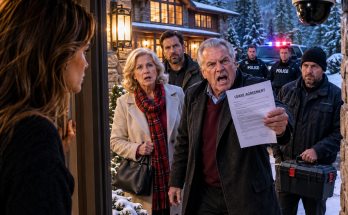
The officers separated the conversations.
My father was asked to explain the lease.
Julian was questioned about the pry bar.
The locksmith gave his account.
My mother remained near the driveway.
She kept looking toward the entrance.
I knew she wanted me to come outside.
She had always preferred conversations where nobody else could hear the beginning.
If I became upset, she could explain my reaction afterward.
If I cried, she could say I was overwhelmed.
If I raised my voice, she could tell everyone I was impossible to reason with.
The presence of the officers changed that.
She couldn't control the entire conversation.
Eventually, she approached the door.
"Clara?"
I didn't answer immediately.
She looked toward the camera.
"Please, sweetheart. Just let me see you."
I stood in the entrance hall.
My hand rested against the wall.
For a moment, I considered opening the door.
Not because I trusted her.
Because some part of me still wanted to see whether she would say something honest.
Then I remembered the letter.
The false letter from the psychiatrist.
The one claiming my parents had authority to intervene in my housing decisions.
I stayed where I was.
"Tell the officers what you know about the documents."
She wiped her cheek.
"I don't know anything about those papers."
I looked toward Harrison.
He had already placed the psychiatric letter on the table.
I pressed the intercom.
"You brought the letter here."
My mother shook her head.
"We only wanted to help."
"Did you know the doctor didn't write it?"
She didn't answer.
I waited.
Then she said she had been told the document was necessary.
By whom?
I asked.
She looked toward Dad.
He was speaking with the other officer.
"Your father was handling everything."
There it was.
The same arrangement as always.
Dad made the decision.
Mom supplied the explanation.
Julian agreed.
And I was expected to accept the result.
I told her that the doctor had never authorized the letter.
She looked genuinely uncomfortable.
"I didn't know that."
I wanted to believe her.
But I couldn't.
She had known enough to bring it to my home.
She had known enough to record the confrontation.
She had known enough to stand beside my father while he claimed I couldn't make decisions for myself.
I asked her whether she had read the letter.
She looked down.
"Not carefully."
That answer stayed with me.
Not carefully.
A document claiming her daughter was incapable of managing her own life, and she hadn't bothered to read it carefully.
I stepped away from the intercom.
Harrison was reviewing the paperwork with the officer.
The officer had asked about the loan guarantee.
Harrison explained how it had been used in the corporate restructuring.
He showed the original address discrepancy.
He pointed out the incorrect middle initial.
He also explained that the notary information was connected to an employee at my father's company.
The officer made notes.
My father noticed the discussion.
He walked closer.
"That loan was a business matter."
Harrison looked at him.
"Then you can explain why Clara's signature appears on a guarantee she never authorized."
Dad waved his hand.
"She knew we were using her name."
I felt my stomach tighten.
That was a new claim.
I had never agreed to anything.
I had never discussed guaranteeing a loan.
I had never been told that my name was being used in the company's financial records.
The officer asked Dad whether he had written authorization.
He didn't answer directly.
He said the family had been discussing the business for years.
Harrison asked whether he could produce a signed agreement.
Dad looked irritated.
"You're twisting everything."
Harrison didn't raise his voice.
"Then produce the authorization."
Nothing.
The silence lasted longer than I expected.
Julian moved toward the suitcases.
One of the officers told him to remain where he was.
He looked annoyed.
"Are we being arrested?"
The officer said they were documenting the incident and examining the evidence.
Julian shook his head.
He turned toward my mother.
"This is what happens when you let her do whatever she wants."
I heard him clearly through the microphone.
I almost responded.
Then I stopped.
There was nothing useful I could say.
He had spent his entire life believing that my independence was an insult to him.
When I stopped giving money, I was selfish.
When I stopped answering calls, I was cruel.
When I bought something he wanted, I was taking something away from the family.
He had never learned to distinguish my life from his expectations.
My father approached the entrance again.
He was no longer smiling.
"Clara, we need to settle this privately."
I looked at him through the camera.
"You had years to speak to me privately."
He stared at the lens.
"This is a family matter."
"No. The forged documents are a legal matter."
He opened his mouth.
Then closed it.
The officer asked him to return to the driveway.
My father obeyed.
It was the first time I could remember him following an instruction from somebody he hadn't chosen to impress.
The reporters remained inside.
One of them approached Harrison and asked whether the company had been notified about the alleged misuse of my identity.
Harrison explained that the lender's fraud unit had already been contacted.
He also confirmed that the records were being preserved.
I sat at the library table.
The psychiatric letter was in front of me.
I read the first paragraph again.
It referred to a short period after college when I had struggled with anxiety.
The writer claimed to have assessed my decision-making abilities.
The doctor had never made that assessment.
The letter used my old address.
It contained language that sounded official.
But the details were wrong.
I remembered the actual appointments.
The waiting room.
The small office.
The doctor's habit of asking me to explain what had happened rather than telling me what I should feel.
He had never met my parents.
He had never authorized them to control my housing decisions.
Somebody had taken a small piece of my medical history and turned it into a weapon.
I felt angry.
Not the hot anger I had experienced during childhood.
This was quieter.
It came with a clear understanding of what they had tried to do.
Harrison sat across from me.
"Are you all right?"
I looked at the letter.
"I don't know."
He nodded.
"You don't have to decide that right now."
I appreciated him saying it.
Outside, the officers continued their work.
My mother was still crying.
Julian had stopped arguing.
My father was speaking less and less.
The suitcases remained beside the broken frame.
I thought about the guest rooms I had planned for the residency.
I thought about the women who might eventually stay there.
I wondered whether they would feel safe walking through the entrance.
Then I looked at the damaged wood.
The broken edge was rough.
It needed repair.
I would have to call the contractor.
I would have to pay for the damage.
But it was still my door.
And I would decide who came through it.
Click here to continue reading: PART 7: The Records Harrison Placed on the Library Table Connected My Father’s Failing Company to Every False Claim Against Me
My Family Remembered My Existence Only After I Bought the One House They Could Not Afford to Lose
Part 6 of 12