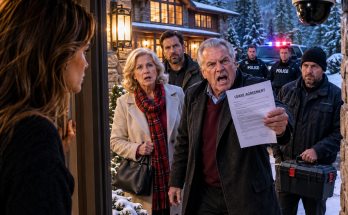
After the vehicles disappeared, I walked through the entrance hall.
The damaged frame looked worse without people standing around it.
A section of wood had split near the lock.
There were scratches along the edge.
The door itself had survived.
I ran my fingers over the damaged area.
I remembered choosing that door during the restoration.
It had been old but solid.
The contractor had told me it was worth saving.
I had agreed.
Now I would have to pay for another repair.
That was manageable.
The house had survived worse neglect.
I called the contractor and explained what had happened.
He said he would come to examine the frame.
I thanked him.
Then I returned to the library.
Harrison was preparing copies of the documents for the investigation.
He reminded me to keep the originals separate.
I had already made that decision.
The false lease went into its own folder.
The loan guarantee went into another.
The medical letter remained untouched.
I wanted the records preserved exactly as they had arrived.
The reporters stayed long enough to confirm their notes and discuss the material they had been given.
They didn't promise an immediate publication.
I didn't ask them to.
They had their own work to do.
Before leaving, one of them asked whether I would be willing to explain the background of the family relationship.
I considered the question.
Then I told her I could explain what had happened without turning my childhood into a public performance.
She understood.
I wasn't ashamed of being excluded.
I was ashamed that I had spent so many years believing I deserved it.
After the reporters left, Harrison and I sat at the central library table.
He opened the binder again.
He wanted to make sure we had a clear record of the sequence.
The suspicious guarantee had arrived at my private mailbox.
I had contacted him.
The lender's fraud unit had been notified.
Then Julian had sent the photograph of the estate.
After that, the locksmith had contacted me about the proposed entry.
The lease and psychiatric letter had followed.
We had installed cameras and preserved the recordings.
My family had arrived.
They had presented the lease.
They had claimed I lacked the ability to refuse access.
Julian had attempted to force the entrance.
The officers had intervened.
Everything was documented.
Harrison closed the binder.
"Now we let the process work."
I nodded.
I wanted to ask how long it would take.
I wanted to know whether my father would face consequences.
I wanted to know whether the lender would believe the evidence.
But those were questions nobody could answer immediately.
Harrison reminded me that I should not try to resolve the matter by sending money or negotiating privately.
I told him I wouldn't.
He looked at the library.
"Have you thought about whether the residency plans should change?"
I looked around the room.
For a moment, I couldn't answer.
The estate had been my escape.
But it was never meant to become a hiding place.
I had purchased it because I wanted to build something useful.
I told him I still intended to continue.
He nodded.
"Then we make sure the property is secure and keep moving."
After he left, I remained at the table.
The false medical letter was still on my mind.
I thought about the psychiatrist I had seen after college.
I remembered sitting in his office, explaining why I felt guilty whenever I disagreed with my parents.
He had listened.
He had asked questions.
He had never told me I was incapable of making decisions.
He had never suggested that my parents should control my life.
Somebody had taken the fact that I once sought help and turned it into evidence against me.
That hurt.
But it also clarified something.
Getting help had never been a mistake.
Trusting my family to respect that private part of my life had been misplaced.
I put the letter away.
Then I went upstairs.
The guest rooms were not finished.
One still had protective coverings over the floor.
Another needed a final coat of paint.
I opened the windows for a few minutes.
Cold air entered.
The curtains moved slightly.
I stood there imagining the women who might eventually stay in those rooms.
Some might have left marriages.
Some might have lost their homes.
Some might simply need time to rebuild their work and confidence.
I didn't want them to feel they had to prove their suffering before receiving help.
I wanted the rooms to be ordinary.
Clean sheets.
A warm bed.
A desk.
A door that locked.
A place where nobody could enter simply because they believed they had a right to.
I returned downstairs.
The broken piece of the doorframe was still inside the small box.
I placed it in the office where the restoration records were kept.
Then I opened my notebook.
I found the list of unfinished projects.
Library measurements.
Guest-room furniture.
Gallery lighting.
Carriage-house repairs.
Residency application materials.
I picked up my pen.
I crossed out nothing.
The list remained.
The work remained.
And I still had a reason to finish it.
That evening, I made dinner in the kitchen.
Nothing special.
I ate alone at the counter.
I didn't turn on the television.
I didn't check whether my mother had sent another message.
I washed my plate.
Then I walked into the library and switched off the lights one by one.
The house was quiet again.
But this time, the quiet belonged to me.
Click here to continue reading: PART 11: I Returned to the Work My Family Had Interrupted, but the Old Christmas Letter Finally Helped Me Understand What Freedom Meant
My Family Remembered My Existence Only After I Bought the One House They Could Not Afford to Lose
Part 10 of 12