I used to think being forgotten was the worst thing my family could do to me.
I was wrong.
Being remembered by them was much worse.
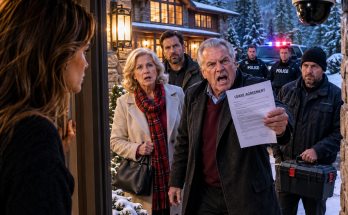
Three days before Christmas, I watched my father stand outside my front door with a locksmith, a folder of fraudulent documents, and the same expression he used whenever he believed nobody could challenge him.
My mother was filming.
My brother had already brought luggage.
And my father was telling a stranger that I wasn't mentally capable of making decisions about my own property.
I watched everything from inside my house.
I didn't cry.
That surprised me more than anything.
For most of my life, I had wanted my father to look at me long enough to recognize that I was standing in front of him.
Now he was looking directly into a security camera, and I wished he would leave.
My name is Clara Vance.
I was thirty-five years old, and the house behind me had taken almost everything I had saved, earned, and worked for.
It was an old stone estate outside Asheville, North Carolina.
Fourteen rooms.
Two courtyards.
A library with dark wooden shelves.
A detached carriage house that needed more repairs than I wanted to count.
There were unfinished galleries, aging plumbing, and electrical work that had scared away several potential buyers.
I had fallen in love with it anyway.
Not because it was impressive.
Because nobody in my family had any claim to it.
For the first time, I had something that existed entirely outside their expectations.
I bought the property through a company connected to my design business.
The arrangement was legitimate.
The money was mine.
The decision was mine.
And my father had no idea I owned it.
At least, that was what I believed until the morning his car appeared on my security monitor.
But I am getting ahead of myself.
To understand why I didn't open that door, I have to explain what Christmas looked like in my family.
It was never particularly complicated.
My younger brother, Julian, was remembered.
I was not.
When I was eleven, Christmas morning arrived with a tree, presents, and a large breakfast spread across the kitchen island.
Julian had a remote-controlled car.
He had a new bicycle.
He had a collection of expensive toys that occupied most of the living room.
I had nothing with my name on it.
At first, I thought my parents were saving my presents for later.
I waited until breakfast ended.
Then I waited until my father finished opening the gifts from his business associates.
Eventually, my mother noticed me standing near the tree.
She disappeared into the bedroom and returned carrying a sweater.
It had already been wrapped once.
She removed the old ribbon, found another sheet of paper, and put my name on the package.
I remember the sweater was too large.
I also remember thanking her.
I didn't want her to feel bad.
Later that afternoon, my father told one of his relatives that I had been difficult about opening presents.
Apparently, I had been having a phase.
Nobody asked me what happened.
I learned something that morning.
My family could make a mistake and then make me responsible for remembering it.
At sixteen, the same thing happened in a different way.
My parents planned a Christmas vacation in Colorado.
Julian knew about it.
He had been talking about skiing for weeks.
I heard nothing.
On the morning they left, I woke up to an empty house and a note on the kitchen counter.
It reminded me to feed the dog.
There was no explanation.
No phone number for the hotel.
No message saying they had forgotten to wake me.
I called my mother.
She didn't answer.
I called again that evening.
Nothing.
I spent the next three days alone, eating canned soup and whatever I could find in the freezer.
Outside, snow covered the neighborhood.
Inside, the house was so quiet that I could hear the refrigerator motor switching on and off.
I wasn't frightened.
I was embarrassed.
I didn't know how to explain to anyone that my parents had gone on vacation without me.
When they returned, my father told me I should have made more of an effort to join them.
He said I had been invited.
I asked when.
He looked at me as if the question itself was unreasonable.
The family Christmas video that year showed my parents and Julian standing beside a decorated tree in Colorado.
My father spoke about how wonderful it was to have everyone together.
I watched the video once.
Then I turned it off.
By the time I was twenty-two, I had learned not to expect much.
I studied illustration and architectural design.
I worked constantly.
I took freelance jobs whenever I could find them.
I was proud of the sketches I made, even when nobody else seemed interested.
One Christmas, I brought four framed architectural drawings to my parents' house.
I had spent months working on them.
They were detailed studies of old buildings, with careful measurements and shadows that took hours to get right.
I thought my father might appreciate them.
He had spent his career in business and construction-related logistics.
He knew enough about buildings to understand the work.
At dinner, one of his business partners asked who I was.
Before I could answer, Dad laughed.
"That's Clara. She shows up every so often when there's something to eat."
Everyone laughed.
Including Julian.
I stood beside the dining table holding a glass of water.
I could have explained that I lived fifteen minutes away.
I could have mentioned that I called my mother every Sunday.
I could have told them about the projects I had completed.
Instead, I put the glass down.
Nobody noticed.
That was the strange part.
I could leave a room, and sometimes the conversation didn't change at all.
I spent years believing there was something wrong with me.
Maybe I wasn't interesting enough.
Maybe I was too quiet.
Maybe I had somehow failed to become the kind of daughter my parents knew how to love.
I tried harder.
That was my mistake.
When I was thirty, my father praised Julian during Christmas dinner.
Julian had left his MBA program before finishing it.
He had also developed expensive interests in sports betting, cryptocurrency, and vintage cars.
Still, Dad spoke about him as if he were preparing to take over a major corporation.
"He understands the future of the business," Dad said.
Then he looked at me.
"Are you still doing those little drawings?"
I had illustrated three bestselling books by then.
I had completed a large municipal mural.
One of my advertising campaigns had been used nationally.
I had also sent my parents fifteen thousand dollars earlier that year.
My mother had called me crying because the family company supposedly couldn't afford its employees' health insurance.
I hadn't asked for the money back.
I hadn't even mentioned it afterward.
But my work was still a hobby.
Julian's mistakes were investments in his future.
I sat through dinner without arguing.
That night, I drove home and opened a document on my computer.
I didn't know what I intended to write.
I only knew I needed to stop carrying the words around in my head.
I typed a heading.
The letter I will never send.
Then I began.
Dear Mom and Dad,
I have spent my entire life trying to become someone you remember without being reminded.
I have tried to be useful.
I have tried to be successful.
I have tried to be quiet when you hurt me and grateful when you gave me less than you gave everyone else.
I am tired of asking for a place in a family that keeps telling me I don't belong.
I stopped typing.
My hands were shaking.
I read the letter twice.
Then I saved it.
I didn't send it.
I didn't need an argument.
I needed an exit.
And for the first time, I began making one.
Click here to continue reading: PART 2: I Changed My Number, Built a Business in Silence, and Found a Way to Own Something Nobody Could Take From Me
My Family Remembered My Existence Only After I Bought the One House They Could Not Afford to Lose
Part 1 of 12