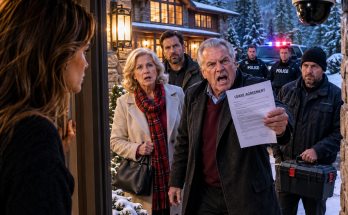
The officers asked Harrison to explain the documents in chronological order.
He opened the binder.
I recognized the sections immediately.
The first contained the loan guarantee.
The second contained records from the corporate restructuring.
The third contained messages from Julian.
The fourth held the lease and the copied property pages.
The last section contained the psychiatric letter.
Harrison began with the financial records.
He explained that the guarantee had appeared during a restructuring intended to make my father's company look financially stronger.
My name had been presented as evidence of additional support.
The lender had been given the impression that I stood behind the obligation.
I didn't.
The officer asked whether I had any ownership interest in the logistics company.
I said no.
Had I ever been employed there?
No.
Had I signed a guarantee?
No.
Had I authorized anyone to use my name?
No.
Each answer felt strangely important.
I had spent years being told that my memory was unreliable.
Now I was answering direct questions about my own life.
Harrison showed the officer the old address.
It was an apartment I had left seven years earlier.
Then he showed the incorrect middle initial.
The officer compared the document with my identification.
He made a note.
The notary information came next.
Harrison explained that the document had been notarized by an employee at my father's company.
The investigators would need to examine the circumstances.
He didn't claim to know every detail.
He simply showed what we had found.
Then he moved to Julian's messages.
The first photograph showed the estate.
The second message said Dad believed family property should remain in the family.
The locksmith's communication followed.
It established that Julian had requested access using documents that supposedly gave the family a right to occupy the house.
The officer read the messages.
He looked at Julian.
"Did you send these?"
Julian nodded.
"Yes."
"Did you have permission from the owner to enter the property?"
"No."
"Did you believe the lease was genuine?"
Julian hesitated.
"My father said it was."
The officer asked whether he had personally verified it.
Julian looked away.
"No."
My father interrupted.
"I was handling the legal side."
Harrison turned another page.
The lease carried my forged signature.
The officer asked who had prepared it.
Dad said he had received it through his business contacts.
Harrison asked for the name of the person who had prepared it.
Dad supplied a name.
Harrison wrote it down.
He didn't argue.
He didn't accuse.
He simply added it to the record.
Then came the medical letter.
The officer read it slowly.
I watched his expression change when he reached the section claiming my parents had authority to intervene in my housing decisions.
He asked whether the psychiatrist had written it.
I said no.
I explained that I had briefly seen the doctor after college.
The doctor had never evaluated me for the purpose described in the letter.
He had never issued such a recommendation.
And I had never authorized my parents to make decisions about my property.
Harrison explained that the letter was being treated as a suspected forgery.
The officer asked whether I had retained any records of the original treatment.
I told him I would cooperate with any lawful request.
I wanted the truth established.
Not a family argument about who remembered what.
The reporters were listening from the other side of the room.
One asked Harrison whether the company had been struggling financially.
Harrison explained that the records indicated serious financial pressure.
He did not offer figures beyond those supported by the documents.
The loan guarantee alone was substantial.
The officer looked toward my father.
"Was the company using this property as part of its financial plans?"
Dad shook his head.
"Absolutely not."
Harrison placed another document on the table.
It showed the property's value and the information my father had obtained about the estate.
Dad stared at it.
He said he had only been trying to protect the family.
I asked him one question.
"Why did you need my signature?"
He looked at me.
"Because you wouldn't help us."
I felt something shift inside me.
Not surprise.
Recognition.
He had just explained more than he intended.
He didn't say I had signed.
He didn't say I had agreed.
He said I wouldn't help.
That meant he knew I had not given him what he wanted.
And he had used my name anyway.
The officer asked him to clarify.
Dad rubbed his forehead.
"You people are making this sound criminal."
Nobody answered immediately.
My mother began speaking.
She said the company had been in trouble.
She said my father was under enormous pressure.
She said the family had been trying to find a solution.
I listened.
Then I remembered the fifteen thousand dollars.
I had given it to them because my mother said employees were depending on the money.
I hadn't asked for anything in return.
I hadn't demanded recognition.
I had simply helped.
And now they had decided my name could be used for another two million, one hundred thousand dollars.
My father looked at me.
"You could have prevented all this."
I didn't understand.
He continued.
"If you'd just spoken to us, we wouldn't be standing here."
I looked at the broken entrance.
The forged lease.
The medical letter.
The loan guarantee.
Then I answered.
"I did speak to you. You told me I had a selective memory."
He looked away.
For a moment, nobody spoke.
The officer returned to the documents.
The reporters continued taking notes.
Harrison closed one section of the binder and opened another.
I noticed the paper clips.
Each one held together a separate part of my family's story.
For years, they had treated the past as something they could rearrange whenever it became inconvenient.
Now the documents were in order.
The dates were visible.
The messages were preserved.
And the signatures could be compared.
My father had always trusted that people would believe him because he sounded certain.
That morning, certainty wasn't enough.
Click here to continue reading: PART 8: When My Father Finally Looked at Me Without His Usual Smile, I Understood That He Had Never Expected Me to Fight Back
My Family Remembered My Existence Only After I Bought the One House They Could Not Afford to Lose
Part 7 of 12