Ms. Osei stayed at the kitchen table long after the first round of questions had ended.
Charlene had stopped jingling her keys.
They lay beside her handbag, perfectly still, while she folded and unfolded a paper napkin between her fingers.
Trent sat opposite her with his elbows on the table.
I stood near the doorway, close enough to hear but far enough away that nobody could accuse me of trying to take over a family conversation.
Gordon was in his recliner.
He had asked twice whether his lunch was ready, although it was only a little after ten.
“I can get him something,” I said.
Ms. Osei nodded.
“Please do.”
I warmed a bowl of soup and brought it to him with a piece of bread.
He looked at the bowl as if I had brought him something from a restaurant he remembered from childhood.
“Did you make this?”
“I heated it up.”
“That isn't what I asked.”
I almost smiled.
“No, Gordon. I didn't make it.”
He considered that answer, then accepted the spoon.
“Honest woman,” he murmured.
I went back to the kitchen before he could look at me long enough to wonder why the words hurt.
Charlene was explaining the pill organizer when I returned.
She had brought it from the counter and placed it in front of Ms. Osei.
“I fill it every Sunday,” she said. “I follow the instructions we've been given.”
Ms. Osei opened the little compartments carefully.
“Do you have the current medication list?”
“In my purse, I think.”
“Please find it.”
Charlene searched through her handbag.
There were tissues, receipts, a small bottle of hand lotion, and a pair of reading glasses in a case.
She found the list folded into quarters.
Ms. Osei compared it with the organizer and wrote something in her notebook.
“I'm not saying anyone has done anything wrong,” she explained. “I need to establish exactly what was prescribed, what was administered, and whether the instructions changed.”
“I understand,” Charlene said.
Her voice sounded thin.
Trent looked at the organizer.
“Mom, why are there two pills on Thursdays?”
Charlene stopped folding the napkin.
“Sometimes his doctor changes things.”
“Did his doctor change this?”
“I don't remember every conversation.”
Ms. Osei raised her eyes.
“That's why we verify the instructions rather than rely on memory.”
Nobody spoke for several seconds.
I thought about the five months of notes on the agency's secure server.
I had written down the dates, the times, the number of pills I saw, and the number Charlene told me Gordon was supposed to receive.
I had not written that she was trying to harm him.
I had not written that she wanted him gone.
I had written what was in front of me.
That distinction had seemed small when I first started keeping the records.
Sitting in that kitchen, I understood how much depended on it.
Ms. Osei asked Charlene for permission to contact the prescribing office and confirm the current instructions.
Charlene agreed.
She also agreed to provide the paperwork concerning the conservatorship folder, though she said she had not yet completed the process.
“What exactly are you trying to arrange?” Trent asked.
Charlene pressed the napkin flat.
“I am trying to make sure your father has care when I cannot manage everything myself.”
“Does that mean moving him?”
“I haven't made a decision.”
“Then why is the house being emptied?”
Charlene looked toward the living room.
For the first time that morning, she seemed too tired to arrange her face before answering.
“The dining set was too difficult to keep clean. The cabinet was taking up space. The old chair was hurting his back.”
“And the photographs?”
She looked down again.
“I don't know where every photograph went.”
I knew where one of them was.
It was in the shoebox at the back of Gordon's closet, beneath the watch and the old mass card.
I had put everything back exactly as I found it.
I had not taken the photograph with me.
I had not earned the right to keep it simply because the words on its back were still mine.
Ms. Osei asked whether the missing items had been sold, donated, or moved into storage.
Charlene said she would have to check.
Trent rubbed both hands over his face.
“I should have come sooner.”
Nobody contradicted him.
I had spent years thinking of Trent as the boy who once came running into the kitchen with a split lip and insisted he had not been crying.
He was a grown man now, with a job and a life of his own, and he had flown in because his father's condition had reached a point where decisions could no longer be postponed.
I knew better than to mistake his absence for indifference.
Families could become experts at believing there would be another weekend, another visit, another chance to ask the questions everyone was avoiding.
Gordon finished his soup and pushed the bowl away.
“Is the meeting over?”
“Almost,” I told him.
“Good. I don't like meetings.”
“You never did.”
The words slipped out before I could stop them.
He looked at me.
For a moment, something moved behind his eyes.
“Have we met?”
My hands went cold.
“Yes,” I said quietly. “A long time ago.”
He nodded as though that answered everything.
Then he asked where his shoes were.
I fetched them from beside the recliner and placed them within reach.
Ms. Osei watched me help him settle back.
“Does he recognize you?” she asked when I returned to the doorway.
“Not consistently.”
“And you knew him before this assignment?”
“Yes.”
Charlene's head came up.
The silence that followed was different from the earlier ones.
“What do you mean, you knew him?”
I could have waited for Ms. Osei to answer for me.
Instead, I took a breath.
“Gordon and I were married for thirty-one years.”
Charlene stared at me.
Trent turned in his chair.
I had rehearsed that sentence in my mind during the nights when I drove home from Maplewood Drive, but every version had sounded either accusing or pathetic.
The truth required neither tone.
“I am his first wife,” I said. “We divorced in 2003.”
Charlene's mouth opened, then closed.
“You knew who he was when you came here?”
“Yes.”
“And you didn't tell me?”
“No.”
Her eyes sharpened.
“Why not?”
I looked toward Gordon.
He was studying the laces of his shoes with the concentration of a child learning to tie them.
“Because I was assigned to care for him,” I said. “I wanted to do the work properly. I also wanted to know that he was safe.”
“You could have told me.”
“Yes. I could have.”
It was the only honest answer I had.
Charlene leaned back.
For a second, I thought she might tell Ms. Osei that I had been dishonest about the assignment, that my history made every note I had written suspect.
Instead, she looked at the pill organizer.
“Were you watching me?”
“I was watching the care.”
“That isn't the same thing.”
“No,” I said. “It isn't.”
My voice remained steady, though my fingers were pressed so tightly together that my knuckles hurt.
“I wrote down what I observed. I didn't write down what I imagined it meant.”
Ms. Osei closed her notebook.
“That is an important distinction.”
Charlene gave a short, disbelieving laugh.
“So my husband's former wife is the person who reported me.”
“I reported concerns about his care,” I said. “I did not report you because you were his wife.”
“And you expect me to believe that?”
“No.”
The answer surprised her.
It surprised me, too.
“I don't expect you to believe anything about my feelings,” I continued. “I expect the records to be checked.”
Trent looked from Charlene to me.
“Did you tell the agency about your history with Dad?”
“I told Denise when I understood that the situation might need outside review.”
“And before that?”
“I did not tell her at the beginning.”
I would not pretend I had handled everything perfectly.
I had taken the assignment partly because I wanted to see Gordon.
That was true.
I had also stayed because he needed someone who could help him eat, wash, dress, and get through a frightening day without making him feel ashamed.
Both things could be true at once.
Ms. Osei made a note.
“Your prior relationship is relevant context,” she said. “It does not automatically make your observations unreliable. We will review the documentation and verify the information independently.”
Charlene stared at the table.
“I never asked for any of this.”
“I understand,” Ms. Osei said. “But we have to address the concerns that were raised.”
The visit continued for another hour.
Ms. Osei spoke privately with Gordon for a short time, using simple questions and giving him space to answer.
She asked about his meals, his medication, the people who helped him, and whether he felt safe in the house.
His answers wandered.
He spoke about a fishing trip that had happened decades earlier, then asked whether his father was coming home from work.
When Ms. Osei asked who helped him bathe, he pointed toward me.
“Wanda does.”
The room went quiet.
I had not expected him to remember my name.
“Do you like having Wanda help you?” she asked.
He thought about it.
“She doesn't rush.”
That was all he said.
It was enough to make me look away.
Afterward, Ms. Osei explained the next steps.
She would contact the prescribing office, review the medication records, and follow up on the proposed legal arrangements and changes in the house.
She would also assess whether Gordon's present care plan adequately met his needs.
Nothing would be decided simply because I had raised a concern.
Nothing would be dismissed simply because Charlene denied wrongdoing.
The facts had to be checked.
Before leaving, Ms. Osei gave Charlene her contact information and explained what records she needed to provide.
She asked Trent to remain involved in the discussions about his father's care.
Then she turned to me.
“Please continue documenting anything you directly observe during your shifts. If you see an immediate danger, don't wait for a scheduled review.”
“I will.”
She did not promise me an outcome.
I was grateful for that.
Promises would have been easier to hear, but they would not have meant anything.
When the door closed behind her, Charlene stood in the hallway with her arms folded.
Trent remained at the table.
I could hear Gordon humming in the living room, a tune without a clear beginning or end.
Charlene looked at me.
“Do you hate me?”
I had imagined that question many times over the years, though never in that house.
For a long time, I might have answered yes.
I could have listed the years, the divorce, the humiliation of starting again at fifty-two, the empty rooms, and the way Gordon had left our marriage as if thirty-one years could be placed in a box and carried away.
But that was not what she was asking now.
“I don't want Gordon hurt,” I said.
“That isn't an answer.”
“It is the answer I have.”
She looked toward the living room.
“I didn't know what to do with him anymore.”
There was no triumph in hearing her say it.
I had spent months wondering what her plans meant.
The real estate card, the empty rooms, the folder marked conservatorship, the pills on Thursdays.
I had joined those things together in my mind because I was frightened for Gordon.
But I had not been inside Charlene's thoughts.
I did not know which decisions came from exhaustion, which came from fear, and which came from a desire to make her life easier.
I could not turn suspicion into certainty merely because I had once been hurt by her.
“Then get help,” I said. “Don't try to carry everything alone.”
Charlene's eyes filled, although she did not cry.
“I don't know if I can keep doing this.”
“Then tell the people who can help you.”
She looked at me for a long time.
“I thought you would want to see me fail.”
I thought of the woman I had been in 2003, sitting at a table with divorce papers and a pen that kept slipping in my damp hand.
I thought of the woman I had become, driving to Maplewood Drive three nights a week with a clean uniform folded on the passenger seat.
“I wanted you to stop making decisions without enough help,” I said. “That isn't the same as wanting you to fail.”
Charlene looked away.
Trent finally stood.
“Mom, we need to sort this out.”
She nodded, but she did not answer him.
I finished my shift the way I always did.
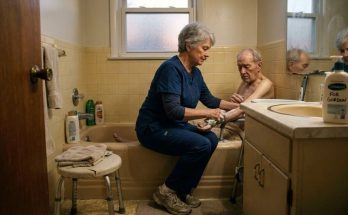
I checked Gordon's skin, made sure he had eaten, helped him wash, and laid out what he needed for the evening.
I recorded the medication information according to the instructions available to me.
I wrote down that Ms. Osei had visited and that the matter was under review.
I did not write that Charlene had cried.
I did not write that Trent looked ashamed.
Those things were real, but they were not care observations.
Before I left, Gordon reached for my wrist.
His hand was thinner than it had been in March.
“Will you be here Thursday?”
“Yes,” I told him. “If I'm still scheduled.”
He nodded.
“Good. You don't rush.”
I pulled the blanket over his knees.
“I'll see you Thursday, Gordon.”
He let go of my wrist.
I walked out into the cool evening and sat in my car for several minutes before starting the engine.
I was not relieved.
The visit had not solved everything.
The medication instructions still needed to be verified, the legal paperwork still needed review, and Gordon's future care remained uncertain.
But the questions were no longer mine to carry alone.
In the weeks that followed, the agency continued to schedule me for the same three evenings.
Denise checked in with me regularly and reminded me to document only what I saw.
Ms. Osei followed up with the family and the relevant offices.
I was not given private details of every conversation, and I did not ask for them.
I learned only what affected Gordon's care.
The medication instructions were reviewed, and the organizer was adjusted to match the verified directions.
The extra Thursday pills I had recorded were not treated as proof of an intention to harm him.
They became a reason to make the routine clearer and to ensure everyone involved was following the same instructions.
That was not the dramatic answer a hurt woman might have wanted.
It was the answer a patient needed.
Trent began taking a more active role in the conversations about his father's future.
He asked questions he should have asked earlier, and sometimes he asked them badly.
Charlene grew defensive when he challenged her.
Then, little by little, the arguments became more practical.
Who could provide care during the hours she was away?
What would Gordon need if his memory worsened?
Which changes could wait, and which could not?
The house was still being considered as part of those decisions, but I never received proof that Charlene had intended to sell it simply to get Gordon out of her way.
I had suspected that.
I had feared it.
I had not known it.
That distinction mattered more to me as time passed.
One Thursday, I found Charlene sitting beside Gordon's recliner when I arrived.
She had not left for an errand.
A cup of tea sat untouched on the side table, and the television was playing a program neither of them seemed to be watching.
“You can go,” she said when I set down my bag. “I'll stay for a while.”
I checked the care schedule.
“If you're taking over tonight, I need to confirm it with the agency.”
She nodded.
“Of course.”
There was no warmth in the exchange, but there was no fight either.
I called Denise, confirmed the change, and wrote down the time I left.
Before I reached the door, Charlene spoke again.
“I found some of the photographs.”
I turned.
“They were in a storage box. I hadn't thrown them away.”
I waited.
“There was one of you,” she said. “By a car, in a yellow dress.”
My throat tightened.
“Did you see the writing on the back?”
She nodded.
“I did.”
Neither of us knew what to say after that.
I could have told her that I remembered the afternoon clearly.
The sun had been hot on the hood of the Ford, and Gordon had complained that I was standing too far from the car for the picture to look right.
I could have told her that the photograph had survived moves, arguments, and the end of our marriage.
Instead, I said, “I'm glad you found it.”
Charlene looked down at her hands.
“I didn't know he kept it.”
“Neither did I.”
That was true.
I had not known about the shoebox until I found it myself.
I had not known what Gordon remembered or what he had lost until I watched him struggle with a spoon in his own living room.
I had thought knowing his history would make the work easier.
Sometimes it made it harder.
When I returned the following week, the photograph was no longer in the shoebox.
Charlene had placed it on a small table near Gordon's recliner, in a plain frame.
He looked at it several times that evening.
Once, he pointed at the yellow dress.
“Pretty,” he said.
I stood beside him.
“Yes,” I answered. “It was.”
He looked at me, then back at the photograph.
“Who is that?”
“Someone you knew a long time ago.”
He seemed satisfied with that.
I did not tell him I had been his wife.
I did not ask him to remember me.
There was no kindness in forcing a memory out of a man who could no longer reach it.
I had once believed that if Gordon ever looked at me and understood who I was, something inside me would finally settle.
It did not happen that way.
He remembered my name on some nights and forgot it on others.
Sometimes he spoke to me as if I were a stranger.
Sometimes he trusted me with the small, ordinary things that made his day bearable.
I learned to accept each moment for what it was.
I still work as a home health aide.
At seventy, I am slower on the stairs than I used to be, and I have to remind myself not to lift with my back when a client needs help standing.
I still keep my notes clean and factual.
I still check the room temperature, the food, the skin, the medication instructions, and the little details that can become serious when nobody pays attention.
I do not tell every family that I once had a marriage of my own.
My clients do not owe me a place in their history.
And I do not owe every person who hurt me the rest of my life spent trying to prove that I survived.
My sister still asks why I kept going back to Gordon's house.
She says I could have let another aide take the assignment.
She says I had already given him thirty-one years.
Sometimes she is right.
But I know what it feels like to be left alone with a life that has suddenly become unfamiliar.
I know what it feels like to watch a person you once knew better than anyone become someone you cannot reach.
And I know the difference between caring for someone and trying to make them love you again.
I did not go back to Maplewood Drive to reclaim my marriage.
I went because a man who had once shared my home needed help getting through his days.
I went because the facts mattered when the people around him were frightened, exhausted, or too close to the situation to see clearly.
And I went because the woman I had become could do the work without pretending the woman I had been never existed.
The last time Gordon called me by name, he was sitting in his recliner with the yellow-dress photograph on the table beside him.
He looked at me for a long moment.
“Wanda?”
“Yes, Gordon.”
His face softened.
“I thought you might come.”
I felt the old ache rise, familiar as a song heard through a wall.
“I did come,” I said.
He smiled faintly and looked toward the window.
A few minutes later, he asked whether I was the new girl.
I told him I was.
Then I warmed his soup, checked the temperature, and set the bowl where he could reach it.
He ate slowly while I sat nearby.
There was no grand apology.
There was no return to the years we had lost.
There was only the room, the quiet television, the photograph in its plain frame, and the small work of making sure he was safe.
When my shift ended, I wrote my notes, washed the bowl, and put my coat on.
At the door, I looked back once.
Gordon was still eating.
Charlene was in the kitchen, reading the medication instructions again.
I left them to their evening.
For the first time in a long while, I did not drive away wondering what I should have done differently.
I had told the truth as carefully as I could.
I had kept the records.
I had asked for help when the situation required more than one person could provide.
And I had cared for a man who could no longer remember all the ways he had once mattered to me.
That was enough.
Not because the past had been repaired.
Because it hadn't.
Because some things do not return to the way they were, no matter how patiently we wait.
But the past does not have to be repaired before we can do something decent in the present.
I learned that at seventy, in a house where my former husband sometimes knew my name and sometimes did not.
I learned it one bowl of soup, one careful note, and one quiet evening at a time.
The End
Read more original stories on Feel Every Story.
The Man Who Forgot My Name Still Had a Place in My Heart, and I Was Afraid of What I Might Find There
Part 9 of 9