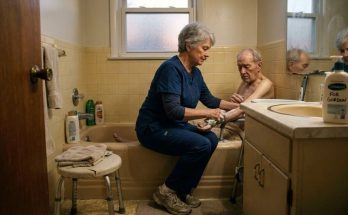
By the time July arrived, I had stopped trying to convince myself that the things I noticed at Maplewood Drive were unrelated.
I still couldn't say what Charlene intended.
I could say that Gordon was vulnerable, that the house had changed, and that the medication counts had concerned me enough to record them repeatedly.
Those were facts.
The rest needed to be examined by someone who could do more than stand in a hallway and wonder.
I kept going to work.
Three evenings a week, I parked outside the house, collected my bag, and walked in through the same door.
Sometimes Gordon was awake.
Sometimes he sat in his recliner with his eyes half closed, his hands resting on the armrests.
I greeted him each time.
He sometimes answered with a nod.
Other evenings, he looked at me as if he were trying to remember why I was there.
I had learned not to push him.
"How are you feeling tonight, Gordon?"
He glanced toward me.
"Do I know you?"
I swallowed the answer that came naturally.
"I'm Wanda. I'm here to help you."
He accepted that and turned back toward the television.
There were nights when I could manage the question without feeling anything sharp.
Other nights, I had to concentrate on the small tasks in front of me.
The washcloth.
The clean towel.
The water running into the basin.
The familiar work gave my hands something to do while my mind caught up.
I had once believed that being forgotten would be worse than being hated.
I was no longer sure.
Being hated would at least have meant that some part of our history remained accessible to him.
But Gordon could look at me without anger or affection.
I was simply the woman who arrived to help him.
And I had to accept that as his present reality, even when my own memories refused to follow.
I kept the shoebox in mind.
I never went searching for it again.
I had found it by accident, and I had no right to turn Gordon's private possessions into a place where I went looking for answers.
Still, the image stayed with me.
The old watch.
The funeral card.
The photograph of me in the yellow dress.
My name in his handwriting.
I sometimes wondered whether he had kept the box because he remembered the life we shared, or whether he had simply never thought to throw it away.
There was no way to know.
The photograph could not tell me what the man in the recliner remembered.
It could only show me that the photograph still existed.
That was enough.
At the agency, I continued entering my notes after each shift.
I did not write about the photograph.
I did not write about my feelings.
I recorded the temperature, the meals, the assistance Gordon needed, and the medication discrepancies I observed.
I also kept track of the things that had disappeared from the rooms.
The dining table had gone.
The china cabinet had gone.
The old recliner had been replaced.
The walls had been stripped of pictures.
I described what I could see without assigning a motive.
The records accumulated.
Week after week, the entries remained in the system.
Sometimes I wondered whether anyone would ever need them.
I hoped they wouldn't.
I hoped Charlene would arrange appropriate care for Gordon.
I hoped the medication count would be corrected.
I hoped the legal folder meant nothing more than an ordinary effort to manage the affairs of a man who was losing his memory.
I wanted my concerns to turn out to be unnecessary.
That would have been the easiest ending for everyone.
But I couldn't make myself ignore what I had seen.
One evening, Charlene asked me to check whether Gordon had eaten enough of his supper.
"He hasn't been finishing his meals," she said.
"I'll keep an eye on it."
She nodded, already looking at her phone.
I checked the bowl after he finished.
He had eaten some, but not all.
I recorded the amount as accurately as I could.
I offered him a little more.
He shook his head.
"That's enough."
"All right."
I cleared the bowl.
Then I helped him settle back into his chair.
He looked smaller than he had when I first arrived in March.
His clothes seemed loose around his shoulders.
His movements were slow.
I could not say what had caused the changes, and I refused to pretend otherwise.
But I knew they were worth recording.
The next time I saw the thermostat, it was still set low.
I checked the room where Gordon was sitting and made sure he had enough warmth.
I documented the reading.
I did not turn the temperature into an argument with Charlene.
I did not accuse her of deliberately making him uncomfortable.
I simply recorded what was there.
That was becoming my rule.
Observe.
Document.
Do not exaggerate.
Do not look away.
My sister had a harder time understanding that approach.
She knew about my work, but she did not know the full extent of what I was seeing at Maplewood Drive.
I had told her that I was caring for an older man with dementia.
I had not told her that the man was Gordon.
Part of me knew that keeping the truth from her was foolish.
Another part was ashamed of the assignment itself.
I had accepted the job without disclosing my personal connection to the agency.
I had made that decision because I wanted to know whether Gordon was safe.
But wanting to know something did not automatically make every choice I made to discover it wise.
I had to live with that.
By the end of the fifth month, I had reached a point where silence seemed less like professionalism and more like an excuse.
I could continue writing notes while Gordon's situation developed around him.
Or I could take the records to someone who had the authority to examine them.
I knew which choice I would advise another aide to make.
The difficulty was admitting that I needed to follow my own advice.
I called Denise at the agency.
She answered after a few rings.
"Wanda? Is everything all right?"
"I need to discuss a concern about one of my assignments."
Her voice changed.
"Is the client in immediate danger?"
"I don't know that he is in immediate danger right now. But there are things I've documented over several months that I believe need to be reviewed."
I explained the situation carefully.
I told her that I had a personal history with the client and that I should have disclosed it before accepting the assignment.
I did not hide that fact.
I told her about the medication discrepancies.
I described the changes in the house and the legal paperwork I had seen.
I explained that I had been recording observations rather than making accusations.
Denise listened without interrupting.
When I finished, there was a short silence.
"Why didn't you tell me sooner?"
"Because I wanted to be sure I wasn't letting my history with him affect my judgment."
"And are you sure now?"
I looked at the notes beside me.
"I know what I observed. I can't tell you what it means. That's why I'm calling."
She let out a breath.
"All right. I'll review the records."
"Thank you."
"We may need to involve the appropriate county office."
"I understand."
I had spent months worrying that the truth would be dismissed because it came from Gordon's former wife.
Now I was asking the agency to judge the record rather than the relationship.
It was the first step I had taken that felt both frightening and right.
After I ended the call, I sat quietly for a while.
I had not solved anything.
I had not proved that Charlene was doing something wrong.
I had simply stopped keeping my concerns to myself.
That evening, I went to Maplewood Drive as scheduled.
Gordon was in his recliner.
The television was playing without sound.
I greeted him and asked how he was feeling.
He looked at me with a tired expression.
"Have you been here before?"
"Yes," I said gently. "I've been helping you for a while."
He considered that.
Then he nodded, as though the answer had settled some small question in his mind.
I warmed his supper.
I helped him with his evening routine.
I checked that he was comfortable before finishing my notes.
Everything looked ordinary.
But I knew that the records I had entered were no longer just a private effort to make sense of what I saw.
They might soon be read by people who had never met me, never known Gordon as a younger man, and had no reason to care about the history between us.
That was what I wanted.
Someone who could look at the evidence without needing to decide which spouse had hurt the other.
Someone who could ask questions I had no authority to ask.
For the first time since I accepted the assignment, I felt that the burden of deciding what to do might not rest entirely on my shoulders.
I left the house that night with my bag over my arm.
The front door closed behind me.
I walked to my car and sat inside for a moment before starting the engine.
I was still worried.
But I was no longer alone with the worry.
Click here to continue reading: PART 6: When Gordon’s Son Arrived From Out of Town, Charlene Called a Family Meeting, and I Realized I Could Not Keep Waiting
The Man Who Forgot My Name Still Had a Place in My Heart, and I Was Afraid of What I Might Find There
Part 5 of 9