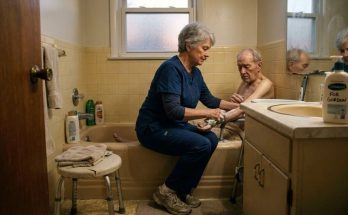
I never imagined I would spend my seventies helping the man who broke my heart get ready for bed.
Yet three evenings every week, that was exactly where I went.
I drove to a house on Maplewood Drive, put my purse beside the door, washed my hands, and checked the water before helping Gordon Pryce into the bath.
He paid me nothing.
His wife did.
Eleven dollars an hour, through the agency that had assigned me to the job.
Charlene Pryce had no idea that the woman she trusted with her husband's most private needs had once shared his bedroom, raised his children, and spent thirty-one years learning the sound of his footsteps.
She thought I was Wanda, a home health aide with experience and a quiet manner.
That was true enough.
It simply wasn't the whole truth.
Last Friday, Charlene stood at the front door while I prepared to begin my shift.
Her car keys jingled between her fingers.
She had somewhere to be, as she usually did on the evenings I arrived.
"You're very good with him," she said.
I looked past her toward the den, where Gordon sat in his recliner with the television playing silently in front of him.
"He's not difficult to care for."
Charlene smiled as if I had given her one less thing to worry about.
"I don't know how you stay so patient."
I could have told her that patience was not the same as kindness.
I could have told her that I had spent most of my adult life learning when to speak and when to swallow what I wanted to say.
Instead, I took my coat off the hook.
"Don't worry about us. We'll be fine."
She thanked me and left.
The front door clicked shut behind her.
I stood in the entryway for a moment, listening to the engine of her car start outside.
Then I went to Gordon.
That was the part I couldn't explain properly to my sister.
Not the bathing, or the eleven dollars, or even the fact that I had accepted a job in a house where I had once lived as a wife.
It was the simple truth that I meant what I told Charlene.
I wanted Gordon to be comfortable.
I wanted him to eat his supper.
I wanted the water warm enough that he wouldn't shiver.
After everything that had happened between us, I still wanted those things.
I was seventy years old, and I had not found a way to make that feeling disappear.
My name is Wanda.
I was fifty-two when my marriage ended, and I had been married to Gordon for thirty-one years.
We married when we were young enough to believe that the future was something we could arrange by working hard and keeping our promises.
Gordon worked at an insurance firm.
He was good at talking to people, good at remembering names, and good at making a client feel as if he had all the time in the world.
I kept our home running.
I raised the children, managed the ordinary troubles that came with a family, and made sure Gordon had clean shirts and a decent meal when he came home.
When the firm entertained clients, I was the one planning the food and setting the table.
I learned which wives drank coffee after dinner and which clients preferred their steak cooked a certain way.
I remembered birthdays.
I wrote thank-you notes.
I made our home look like the sort of place a successful man ought to return to.
I didn't think of those things as sacrifices.
Not then.
I thought that was what marriage meant.
Gordon never ordered me to stay home with the children.
There was no single conversation I could point to now and say that was the moment I gave up my chance at a career.
Life simply arranged itself that way.
One year became five.
Five became fifteen.
By the time I looked up, I had a household that depended on me and a husband whose professional life had grown far beyond anything I had built for myself.
I was proud of him.
That was the embarrassing part.
When Gordon received praise at work, I felt as if some small part of it belonged to me.
When he brought clients home and they complimented the dinner, I watched his face brighten.
I wanted him to succeed.
For a long time, I believed he wanted the same future I did.
Then, in 2003, he left me for Charlene, a woman who worked at his insurance firm.
There was no long illness in our marriage that I could use to explain it away.
No tragedy that suddenly changed him.
He had fallen in love with someone else, or at least decided that the life he wanted was waiting with her.
Whatever explanation he gave himself, I was the person left standing in our old kitchen with the news.
I remember the divorce papers more clearly than I remember some of the conversations that led to them.
Paper.
Ink.
My signature.
The documents made something that had been unthinkable for thirty-one years into a series of ordinary legal facts.
We were no longer husband and wife.
I walked away with half of our savings and no profession I could point to as my own.
I had spent three decades helping Gordon build a life.
Now I had to work out how to build one without him.
I was fifty-two.
I had no recent employment history.
I had experience managing a home, raising children, organizing events, and keeping a hundred small responsibilities from turning into large disasters.
On a résumé, those years looked like empty space.
I could have spent the rest of my life being angry about that.
Some days, I was.
But anger didn't pay the bills.
So I found a way to work.
I trained as a home health aide and earned my certification.
I learned how to help people move safely, how to watch for changes in their condition, how to keep careful notes, and how to do intimate tasks without making another person feel ashamed.
The work wasn't glamorous.
It was physical, sometimes exhausting, and often poorly paid.
It was also useful.
People needed help.
I could give it.
I began at fifty-two and kept going for eighteen years.
By the time I turned seventy, I knew how to walk into a stranger's home and notice the things that mattered.
I could tell when a room was too cold for someone who spent most of the day sitting still.
I could notice a change in appetite.
I knew that a person who suddenly became unusually sleepy might be tired, ill, or affected by medication.
I also knew that the smallest details became important when the person receiving care could no longer explain what was wrong.
The agency taught us to write everything down.
Not what we assumed.
Not what we suspected.
What we observed.
That distinction mattered more than I understood when I first began working.
In March, my agency offered me a new assignment.
The gentleman needed overnight respite care three evenings a week.
He had dementia.
His family lived in the home, and they needed someone who could stay with him while they attended to other responsibilities.
The work sounded familiar enough.
I had cared for older men who struggled to remember the day of the week.
I had helped women who could no longer manage their own medications or bathe without assistance.
I had learned not to take confusion personally.
I opened the assignment details on my phone.
Then I saw the address.
Maplewood Drive.
I read it once.
Then again.
My hands went still on the steering wheel.
There are moments when your mind recognizes something before the rest of you is willing to accept it.
I knew that address.
I had lived there.
For years, it had been the place where I woke up beside Gordon, made breakfast for the family, and waited for the sound of his car returning at the end of the day.
Now I was sitting in an agency parking lot, looking at the same address on a screen.
My first thought was that I should call Denise.
She handled the assignments.
I should tell her there was a personal connection and ask for another case.
That was the professional thing to do.
It was the advice I would have given a newly certified aide without hesitation.
Instead, I remained in the car.
I kept looking at the address.
I told myself I only wanted to know whether Gordon was all right.
That was a reasonable question.
Thirty-one years of marriage did not vanish just because the marriage ended.
We had raised children together.
We had shared ordinary mornings and difficult nights.
We had stood beside each other through the small, forgettable parts of life that never appear in photographs.
I had known the man before he became the person who left me.
I wanted to know what had become of him.
That was what I told myself.
I did not call Denise.
I accepted the assignment.
Looking back, I can see how easily a person can make a decision they know is questionable and still find a respectable explanation for it.
I wasn't trying to take revenge.
I wasn't looking for an argument with Charlene.
I simply wanted to see Gordon with my own eyes.
I wanted to know if he was safe.
I wanted to know if he was being looked after.
And, if I'm being honest, I wanted to see whether the man who had once known everything about me could still remember anything at all.
Click here to continue reading: PART 2: The First Night He Looked Straight Through Me, While the Woman Who Replaced Me Handed Me His Medication List
The Man Who Forgot My Name Still Had a Place in My Heart, and I Was Afraid of What I Might Find There
Part 1 of 9