I returned to Maplewood Drive for the next scheduled shift.
I told myself that the first evening had been difficult because I had not known what to expect.
The second would be easier.
The third would be easier still.
That was how I had learned to handle most things in my life.
You did the work in front of you.
You learned the routine.
You tried not to make your feelings somebody else's responsibility.
I parked in the same place and carried my bag inside.
Charlene greeted me briefly.
Gordon was in the den.
The television was on, and he was looking toward it with the same distant expression.
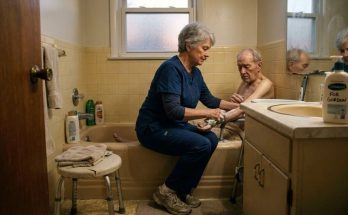
I began my work.
Nothing about the routine seemed unusual.
He needed assistance.
I provided it.
I kept my voice calm and explained each step.
Sometimes he answered.
Sometimes he didn't.
I stopped expecting him to recognize me.
That expectation was only hurting me, and it had no place in the care I was there to provide.
But as the weeks passed, I began to notice other things.
At first, they were small enough to dismiss.
The dining room looked different.
I couldn't immediately say why.
The room had always held a large table, surrounded by chairs that were used when the family gathered.
I remembered meals there.
I remembered Gordon sitting at the head of the table while clients and their wives talked about work, travel, and whatever else successful people discussed over dinner.
I remembered polishing the surface before company arrived.
Now there was more empty space.
The expensive dining set was gone.
I stood in the doorway longer than I needed to.
It wasn't my furniture anymore.
It hadn't been mine for years.
I had no claim to it, and I had no reason to expect the house to remain frozen in the condition I remembered.
People sold furniture.
People changed their homes.
There were sensible explanations for every single thing I had seen.
I reminded myself of that and continued with my shift.
A little later, I noticed that the china cabinet had disappeared too.
That bothered me more than the table.
The cabinet had once held dishes that came out for special occasions.
I could remember arranging them after family dinners, checking each piece before putting it away.
I could remember the way the glass doors reflected the dining room lights.
Now the cabinet was gone.
The wall behind it looked bare.
I didn't ask Charlene about it.
I was an aide, not an inspector.
I had no authority to question the contents of another person's home simply because I remembered them.
Still, I began looking more carefully.
The recliner in the den was different.
Gordon was sitting in it as usual, but it wasn't the chair I remembered as his favorite.
The old one had been familiar to me for years.
I could picture where it had stood and how Gordon settled into it after dinner.
Now it was gone.
The new chair served the same purpose.
It supported him.
It gave him somewhere to sit.
There was nothing wrong with it.
But the old chair was another missing piece.
I noticed the walls next.
There were pale squares where framed pictures had hung.
The paint around those spots was slightly different from the rest of the wall.
Some frames had left lighter marks.
Others had left small shadows that became visible when the light came through the windows.
I knew what had hung there once.
Family pictures.
Photographs from years when the children were younger.
Images of people who had belonged to the household before Charlene arrived.
I could not say who had removed every picture or why.
I could only see that they were gone.
The house was becoming less like the home I remembered.
That was not necessarily a crime.
It was not even necessarily unkind.
But it began to feel as though the rooms were being cleared of a life that had existed before Gordon became too confused to protect it.
I had to be careful with that thought.
I knew what it was to be hurt by a person and then interpret everything they did through the wound they left behind.
I had done it after the divorce.
For a while, every good thing Gordon appeared to enjoy seemed like proof that he had been happier without me.
Every difficulty I heard about seemed like proof that leaving had been a mistake.
Neither conclusion was fair.
I had to remind myself that I could not turn suspicion into fact just because I had been his first wife.
So I watched.
And I wrote down what belonged in my notes.
By April, I had begun paying closer attention to the conditions inside the house.
One evening, I noticed the thermostat.
The setting was sixty-two degrees.
I looked at it twice to make sure I had read it correctly.
The house felt cold.
Gordon was a thin man now, and he spent much of his time sitting still.
He didn't have the same strength he had possessed when I knew him as a younger husband and father.
Cold affected him differently than it might affect a healthy person who was up and moving around.
I checked that he was dressed appropriately.
I made sure he was comfortable.
But the temperature stayed in my mind.
I didn't know whether Charlene preferred the house cold.
I didn't know whether there was another explanation for the setting.
I knew only that sixty-two degrees seemed low for a frail older man who had lost so much weight.
I recorded the temperature.
The next time I came, I checked again.
The setting was still low.
I made another note.
I didn't change anything beyond what my duties allowed.
I was not there to make household decisions.
I was there to care for Gordon, and I needed to remain professional even when I disliked what I was seeing.
Then there were the medications.
Charlene filled Gordon's weekly pill organizer on Sundays.
I learned the routine because the organizer was kept with the other medication supplies, and I had to know what I was observing during my shifts.
There were small compartments marked for the days and times.
The pills were placed inside according to the schedule.
I did not prescribe anything.
I did not change the doses.
I did not pretend that I knew more than the instructions provided.
But I knew how to count.
The little white pills were the sedatives.
I had been told what they were and what they were intended to do.
Most of the time, the organizer appeared consistent with the schedule I had been given.
Then I noticed the Thursday compartment.
There were two little white pills where I expected to see one.
I looked again.
I did not touch them.
I did not remove one or rearrange anything.
I simply made a note of what I saw.
The following week, I paid attention again.
There were two.
I checked on another Thursday.
Again, two.
By May, I had observed the same discrepancy on three occasions that month.
I couldn't explain it.
I didn't know whether someone had made a mistake, whether the instructions had changed, or whether there was some other reason.
I was not a doctor.
I was not qualified to decide why the compartment held more medication than I expected.
But the discrepancy mattered.
A medication count was not a matter of personal opinion.
If the list said one pill and I observed two, the difference needed to be documented and checked by someone qualified to investigate it.
Especially when the person taking the medication could not reliably explain what he had been given.
I kept my notes precise.
I wrote down the date.
I recorded what I had observed.
I did not add accusations.
The work had taught me that a clean record was more useful than an angry one.
By then, the dining set was gone.
The china cabinet was gone.
The old recliner was gone.
The walls held pale outlines where pictures had once hung.
The house was colder than I thought it should be.
And the medication count had not always matched what I expected to see.
One clue could mean very little.
Several clues were harder to ignore.
I still didn't know what they meant.
But I had begun to understand that the job required me to pay attention to more than Gordon's meals and bathing routine.
There was a difference between caring for a person and merely keeping that person occupied until the evening was over.
Gordon could not always tell me what was happening around him.
He could not reliably explain what he needed.
That made the details more important, not less.
So I continued to observe.
I continued to record.
And I kept reminding myself that my past with Gordon could not be allowed to decide what I believed about his present.
I had to let the evidence speak for itself.
Click here to continue reading: PART 4: A Business Card Appeared Beside the Kitchen Counter, and Then a Legal Word Made Me Look at the House Differently
The Man Who Forgot My Name Still Had a Place in My Heart, and I Was Afraid of What I Might Find There
Part 3 of 9