The locksmith's message changed everything.
Until then, I had hoped my father was simply trying to pressure me into helping his company.
I thought he might threaten legal action.
I thought he might demand money.
I thought my mother would eventually call and ask me to make things easier for everyone.
I hadn't imagined they would try to enter my home using forged documents.
Harrison didn't waste time.
He contacted investigators and arranged for the lender's fraud unit to receive the relevant paperwork.
The forged guarantee was only one part of the evidence.
We also had Julian's messages.
We had the locksmith's account.
We had the suspicious lease.
And now we had the psychiatric letter.
I gave Harrison copies of everything.
He organized the documents into separate sections.
Financial records.
Property records.
Communications.
The medical letter.
Each section had its own evidence.
I watched him work and realized how much preparation would be necessary to prove something I knew was false.
My family had spent years making my word seem less reliable than theirs.
Now I needed records to establish that I knew my own signature.
That I knew my own property.
That I knew what I had and hadn't agreed to.
It was exhausting.
But I wasn't going to surrender.
The locksmith agreed to cooperate.
He had not opened the property.
He had not damaged anything.
He had simply been contacted by Julian and shown documents that he believed might be fraudulent.
When he learned who actually owned the estate, he became concerned about his own position.
He agreed to provide the communications and explain exactly what Julian had requested.
That was important.
Harrison also wanted every interaction recorded properly.
We arranged for security cameras to cover the entrances, the driveway, and the accessible exterior areas.
The recordings were backed up remotely.
I didn't want a situation where somebody could take a device and destroy the only copy of what had happened.
We reviewed the access points.
We checked the locks.
We made sure the contractors knew not to let anyone enter without authorization.
The police officers were brought into the arrangement through the investigation.
They understood that the property dispute involved more than an ordinary family disagreement.
There were allegations of forged financial documents and fraudulent claims of occupancy.
The investigators wanted to observe any attempt to use those documents.
Harrison also contacted three investigative reporters.
They had agreed to examine the financial records and the attempted property takeover.
I was initially uncomfortable with the idea.
I didn't want my family problems becoming public entertainment.
I told Harrison that.
He listened.
Then he explained why the reporters were there.
My father's company had employees.
The loan documents involved a substantial amount of money.
The company had been presented to lenders using information that included my identity.
If other people had been misled, the story was bigger than my relationship with my parents.
I understood.
I also wanted the evidence preserved independently.
The reporters were not there to invent a story.
They were there to observe what happened and examine the records we had provided.
I agreed.
The days passed.
Construction continued at the estate.
I spent most of my time coordinating the work and preparing the property for the next stage.
I tried not to stare at the security screens every few minutes.
I wasn't always successful.
Sometimes I stood in the library and looked at the entrance.
The room had become my favorite place in the house.
It was quiet.
The shelves were dark.
The central table was large enough for several people to work around.
I had imagined residents sitting there with notebooks, photographs, and cups of coffee.
I had imagined the room being used for meetings with attorneys and counselors.
Now it was going to hold police officers and reporters.
The thought made me sad.
I had wanted the house to begin its life with something hopeful.
Instead, it was becoming the place where I would finally confront the people who had spent years deciding what my life meant.
One evening, I walked through the main hall.
The contractors had repaired part of the old flooring.
There were still boxes near the staircase.
A few protective coverings remained over the furniture.
The house wasn't finished.
But it was mine.
I stood by the front window and looked toward the driveway.
I wondered whether my parents had ever imagined me owning something like this.
Probably not.
They had never taken my work seriously.
They had never asked what I earned.
They had never wanted to know how I had built my business.
To them, I was still the daughter who needed help.
The daughter who misunderstood conversations.
The daughter who should be grateful for whatever attention they decided to provide.
And now they were coming to take possession of a property they had never helped me buy.
The irony wasn't lost on me.
Three days before Christmas, I woke early.
The sky outside was still dark.
I made coffee and checked the security system.
Nothing unusual appeared.
I reviewed the driveway camera.
Empty.
The entrance camera.
Empty.
The side courtyard.
Empty.
I was beginning to think they might have changed their plans.
Then a vehicle appeared at the end of the driveway.
A dark car.
I recognized it immediately.
My father's.
I didn't move.
The vehicle came closer.
A second car followed.
Then a white service van.
My mother stepped out first.
She was holding her phone.
Julian climbed out of the second car and opened the trunk.
He removed two suitcases.
I watched him place them near the entrance.
He didn't look around as if he were visiting somebody else's property.
He looked like a man arriving at a house where he already expected to live.
My father emerged from the driver's side.
He wore a heavy coat and carried a folder.
He looked toward the front door.
Then he turned to the locksmith.
I recognized the man from the earlier messages.
The locksmith unloaded his equipment.
My stomach tightened.
I switched to the camera above the entrance.
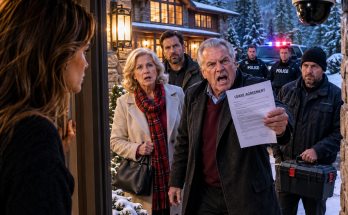
Dad was already speaking.
"Let's get this over with."
My mother positioned herself beside him.
She raised her phone and began recording.
Julian moved the suitcases closer to the steps.
I looked toward the library.
The two police officers were waiting inside.
Harrison stood near the staircase.
Three reporters were seated in the dining room.
Nobody spoke.
I had spent weeks preparing for this moment.
I had reviewed the documents.
I had preserved the messages.
I had checked every camera.
I had made sure the people who needed to be present were there.
Still, seeing my family standing outside made my hands feel cold.
My father walked up to the door.
He knocked.
Once.
Hard.
Then he stepped back.
"Clara."
His voice came through the exterior microphone.
"Come out. We need to settle this."
I remained inside.
He knocked again.
He sounded impatient.
"We have the paperwork. You don't need to make a scene."
My mother moved closer to the camera.
She held up her phone so the lens could capture her face.
Julian stood beside the luggage.
The locksmith waited near his van.
Dad opened the folder.
He removed several pages and held them toward the security camera.
"This agreement establishes our right to live here."
I zoomed in.
The lease.
I could see my name.
I could see the signature.
It was the same false signature we had already examined.
The middle initial was wrong.
The address details had been copied from the property records.
The document was designed to look official.
But it wasn't.
Dad turned toward the locksmith.
"Go ahead."
The locksmith didn't move immediately.
He looked at the paper.
Then at the door.
I understood why he was uncomfortable.
He knew I had denied permission.
He knew the ownership claim was questionable.
And he was standing in front of a house where the actual owner was watching him.
My father pointed toward the lock.
"She has been told this is happening."
That was a lie.
I had told him the opposite.
Through the intercom, I spoke.
"You do not have permission to enter this property."
My father looked up.
For a moment, his face changed.
Then he smiled.
It was the same smile he used when he wanted other people to believe he was being reasonable.
"Clara, we're your parents. Stop making this difficult."
My mother lowered her phone slightly.
"Sweetheart, please."
Her voice was soft.
Almost affectionate.
I remembered that voice.
It was the voice she used whenever she wanted me to feel guilty for refusing something.
I didn't answer.
Dad raised the papers again.
"These documents show that we have a legal right to occupy this residence."
I looked at the officers.
Neither moved.
Harrison stood near the library entrance with the binder in his hands.
The reporters remained silent.
I could hear the heating system running somewhere behind me.
Then Julian stepped closer to the camera.
"The owner isn't well," he told the locksmith.
He said it casually.
As if he were explaining a minor inconvenience.
"Her attorney advised us not to argue with her."
I felt my jaw tighten.
There was no attorney who had given that advice.
There was no legitimate lease.
And there was no reason for Julian to be speaking about my mental condition to a locksmith.
He was repeating the story they intended to use.
My father nodded.
"She doesn't understand what's happening."
I looked at the psychiatric letter on the table beside Harrison's binder.
The false letter.
The one they had prepared to support their claim.
It was all connected.
The loan guarantee.
The lease.
The medical document.
They were building a version of events in which my family had to rescue me from my own decisions.
And the property would become the reward for their intervention.
I pressed the intercom again.
"The deed is held by my company. The lease you're showing is fraudulent. You need to leave."
My father's smile disappeared.
He turned toward my mother.
She began crying.
Not loudly.
Just enough to make the camera capture her wiping her eyes.
"We're only trying to protect our daughter."
I looked at her.
I wanted to ask where she had been when I was sixteen and alone in the house.
I wanted to ask why she hadn't protected me from the loan guarantee.
I wanted to ask why she was standing beside a locksmith while he prepared to enter my home.
But I said none of it.
My father had heard enough.
He pointed at the door.
"Open it."
The locksmith took a step forward.
He placed his equipment beside the entrance.
Then he looked back at Dad.
"Before I do anything, I need to be clear about the authorization."
Dad's expression hardened.
The locksmith continued.
"You understand the person inside has denied access?"
"Yes."
"And you're saying you have the legal right to enter?"
"That's exactly what I'm saying."
The locksmith looked at the lease again.
My father turned toward the camera.
"She can't make decisions for herself."
I looked toward Harrison.
He gave a small nod.
That statement was important.
It was not the first time my father had made it.
But this time, the people who needed to hear it were inside the house.
I took one breath.
Then another.
The locksmith moved toward the lock.
My father watched him.
My mother kept recording.
Julian stood beside the suitcases.
I looked at the screen showing the front door.
Then I looked toward the library.
The officers were ready.
The reporters were waiting.
Harrison had the documents.
Everything we needed was in place.
For once, my family had arrived with a story they couldn't control.
And I was no longer going to help them tell it.
Click here to continue reading: PART 5: The First Crack in My Front Door Came From My Brother, and My Father Still Believed He Was the Victim
My Family Remembered My Existence Only After I Bought the One House They Could Not Afford to Lose
Part 4 of 12