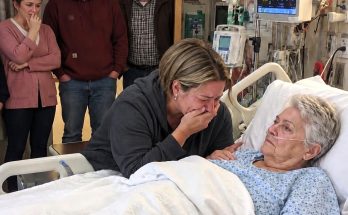
A year later, my son learned how to say Dad's name.
It came out wrong at first.
Dad cried anyway.
He tried to hide it by laughing, but my son saw his face and reached up with both hands. Dad picked him up and held him against his chest.
“Say it again,” he whispered.
My son did.
Dad looked at me.
“I waited a long time to hear that.”
I smiled.
The apartment had changed since the day Dad moved in. The lemon tree had grown tall enough that its branches brushed the balcony railing. He had added two chairs outside and a small table where he drank coffee in the mornings. There were toys in places that made no sense.
My son's favorite wooden truck lived beneath the couch.
A stuffed dinosaur had somehow become a permanent resident of Dad's bedroom.
And on the refrigerator was a photograph of the three of us at the park.
Dad had insisted on printing it.
“Proof,” he had said.
“Proof of what?”
“That we can look happy in a photograph.”
I had laughed.
But I understood.
There had been a time when every photograph from our family seemed to carry a question behind it. Who knew what? Who noticed what? What happened before the picture? What happened after?
Now the pictures were simply pictures.
That mattered.
The legal proceedings were over.
There were no more hearings to attend, no more documents waiting for signatures, no more calls from lawyers asking whether we remembered a particular date. The final decision had left the established facts intact and had considered the later evidence without pretending it could answer every question about another person's private thoughts.
There were things we knew.
There were things we suspected.
There were things we would never know.
I had stopped needing the last category to disappear.
One Saturday morning, Dad asked me to help clean the storage room.
I immediately suspected he had an ulterior motive.
“You just want me to carry boxes.”
“That is a serious accusation.”
“You've been planning this.”
“I have been waiting patiently.”
“That is worse.”
He laughed.
We spent most of the morning sorting through things.
Some were easy to discard.
Old receipts. Broken decorations. Clothes nobody wore. A kitchen appliance Dad had kept for years because he was convinced he would eventually fix it.
He finally looked at it.
“Do you want this?”
“No.”
“Good.”
He put it in the donation pile.
I stared at him.
“What?”
“You're learning.”
“I've had a difficult teacher.”
My son sat nearby, pushing a toy car across the floor.
Every few minutes, he would look up to make sure we were still there.
We were.
The last box contained the things Dad had kept from the old house.
He opened it himself.
Inside was my mother's chair cushion, two albums, the old key, and several photographs.
The baby monitor was there too.
My son reached toward it.
Dad gently moved his hand away.
“That one isn't a toy.”
My son frowned.
I smiled.
“He has your stubbornness.”
Dad looked offended.
“I have no idea what you're talking about.”
We put the photographs into an album.
The old key went into a small wooden drawer.
The monitor stayed in its box.
Dad paused before closing it.
“Are you sure you don't want to get rid of this?”
I looked at him.
For a long time, I thought I would.
But I had changed my mind.
“No.”
“Why?”
“Because it happened.”
Dad waited.
“I don't want to pretend it didn't.”
He nodded.
“That makes sense.”
I touched the lid.
“But I also don't want it to become the most important thing that happened.”
Dad smiled.
“Then it stays here.”
He closed the box.
That was the last time we discussed whether to keep it.
Later that afternoon, we went to the park again.
My son ran ahead.
He was old enough now to understand that he could go farther than before, but young enough to believe every puddle was an invitation. Dad followed him with the exaggerated seriousness of a security guard.
“Stay where I can see you.”
“I see him,” I called.
Dad turned.
“So do I.”
My son splashed through the puddle.
Dad sighed.
“Your grandson is going to ruin those shoes.”
I laughed.
“You bought them.”
“I was manipulated.”
“You were enthusiastic.”
“I was weak.”
My son came running back, soaked to the ankles and delighted.
Dad crouched down.
“Worth it?”
My son nodded.
Dad looked at me.
“I suppose it was.”
We sat beneath a tree afterward.
The afternoon had turned warm.
My son leaned against Dad's side, exhausted from running.
Dad looked across the park.
“You remember when you told me you didn't feel safe?”
I did.
I had not expected the question.
“Yes.”
“I think about that sometimes.”
“So do I.”
He rubbed his hands together.
“I used to wish I could go back and handle everything differently.”
“What would you change?”
He considered it.
“I would listen sooner.”
I waited.
“I wouldn't make you explain every detail before believing that you were uncomfortable. I wouldn't assume that because I didn't see something, nothing was happening.”
I looked at my son.
“He deserves that.”
“He does.”
Dad took a breath.
“And so did you.”
I didn't answer immediately.
There are apologies that ask to be accepted and apologies that simply need to be spoken.
His was the second kind.
“I know,” I said.
He nodded.
That evening, we ate dinner together at Dad's apartment.
My son dropped a piece of food.
Dad picked it up.
My son dropped another.
Dad stared at him.
“You're doing that on purpose.”
My son laughed.
Dad laughed too.
I watched them and thought about how strange it was that a life could become ordinary again after being broken open.
Not the same.
Never the same.
But ordinary.
After dinner, Dad washed dishes while I gave my son a bath.
When I came back into the living room, Dad was standing on the balcony.
The lemon tree had produced its first real fruit.
He touched one of the small lemons carefully.
“Your mother would have liked this.”
I stood beside him.
“She would have.”
Dad smiled.
“She'd probably tell me I planted it too close to the railing.”
“She'd definitely say that.”
We laughed.
Then we stood quietly.
The city lights were coming on one by one.
Dad looked through the glass door toward the living room.
“You know what I like about this place?”
“What?”
“It doesn't have ghosts.”
I looked at him.
He shook his head.
“Not real ones. Memories.”
“I know.”
“The old house had too many rooms for memories to hide in.”
“And this place?”
He smiled.
“This place has just enough room for the people who are here.”
I leaned against the railing.
The sentence stayed with me.
The old house had once represented permanence.
Then it represented danger.
Then evidence.
Then loss.
Now it was simply a house we used to live in.
Nothing more.
Nothing less.
My son called from inside.
“Mom!”
I turned immediately.
Dad smiled.
“There she is.”
I went inside.
My son stood in the hallway holding his pajamas in one hand and pointing toward the bedroom with the other.
“Book.”
“You want a book?”
He nodded.
Dad appeared behind me.
“I'll read it.”
My son immediately reached for him.
I laughed.
“Apparently, I'm no longer needed.”
Dad took the book.
“You can sit with us.”
So we did.
Dad read the same story twice because my son demanded it.
On the second reading, my son's eyes began to close.
Dad lowered his voice.
I watched my father turn the pages carefully, making sure not to wake the child.
There was something almost painfully peaceful about it.
A year earlier, I had been afraid of what a monitor might reveal.
Now there was no monitor in the room.
I didn't need one.
I could hear my son breathing.
I could see Dad sitting beside him.
I could trust the quiet.
After Dad left, I carried my sleeping son to his room.
I tucked the blanket around him.
For one second, I stood beside the bed longer than necessary.
Then I turned off the light.
I walked into the hallway.
The old instinct surfaced briefly.
Check.
Listen.
Watch.
Make sure.
I stood there.
Then I let the feeling pass.
I went into the kitchen and filled a glass of water.
My phone buzzed.
Dad.
HOME SAFE?
I smiled.
I typed back.
YES.
A second message appeared almost immediately.
GOOD.
I put the phone down.
Outside, the city continued making its ordinary nighttime sounds.
A motorcycle passed.
Someone laughed in the street.
A dog barked once.
The refrigerator hummed.
My son shifted in his room and went quiet again.
I stood in the kitchen, listening.
There had been a time when listening meant waiting for proof that something was wrong.
Now it meant hearing that everything was still there.
My family.
My son's breathing.
My father's voice when he called.
The rustle of leaves from the lemon tree.
The small sounds of a home that no longer required constant watching.
I thought about the drawing I had made as a child, the one Dad had kept all those years.
HOME IS WHERE EVERYONE IS SAFE.
Back then, I had thought safety was a place.
Later, I thought safety was something another person could promise me.
I know now it is more complicated.
Safety is being heard.
It is being able to say something feels wrong without being told you imagined it.
It is asking questions before deciding there is nothing to ask.
It is looking at evidence without letting fear write the whole story.
It is knowing when to protect someone and when to let them take their own steps.
And sometimes, it is simply being able to turn off the light and walk away.
I went to my son's room one last time.
I watched him sleep.
Then I closed the door halfway.
I did not check a screen.
I did not replay an old recording.
I did not open the box in the closet.
I went to bed.
In the morning, Dad would come over.
My son would run to him.
The lemon tree would still be on the balcony.
There would be dishes in the sink and toys on the floor and another ordinary day waiting for us.
The past would remain exactly where it belonged.
Behind us.
Not erased.
Not forgotten.
Just no longer in control.
And for the first time in a long time, when I closed my eyes, I did not feel the need to keep watch.
The End
Read more original stories on Feel Every Story.
The Night I Saw My Stepmother Beside My Sleeping Baby, I Realized the House Had Been Hiding Something From Me
Part 18 of 18