
The next time Christopher came home, I wanted the house to be quiet.
I didn't want a shouting match.
I didn't want to beg him for an explanation he would only reshape into another excuse.
I wanted to be able to hear myself think.
I had gathered the documents I needed and arranged them neatly on the table.
The divorce papers lay on top.
My wedding ring rested beside them.
I had taken it off that morning and left it there.
For a long time, I simply looked at it.
The ring had been part of my life for twenty years.
It had accompanied me through celebrations, disappointments, and the ordinary days that had seemed too unimportant to remember.
I had worn it while waiting for Christopher to come home.
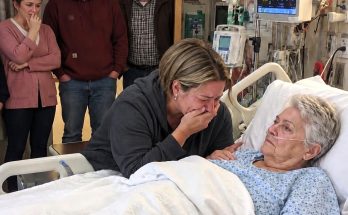
I had worn it while sitting beside Gertrude in the hospital.
I had worn it while calling his number again and again.
Now it lay on the table without meaning anything I wanted to keep.
The silver key was in the folder beside the papers.
I touched the edge of the envelope to make sure it was still there.
I had promised Gertrude I would take care of it.
That promise mattered to me.
I didn't know what she wanted me to find, and I wasn't going to pretend I did.
I only knew I would not discard the last thing she had entrusted to me.
When Christopher entered the house, I heard his keys land in the basket near the door.
He called my name.
I didn't answer immediately.
He came into the living room and stopped when he saw the urn.
For the first time since our conversation on the phone, he seemed to understand that his mother was truly gone.
He stared at the white container on the mantel.
Then he looked at me.
“Why didn't you tell me she was that close to dying?”
I felt the old urge to defend myself.
It rose automatically, as if my body had not yet learned that I no longer needed to make his failures easier for him.
I could have explained the calls again.
I could have described the hospital room.
I could have reminded him that I'd left a message and tried repeatedly to reach him.
Instead, I pointed to the papers on the table.
“I tried to reach you.”
He glanced at them.
His eyes moved from the divorce documents to the ring.
“What is this?”
I stood beside the table.
“I'm ending our marriage.”
He looked at me as if I had spoken in a language he didn't understand.
“Rosalyn, you're upset.”
“Yes.”
“Your mother's death has been hard on you.”
I stared at him.
“Your mother died.”
He looked away.
I waited for him to acknowledge what he'd missed.
I waited for him to ask what happened in the hospital.
I waited for him to say that he wished he had been there.
He said nothing.
I realized then that I had been waiting for the wrong thing again.
I didn't need him to agree that our marriage was broken.
I didn't need him to understand why I could no longer stay.
I needed to stop treating his understanding as permission.
I pushed the papers a little closer to him.
“Please read them.”
He didn't pick them up.
Instead, he looked toward the urn.
“How did this happen so quickly?”
I thought about the hospital monitor.
The nurses moving around the bed.
Gertrude's fingers pressing the key into my palm.
“It happened while you were away.”
His jaw tightened.
“I was handling business.”
I remembered the ocean sounds.
The woman's laughter.
The glasses touching.
I didn't ask him to explain them.
I didn't need another version of the same story.
“I'm not discussing your trip,” I said.
He stared at me.
“You're just going to throw away twenty years?”
The question hurt more than I expected.
Not because I believed I was making the wrong choice.
Because I knew how many years I had already spent trying to save something he was now asking me to preserve.
“I didn't throw them away,” I said. “I lived them.”
He had no answer.
I looked down at the ring.
“I can't keep living this way.”
He walked around the table but didn't sit down.
For a moment, I thought he might apologize.
He might tell me he had been selfish.
He might admit that he had chosen himself over his mother and his wife.
Instead, he asked whether I was serious.
I nodded.
He looked at the papers again.
I could see him trying to find a way to turn the situation into something temporary.
A bad week.
A misunderstanding.
An emotional decision he could wait out.
I had done that work for him for years.
I would not do it now.
“I've made my decision,” I said.
The room fell silent.
I didn't feel triumphant.
I felt exhausted.
There was no satisfaction in knowing that the marriage had reached its end.
There was only the weight of everything that had led us there.
Christopher eventually picked up the papers.
He looked through them without saying much.
I didn't follow him around the room.
I didn't demand that he react the way I wanted.
For once, I let him carry his own discomfort.
When he set the documents down, I took the ring from the table and placed it beside them again.
The small sound of metal touching wood seemed louder than it should have.
I looked at the ring one last time.
Then I stepped away.
The next few days were difficult in ordinary ways.
I had to make calls.
I had to sort through documents.
I had to think about what would happen to the things we had shared.
There were moments when I reached for my phone because I wanted to tell Christopher something out of habit.
Then I remembered that habit was not the same as trust.
I stopped myself.
I began to notice how much of my day had once been shaped around his needs.
I had arranged appointments around his schedule.
I had postponed my own plans when he said he might be home.
I had kept meals warm because he claimed he would arrive soon.
I had spent years preparing for a version of our life that rarely appeared.
Without those expectations, the hours felt unfamiliar.
But they also belonged to me.
I could make a cup of tea and drink it while it was hot.
I could sit in the living room without listening for his car.
I could go to bed without wondering whether he would call.
None of those things fixed the grief.
They simply gave me small places where I could breathe.
The urn remained above the fireplace.
I still spoke to Gertrude sometimes.
Not because I expected an answer.
Because there were things I had never said while she was alive.
I told her I missed her.
I told her I was sorry her final hours had been so difficult.
I told her I was grateful I had been there.
And I told her that I had kept the key.
That last part mattered most.
I had begun to understand that the key was not something I could forget simply because I didn't know what it opened.
Gertrude had chosen the moment she gave it to me.
She had reached beneath her gown with trembling fingers.
She had made sure I held it.
Whatever she intended, she had not wanted the key to leave the hospital with anyone else.
I returned to the envelope.
I took the key out and laid it on my palm.
It was small enough to disappear inside my closed hand.
For a moment, I thought about putting it back in the envelope and waiting until I felt ready to search for its purpose.
But I had already spent too much of my life waiting.
I couldn't promise myself that I would find an answer quickly.
I couldn't even promise that I would find one at all.
Still, I had made a promise to Gertrude.
I would keep the key safe.
I would try to understand why she had given it to me.
And I would no longer let Christopher's absence decide what I did with my own life.
I placed the key back in its envelope.
Then I put the envelope into my folder and closed it carefully.
The white urn remained on the mantel.
The ring remained beside the divorce papers.
And for the first time in years, I understood that those two objects represented separate endings.
One marked the loss of a woman who had loved me well.
The other marked the end of a marriage I had tried to save alone.
I couldn't bring Gertrude back.
I couldn't recover the years I'd spent excusing Christopher.
But I could honor the woman who had shown up for me by finally showing up for myself.
That was where I began.
Not with a dramatic declaration.
Not with revenge.
Just a decision to stop waiting for someone who had already shown me who he was.
I still didn't know what the silver key would unlock.
I had no proof that it would explain anything about Christopher, or our marriage, or the life Gertrude had lived before I knew her.
I refused to invent an answer simply because uncertainty hurt.
But I knew one thing.
Gertrude had placed that key in my hand when she had almost no strength left.
She had looked at me as if she needed me to understand that the gesture mattered.
I would not betray that trust.
I would carry the key with me.
I would keep the urn where I could see it until I was ready to decide otherwise.
And I would let the divorce proceed without turning my grief into another reason to forgive Christopher.
The woman who had sat beside Gertrude's bed had been frightened of losing her marriage.
The woman who stood in the living room now was frightened, too.
But she was no longer willing to lose herself to keep it.
I looked once more at the silver key through the open envelope.
Then I closed the folder and placed it with the papers that would begin my next life.
The End
Read more original stories on Feel Every Story.
Thirty Calls Into the Night, One Empty Hospital Chair, and the Small Silver Object His Mother Refused to Explain
Part 4 of 4

One Comment on “PART 4 – I Set My Wedding Ring Beside the Divorce Papers and Kept the Key That Gertrude Had Trusted Me to Carry”