I used to believe that if you loved someone long enough, they would eventually learn how to love you back.
It took me twenty years to understand how wrong I was.
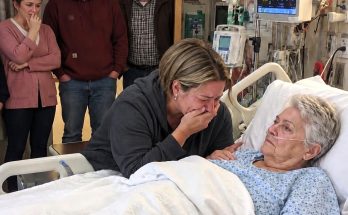
The night Gertrude died, I sat beside her hospital bed with my phone in one hand and her cold fingers in the other.
The room smelled of disinfectant and the weak coffee I'd bought from the machine near the elevators.
A monitor blinked beside her.
Every few seconds, it made a small sound that reminded me to keep breathing.
Gertrude's eyes were closed.
An oxygen mask covered the lower half of her face, and the elastic strap had left a faint red mark against her skin.
I leaned closer.
“I'm here, Mom.”
She had always liked being called that.
Not because she expected me to pretend she was my birth mother, but because she understood what the word meant when I said it.
She had been there for me in ways my own family never had.
Now I was trying to be there for her.
My phone lit up in my palm.
Christopher.
For half a second, I thought his name meant he was finally calling me back.
It was only the contact screen from my last attempt.
I pressed his number again.
The call rang.
Then voicemail.
I stared at the screen until it went dark.
Thirty calls.
That was how many times I'd tried to reach my husband since Gertrude's condition had worsened.
Thirty attempts to tell him that his mother might not survive the night.
Thirty chances for him to answer.
He had taken none of them.
I wanted to be angry, but I was still holding on to hope.
That was the embarrassing part.
Even then, with Gertrude struggling to breathe, I was making excuses for Christopher.
Maybe he was in a meeting.
Maybe his phone was on silent.
Maybe the reception was terrible.
Maybe he would call as soon as he saw everything.
I'd spent years collecting maybes and arranging them into something that looked like a marriage.
I glanced at the empty chair on the other side of the bed.
That chair should have been his.
I had told him about the hospital admission.
I had explained what the doctors said.
I'd even sent him a photograph of the small plastic board outside her room, with her name printed in black letters.
He had responded with three words.
Keep me posted.
At the time, I had thanked him for answering.
Looking back, I hated myself a little for that.
I had been grateful for the smallest scraps of attention from a man who was supposed to be my partner.
Gertrude stirred.
I put the phone down and reached for her hand.
Her fingers were thinner than I remembered, the skin loose around her knuckles.
I rubbed them gently between my palms.
“You don't have to worry about anything,” I told her.
It was a lie.
There were bills, forms, medical decisions, and questions I didn't know how to answer.
There was also her son, who seemed determined to remain absent from every part of her life that required something of him.
But I didn't want her to worry.
She had done enough of that for everyone else.
When Christopher and I first married, Gertrude was the person who made me feel welcome in his family.
I remembered our first Thanksgiving together.
I had been nervous about ruining dinner, so I arrived early and offered to help with the vegetables.
Gertrude handed me an apron and showed me how she liked the carrots cut.
Christopher disappeared into the living room to watch a game.
She didn't complain.
She simply turned the radio up and asked me about my work.
By the end of the afternoon, I had told her things I hadn't planned to share with anyone.
She listened without interrupting.
When I apologized for talking too much, she waved the apology away.
“People need somebody who'll let them finish a thought,” she said.
I hadn't forgotten that.
Neither had I forgotten the birthday Christopher missed three years later.
He had promised to take me to dinner.
I bought a new blouse, put on lipstick, and waited until nearly ten before I accepted he wasn't coming.
Gertrude arrived the next morning with a cake she'd made herself.
The frosting leaned to one side.
She'd written my name across the top in uneven letters.
I cried when I saw it.
She pretended not to notice.
That was how she loved people.
Quietly.
Without making them feel they owed her.
When I lost a pregnancy, she sat beside me in the hospital and held my hand while I stared at the pale curtain around my bed.
Christopher had said work was impossible to leave that day.
He promised to come later.
He never arrived.
Gertrude stayed until the nurse asked her to go home.
She returned the next morning with clean pajamas and a thermos of soup.
I never forgot the weight of that thermos against my lap.
I never forgot that she had come.
And I never asked her why her son hadn't.
I thought protecting her from disappointment was another way of loving her.
Perhaps I was protecting myself.
If I admitted what Christopher was becoming, I would have to admit what my marriage had become, too.
Years passed like that.
Christopher was always busy.
His business was expanding.
His clients were demanding.
His meetings ran late.
His trips became longer.
There was always something urgent enough to put between him and the people who needed him.
Gertrude aged while he was occupied.
At first, it was small things.
She misplaced her reading glasses.
She forgot whether she'd taken her morning medication.
Once, she called me because she couldn't remember the name of the pharmacy she'd used for years.
I started keeping a list on the refrigerator in her kitchen.
Medication times.
Appointment dates.
Phone numbers.
I accompanied her to the doctor and waited beside her while she filled out forms.
When she struggled to open a bottle, I bought one with an easier cap.
When she stopped driving, I took her grocery shopping.
Christopher always said he would help.
“Next weekend, I'll come over.”
“After this deal closes.”
“Things should calm down soon.”
I stopped asking when soon would be.
Instead, I made room in my own schedule.
I told myself that was what families did.
But a family wasn't supposed to depend on one person for everything while another person took credit for caring.
I didn't understand that yet.
I only knew Gertrude needed me, and I loved her.
That night in Camden, the hours moved slowly.
A nurse came in to check the monitor and adjust the oxygen tubing.
I stepped aside so she could reach the equipment.
When she finished, she gave me a sympathetic look.
“Try to rest if you can.”
I nodded.
She knew I wouldn't.
I sat back down and looked at my phone.
No missed calls.
No message.
Nothing from Christopher.
I dialed him again.
The call went straight to voicemail.
I left a message this time.
“It's Rosalyn. Mom's condition has changed. Please call me as soon as you get this.”
My voice sounded calm.
That frightened me more than crying would have.
I had become practiced at delivering terrible news as though I were reading a grocery list.
I put the phone against my chest for a moment.
Then I returned my attention to Gertrude.
“I'm sorry he's not here,” I whispered.
Her eyelids moved.
I leaned forward, wondering whether she'd heard me.
“It's all right, Mom. You don't have to speak.”
She made a faint sound behind the mask.
I reached for the nurse's call button, but Gertrude tightened her fingers around mine.
It was a weak grip.
Still, I stopped.
Her eyes opened.
For the first time in hours, she looked directly at me.
There was something different about her expression.
The fog that had clouded her eyes earlier seemed to have lifted.
She looked tired, but she was present.
Completely present.
I moved closer to the bed.
“I'm listening.”
She tried to say something.
The mask shifted with her breath, and I couldn't understand the sound.
I leaned nearer.
“Take your time.”
She shook her head slightly.
Then her free hand moved toward the neckline of her hospital gown.
At first, I thought she was trying to adjust the fabric.
Instead, her fingers slipped beneath it.
She struggled for several seconds, growing frustrated with the movement.
I helped her lift the edge of the gown without disturbing the oxygen tubing.
Something small caught against the fabric.
Metal flashed beneath the fluorescent light.
Gertrude pulled it free.
A little silver key lay between her fingers.
It was old-looking, with a narrow stem and a worn head.
Nothing about it seemed remarkable.
Yet she held it as though it mattered more than anything else in the room.
She pressed it into my palm.
I looked down at it, then back at her.
“What's this, Mom?”
She didn't answer.
Her gaze stayed fixed on mine.
I closed my fingers around the key.
“Do you want me to keep it safe?”
She gave the smallest nod.
I didn't understand.
I didn't know what the key opened or why she had hidden it beneath her clothes.
I only knew she had made an effort to give it to me when she could barely move her hand.
So I slipped it into my closed fist and leaned toward her.
“I'll take care of it.”
Her shoulders relaxed slightly.
For one brief moment, she looked relieved.
Then the monitor changed its rhythm.
A sharp alarm cut through the room.
I stood so quickly that my chair scraped backward across the floor.
The door opened.
Two nurses came in, followed by a doctor.
Someone asked me to step away from the bed.
I moved toward the wall, still holding the key.
The doctor spoke to the nurses in a quick, controlled voice.
They worked around Gertrude while I stood helplessly beside the cabinet.
I wanted to ask what was happening.
I wanted to tell them that she had just looked at me, that she had recognized me, that she had given me something she wanted me to keep.
But my mouth wouldn't cooperate.
I watched their hands move.
I watched the monitor.
I watched the doctor lean toward her.
Then the room grew quiet in a way I had never heard before.
The doctor turned toward me.
I understood before he spoke.
Gertrude was gone.
I sat down because my legs could no longer support me.
The silver key was still pressed into my palm.
I didn't cry immediately.
I looked at the empty chair across the bed and thought about all the times Christopher had promised to come.
Then I looked at the woman who had stayed.
And I cried.
Click here to continue reading: PART 2: The White Urn on Our Fireplace Became a Daily Reminder of the Son Who Had Missed His Mother’s Final Hours
Thirty Calls Into the Night, One Empty Hospital Chair, and the Small Silver Object His Mother Refused to Explain
Part 1 of 4