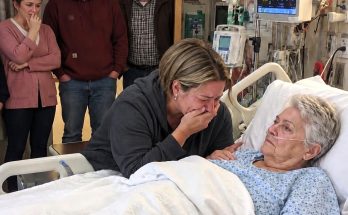
I couldn't remember how long I sat beside Gertrude's bed after the doctor left.
At some point, a nurse brought me a paper cup of water.
I held it with both hands, but I didn't drink.
My phone remained on the small table beside the bed.
The screen was dark.
I picked it up anyway.
No message from Christopher.
I called him once more.
The voicemail greeting began before the first full ring.
I ended the call without leaving another message.
There was nothing left to explain.
The nurse asked whether I had a family member she could contact for me.
I almost laughed.
Instead, I gave her Christopher's number.
“He's her son,” I said.
She wrote it down and stepped into the hallway.
I watched through the open doorway as she made the call.
When she returned, her expression told me she hadn't reached him.
She didn't ask me to explain.
I was grateful for that.
The hospital needed answers.
There were forms to sign and questions about Gertrude's belongings.
I answered what I could.
When they asked about funeral arrangements, I had to stop and think.
I had never imagined making those decisions without Christopher.
But imagining him beside me had become a habit, not a reliable plan.
I gave the hospital the information it needed.
Then I gathered Gertrude's things.
Her handbag.
A folded cardigan.
Her reading glasses in a plastic case.
A packet of tissues with two left inside.
I put everything into a shopping bag the nurse had offered me.
The silver key went into the inside pocket of my handbag.
I checked twice to make sure it was there.
I didn't know why.
Maybe I was afraid that if I lost it, I would lose the last thing Gertrude had deliberately placed in my care.
By the time I left the hospital, the sky outside had begun to lighten.
The parking lot looked washed out beneath the early morning sun.
I sat in my car without starting the engine.
My hands rested on the steering wheel.
I thought about calling Christopher again.
I thought about telling him that his mother was dead.
Then I remembered the way he had spoken to me the last time we'd talked.
He had been angry.
Not worried.
Not confused.
Angry that I kept trying to reach him.
I started the car.
I had to go home.
There were arrangements to make, and Gertrude deserved more than a rushed phone call to a funeral home.
I contacted one that afternoon.
The woman who answered spoke gently and asked what kind of service we wanted.
I told her I needed a little time to think.
She gave me a list of things to consider.
I wrote everything down.
The burial or cremation arrangements had to be confirmed.
Friends needed to be notified.
There were documents to complete and decisions about the memorial.
I had never realized how many small tasks gathered around a death.
Every question required an answer.
Every answer made the loss more real.
I called Gertrude's friends one by one.
Some cried before I could finish the first sentence.
Others went quiet and asked me to repeat what I'd said.
One woman told me she'd spoken to Gertrude only a few days earlier.
They had discussed a recipe.
She couldn't understand how someone could be talking about dinner one week and be gone the next.
Neither could I.
I kept my voice steady as I explained the memorial arrangements.
When I hung up, I sat at the kitchen table and stared at the list in front of me.
Christopher's name appeared nowhere on it.
I hadn't deliberately excluded him.
He had simply failed to become part of anything that needed doing.
That evening, I placed Gertrude's cardigan over the back of a chair.
I couldn't bring myself to put it away.
The sleeves hung down toward the floor.
I straightened them.
Then I stood there, looking at the empty space where she should have been.
I finally allowed myself to cry again.
The following days were a blur of telephone calls and paperwork.
I spoke with the funeral home.
I confirmed the memorial details.
I answered questions from people who wanted to know whether Christopher would attend.
Each time, I gave the same answer.
“I haven't been able to reach him.”
Some people looked surprised.
One person asked whether he was traveling.
I said I didn't know.
That was the truth.
I knew he had told me he was dealing with business.
I knew I'd heard sounds that didn't belong in a conference room.
But I didn't know where he was.
I didn't know who he was with.
And I was too tired to spend another hour pretending I didn't suspect the answer.
The morning of the memorial, I dressed in a plain black outfit and pinned my hair back.
I checked the folder containing the necessary papers.
Then I checked it again.
Before leaving, I took Gertrude's cardigan off the chair and folded it carefully.
I placed it in the closet.
I couldn't keep it sitting there forever.
At the memorial, her friends told stories about her kindness.
They remembered the meals she'd brought to people who were sick.
They talked about the way she remembered birthdays and asked after children by name.
One woman said Gertrude had called her every Sunday for years, even when she was too tired to talk for long.
I sat in the front row and listened.
I wished Christopher could hear them.
Not because I wanted to punish him.
Because I wanted him to know the person he had lost.
Gertrude was more than his mother.
She was a woman who had made room for people in her life.
She had done it without expecting anything in return.
When the memorial ended, I thanked the people who had come.
I accepted their embraces.
I gathered the remaining papers and made sure nothing had been left behind.
Then I drove home alone.
The house felt wrong when I entered it.
Christopher's shoes were still beside the door.
His jacket hung where he'd left it.
A glass sat on the counter, untouched since before he went away.
Ordinary things.
That was what made them difficult to look at.
The world had changed, but the objects in our house had not received the news.
I went into the living room.
The fireplace stood against the far wall, and the mantel was bare except for a few framed photographs.
I had arranged for Gertrude's ashes to be placed in a white urn.
When I brought it home, I set it on the mantel above the fireplace.
I stepped back and looked at it.
The urn was simple.
No bright decoration.
No elaborate design.
Just a smooth white surface that reflected the light from the window.
I touched its side.
“I brought you home,” I whispered.
The words sounded strange.
But I meant them.
I wanted her somewhere familiar.
Somewhere that had held her laughter and her stories.
Somewhere I could stand quietly when the house became too much for me.
I didn't know whether I would keep the urn there forever.
I only knew I couldn't put it away.
That night, I slept on my side of the bed.
Christopher's pillow remained untouched.
I woke several times and reached for my phone.
Each time, the screen showed the same empty list.
I stopped calling.
Not because I had stopped wanting him to answer.
Because I finally understood that I couldn't force someone to care by making myself available for disappointment.
For twenty years, I'd believed patience was a virtue.
Sometimes it was.
Sometimes it was just fear wearing a respectable face.
I had been afraid of what would happen if I stopped making excuses for Christopher.
Now his mother was dead, and I had nothing left to protect him from.
I sat on the edge of the bed and looked at my wedding ring.
It was still on my finger.
I twisted it slowly.
The metal had become familiar against my skin, so familiar that I sometimes forgot it was there.
I remembered the day Christopher put it on my hand.
He had smiled at me in front of our friends and promised we would always be there for each other.
I had believed him.
I had built a life around that promise.
Now I wondered how much of that life had existed only because I kept carrying it.
I took the ring off.
The pale circle beneath it looked almost like a mark left by something that had been removed.
I placed the ring on the bedside table.
Then I picked it up again and put it back on.
Not yet.
There were still things I needed to do.
The next morning, I returned to the paperwork.
I organized the documents from the hospital and funeral home.
I put the receipts into a folder.
I called the people who still needed confirmation of the arrangements.
I answered questions about Gertrude's belongings.
Everything was practical.
Everything had a place.
The one thing I couldn't organize was the key.
I took it from my handbag and set it on the kitchen table.
In daylight, it looked even smaller.
Its surface was dull, with tiny scratches around the head.
There was no number engraved on it.
No tag.
No mark that told me what it belonged to.
I turned it between my fingers.
Gertrude had kept it hidden beneath her clothing.
She had given it to me when she could barely speak.
She had looked directly into my eyes and waited until I understood that she wanted me to keep it.
I had promised her.
I wasn't going to throw it into a drawer and forget it existed.
But I couldn't imagine what she expected me to do with it.
I searched my memory for anything she had said about a key.
Nothing came to mind.
I had been in her home countless times.
I'd helped her sort kitchen drawers and organize medication.
I'd accompanied her to appointments and helped her manage the ordinary business of getting older.
Yet I couldn't remember seeing this one before.
I placed it in a small dish near the kitchen sink.
Then I went to make coffee.
For the first time since the hospital, I didn't check my phone while the machine ran.
The silence felt different.
Not peaceful, exactly.
Just honest.
And in that honesty, one thought kept returning.
Gertrude had given the key to me.
Not her son.
Me.
Click here to continue reading: PART 3: His Excuses Finally Had a Soundtrack, and I Began to See How Much of Our Marriage Had Been Held Together by My Silence
Thirty Calls Into the Night, One Empty Hospital Chair, and the Small Silver Object His Mother Refused to Explain
Part 2 of 4