The first thing I learned was that Nora had not spent eight years in one place.
The second was that she had been carrying a version of our family inside her the entire time.
The third was the hardest.
She did not want to see us immediately.
Detective Ruiz explained it carefully. Nora was working with a family-services counselor named Priya. She was safe. She had stable housing. She was receiving support. She knew we had been looking for her.
“She knows you're alive?” I asked.
Ruiz corrected me gently.
“She knows you're still looking for her.”
That distinction mattered.
I had assumed that if Nora learned we had never stopped searching, she would run toward us.
Instead, she had questions.
She wanted to know whether we were angry.
Whether we blamed her.
Whether we had moved on.
Whether her disappearance had destroyed our marriage.
Whether she would be expected to become the girl she had been at sixteen.
I did not know how to answer those questions without overwhelming her.
So Priya suggested that I write a letter.
Not a dramatic letter.
Not eight years of grief poured onto paper.
Just the truth.
I wrote for three hours.
Then I threw it away.
I wrote another.
That one began with, “You don't owe me anything.”
I kept it.
We were eventually told that Nora had been living in the same general region for several years. She had changed jobs. She had moved apartments. She had built friendships. She had learned to drive. She had taken classes.
She had become twenty-four without us.
I thought I would feel robbed.
Instead, I felt stunned by the ordinary things.
She had probably bought groceries.
She had probably gotten sick and gone to work anyway.
She had probably laughed with friends over something meaningless.
She had celebrated birthdays.
She had lived.
That mattered more than anything else.
The meeting was arranged in a family services building on a Thursday morning.
Priya warned me about the rules.
No rushing forward.
No grabbing her.
No demanding explanations.
Let Nora choose the distance.
I promised.
I failed before she even entered the room.
The door opened.
A young woman stepped through.
Her hair was darker than I remembered. Her face was narrower. She wore jeans and a gray sweater. She had one hand tucked into a pocket and the other wrapped around the strap of a small bag.
She looked at me.
I knew her.
Not because she looked sixteen.
She didn't.
I knew her because of the way she held her shoulders when she was nervous.
Nora used to do that before school presentations.
She would lift her shoulders slightly and pretend she wasn't afraid.
She stopped several feet away.
“Hi, Mom.”
I sat down.
I don't remember deciding to.
I simply couldn't keep my legs under me.
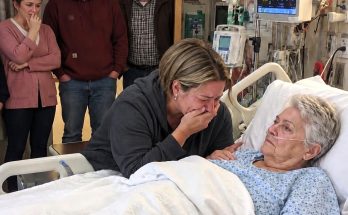
Nora's face crumpled.
She crossed the room and knelt beside me.
I wanted to hold her.
I didn't.
I waited.
She reached first.
Her hand touched my shoulder.
Then she leaned against me.
That was the moment eight years finally broke.
I cried into her hair.
She cried against my chest.
Michael stood several feet away, crying silently.
After several minutes, Nora whispered, “I'm sorry.”
I pulled back enough to see her face.
“No.”
“I left.”
“You were sixteen.”
“I knew what I was doing.”
“You knew you wanted ice cream.”
A tiny laugh escaped her.
It lasted barely a second.
But I heard it.
I had forgotten the sound.
Later, she told us what she remembered.
She remembered leaving the beach.
She remembered getting into a car.
She remembered being frightened when she realized the trip was not going to last a weekend.
She remembered trying to call home once.
She never reached us.
She remembered being told that if she went back, she would be arrested.
She remembered being told that we hated her.
She remembered being told that the police were looking for the person she had left with and that if she cooperated, everyone would get hurt.
The details came slowly.
Not all at once.
Priya stopped the conversation whenever Nora became overwhelmed.
I learned not to ask questions simply because I desperately wanted answers.
That was one of the hardest things I had ever done.
A mother spends eight years imagining the missing conversation.
You imagine asking where she was.
Who she was with.
Whether she was hungry.
Whether she cried.
Whether she remembered you.
Then the moment comes, and you realize every question has a cost.
Nora eventually told us that she had spent much of the first two years believing she could still return.
Then enough time passed that returning became harder.
Every month created another reason.
Every year made the distance larger.
She believed we would be furious.
She believed she had embarrassed us.
She believed she had chosen someone else over her family.
She believed she had no right to ask for forgiveness.
That was the lie that lasted longest.
Not that we hated her.
That she had forfeited her place with us.
I told her that none of it was true.
She listened.
She did not immediately believe me.
That was fair.
Trust does not appear because someone says the correct sentence.
It returns through repetition.
Through ordinary behavior.
Through promises kept.
Through boundaries respected.
Nora had spent years learning to survive by reading other people's moods.
Now she was learning that my silence did not mean anger.
Michael's questions did not mean judgment.
A delayed text did not mean abandonment.
She had to relearn ordinary things.
So did we.
The first time we had breakfast together, she ordered pancakes.
I nearly cried when I saw the syrup.
She used to eat pancakes every Saturday.
I had not remembered until that moment.
She noticed me staring.
“What?”
“Nothing.”
“You're looking at me.”
“I know.”
She smiled.
“You're still weird.”
I laughed.
“Good.”
That breakfast lasted forty minutes.
The next one lasted an hour.
The third lasted almost two.
Small victories.
Nothing dramatic.
Nothing anyone would put in a movie.
But they were ours.
Eventually, Nora told us about Elaine.
Elaine had run a small women's shelter when Nora was twenty.
By then, Nora had already left the man who had taken her from the beach, but she had nowhere stable to go.
Elaine helped her find work.
She helped her obtain new identification.
She helped her understand that what had happened to her was not something she had caused by being sixteen and trusting the wrong person.
When Elaine later opened the café, she offered Nora a job.
Nora stayed.
That was how the turquoise cover-up returned to the story.
Nora had kept it for years.
She hated it.
She loved it.
She could not throw it away.
It reminded her of the day everything changed.
Eventually, she gave it to Elaine.
Elaine put it in a box.
Years later, she wore it on the boardwalk.
The wind lifted the hem.
I saw the yellow sun.
That was all.
One tiny piece of thread connecting two lives that should never have been separated.
I asked Nora whether she remembered the cover-up.
She looked embarrassed.
“Of course.”
“Do you remember the sun?”
She smiled.
“Grandma made it.”
“She did.”
“She told me it was unique.”
I laughed through tears.
“That sounds like her.”
Nora looked down at the table.
“Is Grandma alive?”
I shook my head.
“She died three years ago.”
Nora closed her eyes.
“I knew she would.”
“She never stopped believing you'd come home.”
Nora's mouth trembled.
“She used to tell me that?”
“Not exactly.”
I explained that my mother had made me promise not to stop searching.
Nora was quiet.
Then she said, “That sounds like Grandma.”
The legal investigation continued.
There were records.
Statements.
Old addresses.
People who had known pieces of the story.
I did not follow every detail.
Some things were better left to investigators.
What mattered to me was that the truth was finally being documented.
For years, we had only had absence.
Now there were facts.
Dates.
Names.
Places.
Evidence.
A trail.
Nora wanted some privacy.
We respected it.
The public had once known her as a missing girl.
She did not want to become a story again.
I understood.
The world had spent years asking where Nora was.
Nobody had asked her what she wanted.
Now they were.
And she was learning to answer.
One evening, she asked me whether I was disappointed in her.
I said no.
She looked unconvinced.
“Not even about leaving?”
“You were sixteen.”
“I still made the choice.”
“Yes.”
She looked down.
“That doesn't mean I don't wish you had stayed.”
Her face tightened.
I reached across the table.
“But wishing something had happened differently is not the same as blaming you.”
She looked at my hand.
Then she took it.
“I don't know how to be your daughter again.”
I squeezed her fingers.
“You don't have to be the daughter you were.”
“What do I have to be?”
“Just Nora.”
She cried.
So did I.
That became the phrase we used when things became difficult.
Just Nora.
Not the missing girl.
Not the photograph.
Not the daughter from sixteen.
Just Nora.
A woman who had survived.
A woman who was still becoming herself.
A woman who had every right to decide what came next.
Months passed.
She did not move back home.
At first, I found that painful.
Then I realized why.
Her independence was not rejection.
It was proof that she had rebuilt something.
She had an apartment.
A job.
Friends.
A therapist.
Classes she wanted to take.
She had a life.
We were not replacing it.
We were becoming part of it.
Michael adjusted faster than I did.
He began visiting her once a month.
Sometimes they went for coffee.
Sometimes they worked on small projects together.
He never asked her to call him Dad.
He never acted as though eight years had not happened.
He simply showed up.
Nora noticed.
One afternoon, she told me, “He makes things easy.”
I laughed.
“He always has.”
She smiled.
“I think I needed that.”
I understood.
My relationship with her was different.
There was too much history.
Too much fear.
Too much love mixed with guilt.
We had to learn each other again.
Sometimes she wanted to talk for hours.
Sometimes she needed silence.
Sometimes she canceled plans.
Sometimes I worried.
I learned not to turn every quiet day into a crisis.
She learned that I would still be there the next day.
That was our new language.
Then, one evening, Nora called.
Her voice was strange.
“Mom?”
“What's wrong?”
“Nothing.”
She paused.
“I just wanted to tell you something.”
I waited.
“I enrolled in classes.”
I smiled.
“What kind?”
“Two courses. Starting in spring.”
“That’s wonderful.”
“I don't know if I'll be good at them.”
“You don't have to be good.”
“I know.”
She laughed softly.
Then she said something that made me close my eyes.
“I think I'm ready to start doing things because I want them.”
For eight years, I had imagined finding my daughter as the ending.
I finally understood it was not an ending.
It was the first honest beginning we had been given.
Click here to continue reading: PART 4: The Crooked Stitch Was Never Meant to Save Her, Yet Eight Years Later It Became the Thread That Led Us Back
She Walked Toward the Ice-Cream Stand With Her Phone Still Buried in the Bag Beside Me
Part 3 of 12