Over the next several visits, the orchard became part of my routine.
I drove there whenever my duties allowed, sometimes in the morning and sometimes after a long day at the base.
The Ford's engine continued to rattle at startup.
The glove compartment still stuck if I pushed it too hard.
I began to appreciate those small, familiar inconveniences.
They belonged to a world I understood.
Inside the carriage house, the paperwork was less forgiving.
Helen and I continued checking the records, comparing the property schedules with the loan documents and identifying the gaps that required professional review.
I learned to stop when a term was unfamiliar instead of pretending I understood it.
I learned to ask whether a number represented an original loan amount, an outstanding balance, or a payment due on a particular date.
Those distinctions mattered.
A document could be accurate and still tell only part of the story.
The more we examined the records, the more I understood why Dad had insisted on keeping them together.
The twelve properties were not simply twelve separate buildings.
Their financial arrangements connected them to a larger structure of companies and obligations.
Selling one building might help address a debt, but it could also affect other agreements.
Paying one lender might solve an immediate problem without resolving the rest.
There was no single number that told me whether the inheritance was a fortune or a trap.
There were many numbers, and they had to be read in context.
I found that unsettling.
I'd grown up believing Dad was good at seeing the whole picture.
Now I was discovering how much of that picture he had kept to himself.
One afternoon, Helen brought a fresh copy of the estate-related property schedule.
We compared it with the records in the carriage house.
The names aligned.
The buildings matched.
The associated companies appeared in the documents we'd already reviewed.
Nothing about that comparison erased the debts.
But it confirmed that we were examining the records connected to the properties named in the will.
I leaned back in my chair.
"So the inheritance wasn't imaginary."
"No," Helen said. "The properties exist. The business interests exist. So do the obligations."
"That sounds simple when you say it."
"It's simple to state. It's harder to manage."
I looked at the figures again.
For a brief moment, I imagined Nathan and Tyler sitting in the same room, reading the documents without the confidence they'd worn at the attorney's office.
I wondered whether they would understand the risk.
I wondered whether they already did.
Then I remembered the limits Helen had placed on our conclusions.
I couldn't know what they understood without evidence.
I couldn't know whether Dad had intended to expose them, protect them, or force them to face a responsibility they had underestimated.
All I knew was that he had left the records in my care.
I asked Helen about the manila folder she'd brought on the first night.
She removed it from the filing cabinet and placed it between us.
We had reviewed most of its contents, but a few pages remained to be checked against the other records.
I went through them carefully.
Near the back was a handwritten note about preserving the original documents and keeping the related schedules together.
The language was practical.
There was no dramatic declaration.
No explanation of why I had received the truck.
No accusation against Evelyn.
No prediction that Nathan and Tyler would fail.
Just an instruction to maintain the record.
I sat with it for a long time.
"I thought there would be something telling me what he wanted."
Helen folded her hands.
"Perhaps this is what he wanted you to have."
I shook my head.
"That's not the same thing."
"No. It isn't."
Her answer made me look at her.
I had expected her to defend Dad's choices, perhaps because she had spent so many years working for him.
Instead, she let the disappointment remain in the room.
I was grateful for that.
I loved my father.
I could still be angry with him.
Both things were true.
The next time I visited, I brought a small notebook and copied the questions we had not yet answered.
I wanted to separate what the documents showed from what I felt about them.
The distinction became more important with every page.
I wrote down the outstanding obligations.
I wrote down the deadlines.
I wrote down the questions about the ownership structure.
I did not write that Evelyn had stolen anything.
I did not write that Nathan and Tyler had deliberately taken on debts they couldn't repay.
I had no evidence for either claim.
That restraint felt difficult at first.
Then it began to feel like the only way I could honor what Dad had taught me about doing things properly.
One evening, while we were reviewing the final pages of a particular folder, I asked Helen whether she thought I should tell my stepfamily about the records.
She took off her glasses and rubbed the bridge of her nose.
"That's a decision you'll need to make carefully."
"They're the people who inherited the properties."
"Yes."
"They may be facing deadlines they don't fully understand."
"Possibly."
I waited for her to tell me what to do.
She didn't.
"Would you warn them?" I asked.
"If I were responsible for managing those assets, I would want a complete understanding of the obligations attached to them."
"That's not quite what I asked."
"No," she said. "It isn't."
I looked away.
For eighteen years, Evelyn had made me feel that every act of kindness was an opportunity for someone to take advantage of me.
Nathan and Tyler had treated my father's money as proof of their importance.
The thought of helping them made something inside me resist.
But the records weren't mine to use as punishment.
They weren't a weapon.
They were evidence of a financial situation that needed to be understood.
I could refuse to speak to them because I was hurt.
I could also choose to make a decision based on what I believed was right.
Neither choice would change what they'd said in the lawyer's office.
I closed the notebook.
"I need to think about it."
Helen nodded.
"That's reasonable."
That night, I drove the Ford back toward my quarters.
The road was dry, and the windows were clear. The old truck moved steadily beneath me, its engine humming at a speed that seemed almost gentle after the rain.
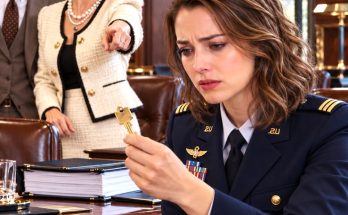
I thought about the brass key.
I thought about the iron key.
One had been handed to me in a room full of people who wanted me to feel small.
The other had opened a place where I could begin to understand what my father had left behind.
Neither key had told me what kind of person I should be.
That decision remained mine.
When I reached a quiet stretch of road, I pulled into a turnout and switched off the engine.
I took Dad's note from my bag.
The paper had begun to soften along its folds.
I read it again beneath the dome light.
He had warned me not to call Evelyn or the boys.
He had directed me to the orchard.
He had told me the truck was not the inheritance itself.
He had never said I should hate them.
I had supplied that part myself.
I folded the note and returned it to my bag.
The next morning, I would continue checking the records.
After that, I would decide what to do with what I knew.
For once, I would not let the people who had hurt me make the decision for me.
Click here to continue reading: PART 8: I Finally Understood What the Truck Had Given Me, Even Though My Father Never Explained Why He Left It That Way
I Sat Through My Father’s Will Without Crying, Until the Attorney Placed One Small Brass Key in Front of Me
Part 7 of 8