The rain was coming down hard by the time I reached Oakdale.
My uniform jacket hung from the back of the passenger seat, and the sleeves of my shirt felt damp from the moisture I'd carried into the truck.
I checked the time.
I had less than half an hour.
The address led me away from the main roads and toward a stretch of land where the streetlights grew scarce. Houses gave way to open fields, then to rows of trees standing dark against the sky.
I slowed when I saw the number on a battered roadside marker.
410\.
A narrow gravel drive disappeared between two rows of walnut trees.
There was no illuminated sign, no mailbox I could read from the road, and no indication that anyone lived there.
I turned in.
The tires crunched over loose stone.
Branches shifted in the wind, sending water onto the windshield. My headlights swept over tree trunks and patches of wet grass until they reached a chain-link gate.
I stopped a few feet away.
A heavy padlock hung from the latch.
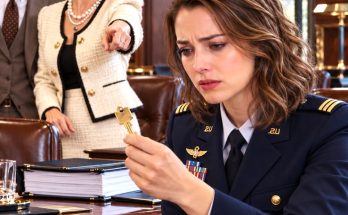
I took the iron key from my pocket.
For a moment, I simply held it.
My father had been dead for ten days. I had spent those days answering calls, signing papers, and sitting through conversations in which people discussed his final arrangements as if they were checking items off a list.
Now I was alone in an unfamiliar orchard with a key I'd never seen before.
I felt foolish.
Then I remembered his handwriting.
I got out of the truck.
Rain struck the back of my neck as I crossed the short distance to the gate. The lock was cold and slick beneath my fingers.
I inserted the key.
It turned without resistance.
The padlock opened with a dull click.
I stood there for another second, listening to the rain.
Then I pushed the gate aside and drove through.
The driveway continued toward a modest ranch house with dark windows. Behind it stood a larger, two-story structure with broad wooden doors and a roofline that looked more suited to farm equipment than a residence.
I parked in front of the larger building.
The engine ticked as it cooled.
I could hear rain running from the roof into a metal gutter.
There were no lights in the house.
No movement behind the windows.
I checked the time again.
I had made it.
That was the only thing I knew for certain.
I climbed out and approached the wooden doors. A smaller entrance stood along one side, partly sheltered by a narrow overhang.
The iron key fit that lock, too.
Inside, I found a breaker panel mounted on the wall.
I switched on the main power.
Nothing happened at first.
Then several industrial lamps flickered overhead, one after another, until the entire room was visible.
I stopped just inside the doorway.
The space was much larger than it had appeared from outside.
I had expected old machinery, perhaps a workbench or a few boxes of things Dad hadn't wanted to keep at home.
There was none of that.
Filing cabinets covered one wall from floor to ceiling. Several steel safes stood along the opposite side. Drafting tables occupied the center of the room, their surfaces crowded with documents, diagrams, and neatly arranged folders.
It looked like an office that had been moved out of a building and hidden in a barn.
I stepped farther inside.
The air smelled of dust, paper, and cold metal.
On the nearest table lay a set of architectural drawings. I recognized one of the buildings immediately.
It was a commercial property in Northern California that Nathan had talked about during a family dinner several years earlier.
He had described it as a major addition to Dad's portfolio.
I moved to the next drawing.
Another familiar building.
Then another.
There were photographs of all twelve commercial properties Nathan and Tyler had received in the will.
I placed my hand on the table to steady myself.
Beside the photographs were stacks of paperwork, each marked with a red stamp.
I picked up the first folder.
DEFAULT NOTICE.
The words were printed in block letters.
I opened it.
The pages inside contained figures, payment dates, and references to a loan agreement. I didn't understand every detail, but I understood enough to see that the document described a debt that had not been paid as required.
I opened the next folder.
BALLOON PAYMENT DUE.
The next carried a notice about collateral.
Another concerned unpaid municipal taxes.
I moved from folder to folder, trying to understand why my father had gathered these documents and hidden them here.
The figures were large.
Larger than anything I had expected to see in a place like this.
Private loans.
Outstanding obligations.
Properties tied to debts that appeared to reach beyond the individual buildings themselves.
I took out my phone and began writing down the amounts, but stopped when I realized I was only recording fragments without understanding how they connected.
I needed someone who knew what she was looking at.
I kept reading.
The papers described approximately thirty-eight million dollars in private loans.
Some of the payments were due soon.
Others had dates that stretched across the coming weeks, with substantial amounts coming due in roughly sixty days.
I read that part twice.
Sixty days.
The properties in Dad's will were valuable, but the debt against them was enormous.
The money Nathan and Tyler believed they had inherited might not be what they thought it was.
I stood very still.
The room had changed around me, though nothing had moved.
That afternoon, my stepbrothers had laughed at the idea that I was receiving an old truck instead of a fortune. Evelyn had watched me as if she had finally settled a long-standing score.
I had walked away believing that Dad had chosen them.
Now I was looking at evidence that the assets they had received came with obligations they might not be able to meet.
I couldn't yet say what that meant.
I wasn't a financial investigator. I had no right to pretend I could interpret every agreement on a table full of unfamiliar paperwork.
But the pattern was too clear to ignore.
The properties were not free and clear.
The debts were not small.
And someone had taken great care to gather the records in one place.
I moved toward the safes.
Their doors were closed, and I didn't have keys for them. Labels on nearby folders suggested that each contained documents related to a different part of Dad's business.
I didn't force anything open.
I had no idea what he had intended me to do once I arrived.
The note had told me to come here.
It hadn't told me what to touch.
I returned to the drafting table and studied the photographs again.
Nathan and Tyler had spent years speaking about Dad's holdings as if the buildings were proof of their own business ability. They had presented themselves as his natural successors, the people who would continue everything he had built.
I had heard them talk about expansion and acquisitions.
I had never heard them talk about these debts.
Perhaps they hadn't known.
Perhaps they had known more than they admitted.
I couldn't tell the difference from the documents in front of me.
Then I heard a sound behind me.
A footstep.
I turned so quickly that my hip struck the edge of the table.
A woman stood in the doorway.
She had silver hair, a dark coat, and a thermos tucked beneath one arm. In her other hand, she held a thick manila folder.
I recognized her before she spoke.
Helen Vance.
She had been Dad's private accountant for nearly twenty years. She was the person who used to sit quietly at the end of business dinners, listening while everyone else talked too much.
Two years earlier, she had left his company.
Nobody in the family had given me a convincing explanation.
I had assumed she wanted to retire.
Now she was standing in the middle of an orchard in the rain, looking as though she had been expecting me.
I glanced at the clock on the wall.
Then at the folder in her hand.
"How did you know I'd come?"
Helen stepped inside and shut the door against the weather.
"Your father was counting on you to find the note."
She looked at the papers spread across the table.
"Looks like you found the rest of it, too."
I wanted to ask ten questions at once.
Instead, I pointed toward the folder.
"What is all this?"
Helen set the thermos down beside the drawings.
"That depends on how much you already understand."
I looked at the stamped notices.
"Enough to know something is wrong."
She gave a small nod.
"Good."
Then she placed the manila folder in front of me.
Click here to continue reading: PART 4: Helen Vance Had Left My Father’s Company Two Years Earlier, but She Knew Why He Sent Me to the Orchard
I Sat Through My Father’s Will Without Crying, Until the Attorney Placed One Small Brass Key in Front of Me
Part 3 of 8