By the time I returned to the orchard again, I had stopped expecting the documents to answer every question.
They could tell me which properties were involved.
They could show me the loans, the deadlines, and the connections between the business interests.
They could establish what had been written down.
They could not tell me everything my father had thought during the last sixteen months of his life.
That part was gone with him.
Helen was waiting beside the drafting table when I arrived.
She had arranged the folders in the order we'd been using and left a clear space near the front for my notebook.
I put my bag down.
"I've been thinking about what you said."
"Which part?"
"That Dad wanted me to look before I decided."
Helen waited.
"I don't know whether he wanted me to discover that the properties were burdened by debt. I don't know whether he expected Nathan and Tyler to understand the agreements or whether he thought they'd need help."
I paused.
"But I know the documents are real, and I know the deadlines matter."
She nodded.
"That's a fair distinction."
I pulled out my notebook.
"I don't want to use this to get back at them."
"Then don't."
The answer was so direct that I almost laughed.
I'd spent days imagining that the truth would arrive with a satisfying explanation, one that would make the people who had mocked me regret their behavior.
Instead, I had learned that a financial problem remained a financial problem regardless of who deserved sympathy.
The properties would still have their obligations.
The lenders would still have their agreements.
The deadlines would still arrive.
My resentment could not change any of that.
I looked at the documents one more time.
"I want a complete record of what we found."
"We can make an inventory of the material here and identify what needs to be verified against the originals."
"And the missing answers?"
"We list those, too."
I nodded.
That was enough to begin.
We spent the morning reviewing the inventory and making sure each group of documents was accounted for. I checked the labels against my notes, and Helen corrected two entries where I'd copied a date incorrectly.
Neither of us rushed.
When we finished, the record was clearer than it had been on the night I first arrived.
It still did not explain why Dad had distributed his estate as he had.
But it gave me something solid to work from.
I asked Helen one final question.
"Did he ever tell you why he chose the truck for me?"
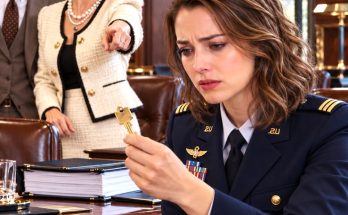
She looked down at the brass key beside my notebook.
"No."
I waited.
"He told me to make sure you knew where to find the note. That was the instruction he gave me."
"Nothing else?"
"Nothing I can honestly add."
I looked at the key.
For a long time, I had believed the worst part of the inheritance was that Dad had chosen to give me so little.
Now I understood that I had been measuring the gift by what it was worth to someone looking at it from the outside.
The truck was old.
It needed work.
Its paint was fading, and the glove compartment barely opened.
But it had carried me to the orchard, and the orchard had given me access to the records that explained the obligations behind the properties everyone had celebrated.
The truck had not made me wealthy.
It had given me a way to find out what was true.
That was not the same thing as an answer.
It was still more than I had believed I was getting.
I slipped the brass key into my pocket.
Then I put the iron key beside the inventory and closed the folder.
I didn't know what would happen to the properties.
I didn't know whether Nathan and Tyler would meet the coming payments, negotiate new terms, sell assets, or face consequences under the agreements.
I didn't know whether Evelyn understood the risks or what she would say if she learned how much of the financial picture had been kept separate.
Those outcomes depended on facts and decisions that had not yet been established.
I could not honestly claim to know them.
What I knew was that the inheritance was more complicated than the will had made it sound.
The buildings represented substantial assets.
The loans represented substantial obligations.
Both were real.
I also knew that my father's last decision had left me with a responsibility I had not asked for.
I could keep the records organized.
I could refuse to pretend that suspicion was proof.
I could make sure the documents were handled carefully and that any next steps were based on the actual agreements rather than my anger.
Beyond that, I would have to decide what I owed the people who had laughed at me.
I wasn't ready to forgive them.
I wasn't sure forgiveness was even the right question.
But I didn't want to become someone who used another person's possible failure as a substitute for her own happiness.
I had seen enough of that behavior already.
Helen walked with me to the door.
The afternoon was bright, and the walnut trees cast broken shadows across the gravel.
I looked back at the carriage house.
For sixteen months, my father had been preparing this place. He had kept records here, arranged the keys, and made sure the note would reach me.
He had planned the discovery.
He had not explained the meaning.
I wished he had trusted me with more words while he was still alive.
I wished I'd asked more questions when I had the chance.
Those wishes would have to remain wishes.
I climbed into the Ford and placed the iron key in the pouch beside the note.
Then I started the engine.
It rattled twice before settling into its familiar rhythm.
I no longer heard that sound as a reminder of how little I'd inherited.
I heard the truck as it was: an old machine that had kept running long enough to bring me somewhere important.
I drove out through the gate and stopped to lock it behind me.
The iron key turned smoothly.
I returned it to the pouch and put the pouch in the glove compartment, pressing the latch until it finally caught.
Then I got back behind the wheel.
The road ahead was ordinary.
There were no answers waiting around the next bend, no promise that the next sixty days would be easy, and no assurance that the people who had hurt me would ever understand what they'd done.
I had spent years believing that doing the right thing meant trusting the people I loved.
Now I understood that sometimes it meant looking carefully, asking difficult questions, and accepting that love did not make another person infallible.
My father had left me a truck.
He had also left me a choice.
I could spend the rest of my life measuring myself against the money he gave someone else, or I could take what he'd placed in my hands and decide what to do with it honestly.
I chose the second.
The engine hummed as I headed away from the orchard.
For the first time since the lawyer had read the will, I didn't feel as though I had to prove anything to Evelyn, Nathan, or Tyler.
I didn't even feel the need to prove anything to Dad.
I only had to be able to live with the choices I made.
And that, I finally understood, was something no inheritance could do for me.
The End
Read more original stories on Feel Every Story.
I Sat Through My Father’s Will Without Crying, Until the Attorney Placed One Small Brass Key in Front of Me
Part 8 of 8