I used to believe that if you did your duty, kept your word, and treated people fairly, things would eventually work out.
My father's funeral taught me that life didn't care what I believed.
Ten days after we buried Arthur Bennett, I found myself in a lawyer's office in downtown Sacramento, watching strangers decide what his life had been worth.
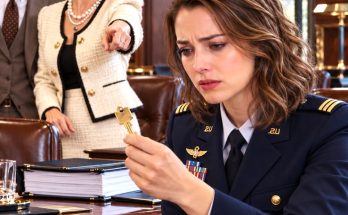
I wore my Air Force dress blues.
The collar felt too tight, though I knew it wasn't. I'd worn the uniform through ceremonies, inspections, and days when other people needed me to stay calm.
That morning, I needed somebody to tell me I was allowed to fall apart.
Nobody did.
The conference room had dark wooden walls and a long table polished so carefully that the overhead lights showed up in it. A glass of water sat untouched beside my right hand.
Across from me sat Evelyn Bennett, my father's wife for eighteen years.
She wore black silk and a diamond bracelet that flashed every time she moved her wrist. She kept a folded tissue near her face, but I hadn't seen her wipe away a tear.
Beside her were Nathan and Tyler, her twin sons.
Both were thirty-one. Both wore charcoal suits. Both had the same habit of leaning back when they thought they had already won.
They'd perfected it over the years.
I had spent much of my childhood trying to understand how two people could take up so much room without ever seeming to notice anybody else.
Dad had married Evelyn when I was sixteen.
At first, I thought she was simply a woman who wanted a comfortable life with a successful man. I was young enough to think wanting something and taking it were two different things.
By the time I understood the difference, she had become part of the family.
Nathan and Tyler followed her everywhere.
They attended business dinners with Dad, rode in his cars, and introduced themselves to people who had known him for decades. They used his connections to build their own reputations.
When Dad bought another commercial property, they talked as though they'd helped him find it.
When he closed a profitable deal, they were the first to congratulate him.
When something went wrong, they somehow became difficult to reach.
I had watched that pattern repeat until I stopped expecting anything else.
I chose a different life.
I joined the Air Force, learned to follow procedures, and built a career that didn't depend on my father's name. I rarely asked him for money, and I never asked him to solve problems I could handle myself.
I thought that independence mattered to him.
I still don't know whether it mattered as much as I hoped.
The estate attorney sat at the head of the table with several documents arranged in front of him. His name was on the folder, but I couldn't bring myself to read it.
He had already explained the formalities.
Now he began reading the will.
Nathan and Tyler were to receive twelve commercial office properties spread throughout Northern California, along with the holding companies and business interests attached to them.
Nathan stopped moving his foot beneath the table.
Tyler straightened his tie.
Evelyn lowered her tissue and gave them a small, satisfied smile.
The lawyer continued.
She would receive the Granite Bay house, the investment portfolios, and other assets worth close to eighteen million dollars.
Evelyn's expression barely changed, but her fingers tightened around the tissue.
I looked down at my hands.
My father had built his fortune over decades. I remembered him leaving before sunrise and coming home long after dinner, sometimes smelling of dust from a construction site or the sharp coffee he'd bought at a gas station.
He had worked for what he owned.
That was what he'd always told me.
And now I was listening to his money being divided as though we were settling the contents of a storage unit.
The lawyer turned another page.
I waited for my name.
I didn't expect to inherit a fortune. I had never built my life around that possibility.
Still, there was a difference between receiving nothing and discovering that your father had apparently considered you worth almost nothing.
I hated myself for thinking that.
Then I hated myself for caring.
The attorney adjusted his glasses.
"To Claire Bennett, my daughter, I leave my 1998 Ford F-150 pickup, including everything contained inside the vehicle."
For a second, I didn't understand what I'd heard.
Then Nathan laughed.
It wasn't a polite laugh or one that escaped him by accident. He leaned forward, slapped the table once, and looked at his brother as though Dad had just delivered the funniest joke of his life.
Tyler covered his mouth.
His shoulders shook.
Evelyn lifted her tissue to her cheek and turned toward me with an expression of manufactured concern.
"Well, Claire. You always did like to keep things simple."
She glanced at the lawyer's papers.
"At least you won't need to worry about a car loan with your military pay."
I felt the heat rising in my face.
I kept my hands still.
Tyler reached into his pocket and produced a small brass key. He slid it across the table until it stopped near my water glass.
"Provided the old thing still runs."
Nathan was still smiling.
"If it doesn't, I can put you in touch with someone who buys scrap."
They looked at each other again.
I wanted to tell them exactly what I thought of them.
I wanted to ask Evelyn how she could sit there and treat my father's death like a business victory.
Instead, I stared at the key.
I knew its scratches.
I knew the worn place near the head where Dad's thumb had rubbed against it over the years.
When I was twelve, he used to hang that key from a belt loop. On Sunday mornings, he'd take me through the orchards in the same green truck, stopping for doughnuts and coffee at whichever gas station we passed.
He would let me choose the music.
Sometimes we talked about school.
Sometimes we talked about nothing.
We never talked about money unless I asked him why he worked so hard.
His answer had always been simple.
"Having something and being somebody aren't the same thing, Claire."
I had carried that sentence into adulthood.
Sitting in the lawyer's office, I wondered if I had misunderstood it.
The attorney cleared his throat.
"That completes the distribution specified in the will."
I looked at him.
"There's nothing else?"
He hesitated before answering.
"No, Captain Bennett. That's everything allocated to you."
Evelyn watched me closely.
She expected a reaction. I could see it in the way she held herself, waiting for me to give her something she could repeat to friends and relatives.
She wanted anger.
Perhaps she wanted tears.
I wasn't sure which would have pleased her more.
I picked up the key.
"All right."
Nathan's smile widened.
I pushed my chair back and stood.
"Then we're done here."
Nobody tried to stop me.
I walked out through the glass doors and kept going until I reached the elevator.
Only when the doors closed did I let my shoulders drop.
I wasn't composed.
I was just alone.
Click here to continue reading: PART 2: The Old Ford Smelled Like My Childhood, but a Hidden Pouch in Its Glove Compartment Changed the Meaning of Everything
I Sat Through My Father’s Will Without Crying, Until the Attorney Placed One Small Brass Key in Front of Me
Part 1 of 8