The attorney continued reading.
I couldn't take my eyes off the envelope.
Arthur's handwriting looked familiar, but the words coming from the attorney's mouth belonged to a man I had never known.
For twenty years, I had believed I understood what happened in my house.
I knew who paid the bills.
I knew who went to work.
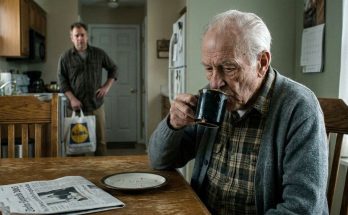
I knew who came home tired and who sat in a chair drinking coffee.
Or so I thought.
The attorney paused to straighten the paper.
Then he continued with Arthur's explanation.
I listened without moving.
Sarah's fingers remained wrapped around mine, but I barely felt them.
Kevin sat across from us, his arms no longer crossed.
Nobody interrupted.
I had spent years wishing Arthur would explain himself.
Now that he was finally doing it, I wasn't sure I could bear to hear the truth.
The attorney read the next lines slowly.
Arthur knew I had worked hard to keep the household running.
He knew I had taken extra shifts when the transmission shop was busy.
He knew I had worried over every unexpected expense, even when I tried to hide it from Sarah.
He had watched me come home with oil on my hands and exhaustion in my face.
He had noticed more than I thought.
I looked down at my own hands.
The skin around my knuckles was rough.
A small scar crossed one finger, a souvenir from a job that had gone wrong years earlier.
I had carried those hands into our house every night and believed they were the only reason we had survived.
Arthur's letter told me he had never overlooked what they had done.
The attorney reached for the blue ledger.
He opened it carefully, letting the cover fall flat against the table.
Inside were columns of handwritten figures.
Some entries had dates beside them.
Others had short descriptions.
The pages were crowded, but the writing was orderly.
I leaned forward.
I recognized the shape of Arthur's numbers.
He had written them himself.
The attorney explained that the ledger was among the records Arthur had specifically requested be preserved with his letter.
He did not pretend that every entry could be understood at a glance.
He simply turned to the pages Arthur had identified.
Kevin shifted in his chair.
"Are you saying Dad kept financial records all this time?"
The attorney answered that the documents were part of the estate materials.
That was all he said.
I stared at the columns.
I had seen Arthur sitting at the kitchen table with notebooks.
I had watched him write while his coffee cooled.
Sometimes I had wondered what he was doing.
Usually, I decided it wasn't my concern.
Once, I had asked whether he was making a shopping list.
He had looked up and said he was writing a few things down.
I had accepted that answer without thinking about it again.
Now I wished I had asked one more question.
The attorney returned to the letter.
Arthur wrote that he had never wanted Sarah to feel she had to choose between her father and her husband.
He knew she had been caught between us.
He knew the arguments had hurt her, even when we tried to keep them quiet.
Sarah lowered her head.
A tear dropped onto her hand.
I reached for a tissue on the table, but she shook her head slightly.
She wanted to listen.
So did I.
Arthur's letter acknowledged that he had depended on us.
He had needed a place to live.
He had needed meals, medical care, and help with the things age had made difficult.
He had not been proud of that dependence.
He had known the household was under pressure.
He had seen the sacrifices I made, including the sale of my truck to help pay for his cataract surgery.
I closed my eyes.
That memory had always hurt because I loved that truck.
I had also been angry that the money was needed at all.
Arthur had known both things.
The attorney read that he had not forgotten what the sale meant to me.
I looked at the faded photographs beside the ledger.
One showed Arthur when he was younger, standing outdoors in clothes that looked nothing like the old sweaters he wore in our house.
Another showed Sarah as a child.
I couldn't make out every detail, but I recognized her face.
She leaned closer to see the pictures.
For a moment, the expression on her face was not that of a woman who had just lost her father.
She looked like a little girl who had found an old family album.
"That's me," she whispered.
The attorney waited while she studied it.
Then he continued.
Arthur had kept records over the years.
He had saved receipts and bank documents.
He had written down amounts and dates.
He had kept photographs that tied the papers to his memories of the family.
The records were not something I could understand fully just by glancing at them.
But their existence alone changed what I believed about him.
He had not been oblivious.
He had not simply wandered through our home taking whatever he needed.
He had been watching.
He had been keeping track.
And he had known that one day, he might have to explain himself.
I felt embarrassed by how quickly my thoughts turned toward money.
Even then, I wanted to know how much there was.
I wanted to know what the documents meant for Sarah and the boys.
I wanted to know whether the debt I had carried in my head for twenty years had been real.
That was the way I had trained myself to think.
Every feeling became a number if I stared at it long enough.
The attorney turned another page.
Arthur explained that the money he had saved was not something he had wanted to use to control us.
He had not wanted to make Sarah feel obligated to keep him in the house.
He had not wanted me to feel that his help came with a price.
He had made a decision to keep the details private.
I could understand the intention.
I couldn't yet understand the choice.
If he had money, why hadn't he told us?
If he knew I was struggling, why had he let me believe he had nothing?
I felt anger rise in me again, but it was no longer the familiar anger I had carried for years.
This time, I was angry because I had been wrong.
And because part of me still wanted to defend the man I had been.
I had worked hard.
I had provided for my family.
I had sold things I loved and postponed repairs because the money had to go somewhere.
Those sacrifices were real.
Arthur's records did not erase them.
But they also did not make him the careless old man I had imagined.
The attorney explained that Arthur had made arrangements concerning his assets.
He had left instructions for how those matters were to be handled after his death.
The legal details were in the folder, and he would review them with us after finishing the letter.
Kevin leaned forward.
"So what exactly did he leave?"
The attorney raised his eyes.
"I will explain the estate once I have completed Mr. Henderson's instructions."
Kevin sat back again.
I watched him glance at the blue ledger.
He had arrived expecting a simple answer.
Arthur had died.
There would be papers to sign, perhaps a few belongings to divide, and then everyone would go home.
Now he was sitting in our living room listening to a letter addressed to the man who had housed their father for two decades.
His expression had become difficult to read.
Mine probably had, too.
The attorney continued.
Arthur wrote that he had been grateful for every meal.
He had never considered our food something he was entitled to receive without thought.
He knew the groceries cost money.
He knew the electricity did not pay for itself.
He knew the roof leaked.
I looked toward the hallway, where the old water stain remained visible above the bucket we had kept there for months.
Arthur had known about that, too.
I remembered the nights I had moved the bucket because the dripping kept me awake.
I remembered muttering that the roof would have been repaired already if we weren't always paying for someone else's needs.
The attorney read on.
Arthur had noticed the things I gave up.
He had not forgotten them.
And he had not believed that the kindness Sarah showed him gave him the right to ignore the strain on our household.
I looked at Sarah.
She was crying quietly now.
I wanted to comfort her, but I was afraid that speaking would interrupt something we had waited twenty years to hear.
The letter continued to explain that Arthur had made a deliberate choice about the money he held.
The records were meant to show what he had preserved and how carefully he had handled it.
He wanted the family to understand that the life he had lived in our home was not the whole story of his life.
I thought of the back bedroom.
The old dresser.
The slippers beneath the bed.
The radio with its scratched plastic casing.
I had mistaken the smallness of his room for the smallness of his world.
I had assumed that because he lived simply, he had nothing.
I had assumed that because he asked for help, he had nothing to offer.
Those assumptions had made it easy to resent him.
They had also kept me from asking the questions that might have changed everything.
The attorney reached the end of the letter's main explanation.
He folded the page slightly, then looked at the documents on the table.
Arthur had left further instructions about the estate.
The attorney would now explain the records and the arrangements that followed from them.
Kevin sat forward again.
Sarah wiped her face.
I placed both feet flat on the floor and tried to steady myself.
For twenty years, I had wanted the truth about Arthur's place in our household.
Now I was finally going to hear it.
And I knew that whatever the documents said, I would never again be able to look at that back bedroom and see only what it had cost me.
Click here to continue reading: PART 6: When the Attorney Finished Explaining Arthur’s Estate, I Finally Understood What His Quiet Years Had Been Trying to Tell Me
The Man in the Back Bedroom Who Made Every Payday Feel Like Another Bill I Could Never Afford
Part 5 of 6