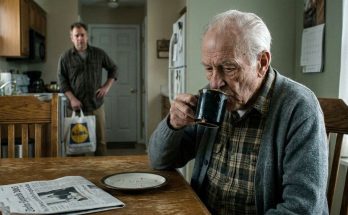
I used to think a person could only carry so much before something inside him broke.
For a long time, I blamed Arthur Henderson for how close I came to that point.
He was my wife's father, and for twenty years, he lived under my roof without paying toward a single household expense.
Not the groceries.
Not the electricity.
Not even the coffee he drank every morning.
I kept a running account in my head, even when I pretended I didn't.
Arthur slept in the small bedroom at the back of our house, beside the laundry room.
The washing machine rattled against the wall whenever it reached the spin cycle, and the dryer gave off a warm, dusty smell that drifted under his door.
He never complained about either one.
He barely complained about anything.
Most mornings, I found him in the kitchen wearing the same faded baseball cap, its brim bent down from years of use.
He would take a bowl from the cupboard, pour himself some oatmeal, and put two slices of bread in the toaster.
Then he'd make his coffee.
Black.
No sugar, no cream.
He drank it slowly, as if he had nowhere else to be and no reason to hurry.
I envied that more than I wanted to admit.
I worked at a transmission shop in Austin, Texas, where the days were loud, greasy, and hard on the hands.
By the time I got home, my fingers ached from handling tools, and the black stains around my nails seemed permanent.
I usually wanted a shower, a hot meal, and an hour in my recliner without anyone asking me for anything.
Instead, Arthur was often already sitting there.
The television would be off.
His little radio would be playing a talk show near the window, and a plate of shortbread cookies would rest on his knee.
He never acted as if the chair belonged to me.
Maybe that was what bothered me most.
He didn't seem to understand how much of our home had become his simply because he'd been there long enough.
I would stand in the doorway, still wearing my work boots, and look at him.
He would glance up.
"Long day, David?"
"Same as always."
He'd nod and return to his radio.
That was the whole conversation.
Sometimes he thanked me for dinner.
Sometimes he thanked Sarah.
But gratitude wasn't what I needed, and I hated myself a little for that.
I needed money.
I needed space.
I needed to stop feeling like one unexpected expense would put my family underwater.
Sarah understood some of that, but she never saw her father the way I did.
"He's not asking for anything fancy," she told me one night while she stacked the dishes.
"He doesn't have to ask. We pay for everything."
"He's my father, David."
"And I'm your husband."
She stopped moving.
I knew I'd hurt her before she turned around.
Her shoulders tightened, and she put the plate down too carefully.
"He has nobody else who will take him."
"He has children besides you."
"They have their own lives."
"So do we."
Sarah looked at me as if I had just admitted something unforgivable.
Then her eyes filled.
I had learned that when Sarah cried, the argument usually ended.
Not because either of us had changed our minds.
Because I couldn't stand to watch her cry over something I believed was obvious.
I'd rub my face, lower my voice, and tell her we would figure it out.
Then I'd go to bed angry.
Arthur usually stayed out of our disagreements.
He could hear us through the thin walls, especially when the dryer was running, but he never stepped into the hallway to defend himself.
Sometimes, when I came into the kitchen afterward, I'd find him rinsing his own bowl.
He would keep his eyes on the sink.
"I'm sorry, son."
I never knew what to do with those words.
If he had argued, I could have argued back.
If he'd accused me of being selfish, I could have defended myself.
But he only apologized, and I was left feeling like the cruel one.
That feeling didn't make me kinder.
It made me resent him more.
Every other Friday, my paycheck came through, and I sat at the kitchen table with a stack of bills.
Mortgage.
Utilities.
Insurance.
Groceries.
Arthur's prescriptions.
I wrote numbers in the margins of envelopes and moved amounts around until the money looked less frightening.
It never lasted long.
The pantry always seemed fullest on payday morning.
By the following week, the cereal boxes were lighter, the bread was nearly gone, and the oatmeal container had sunk below the halfway mark.
Arthur ate ordinary food.
That was part of the problem.
He didn't ask for expensive things I could point to and call unreasonable.
He simply ate breakfast, lunch, and dinner like anyone else.
But I counted every meal anyway.
I counted the eggs.
The slices of bread.
The coffee grounds.
I even noticed when he took an extra piece of toast.
Looking back, that small detail embarrasses me more than some of the things I said out loud.
A man in his eighties was eating breakfast in the house where his daughter had brought him to live, and I was watching the toaster as if it were a cash register.
I told myself I was protecting my sons.
They were growing boys, and they shared one bedroom because Arthur occupied the only other spare room.
Their beds stood against opposite walls, with a narrow path between them.
Their school clothes hung together in the closet, and their shoes collected in a heap near the door.
They never complained about their grandfather taking the extra room.
They loved him in the unthinking way children love someone who has always been there.
He taught them how to shuffle a deck of cards.
He showed them how to tighten a loose screw on a cabinet hinge.
When one of them came home upset from school, Arthur sometimes sat beside him on the porch without asking what had happened.
He was good at being present.
He was less good at explaining himself.
I didn't see much value in that at the time.
Presence didn't pay bills.
Kindness didn't fix the roof.
And quietness didn't make the grocery money stretch.
When a patch of shingles began leaking over the hallway, I put a bucket beneath the stain and promised myself I'd repair it after the next payday.
Then Arthur needed medication.
The pharmacy receipt sat on the counter beside a jar of loose change, and I stared at the total for a long time.
Sarah stood behind me.
"We can't skip his refills," she said.
"I didn't say we could."
"I know you're worried."
"Worried doesn't begin to cover it."
She reached for my arm, but I stepped away to get my wallet.
That was how I ended up selling my Chevrolet Silverado.
I'd owned that truck for years, long enough that the driver's seat had settled into the shape of my body.
The steering wheel was worn smooth where my left hand rested.
There was a small dent near the rear bumper from a parking lot mishap I'd never bothered fixing.
I liked that truck.
It was one of the few things I'd bought for myself without calculating how much money would remain afterward.
When I sold it, I told everyone it was a practical decision.
The money helped cover Arthur's cataract surgery.
Sarah cried when I handed her the paperwork.
She kissed my cheek and thanked me for doing the right thing.
I smiled because she needed me to.
Later, I stood in the driveway looking at the empty space where the truck had been.
Arthur watched from the porch.
He had his cap in his hands.
"I wish you hadn't needed to do that," he said.
"Well, it wasn't exactly a hobby."
His mouth closed.
I saw the hurt pass over his face, but he didn't answer.
He only turned his cap over once and went inside.
I could have called him back.
I could have told him I was tired, that I felt trapped, that I didn't know how to provide for everybody without losing pieces of myself.
Instead, I let the door shut between us.
The roof remained unrepaired for months.
Whenever it rained hard, the bucket in the hallway began to fill, and the steady drip kept me awake.
Arthur's medicine stayed current.
The lights stayed on.
The boys kept growing.
And the back bedroom remained occupied.
I began to measure the years by what I had postponed.
A better truck.
A family trip.
Repairs that should have been done before they became urgent.
The little things I told myself I'd enjoy when life finally became easier.
I blamed Arthur for those things because blaming him was simpler than admitting how little control I felt I had.
He never demanded that I sacrifice anything.
That was the part I refused to understand.
He didn't have to demand it.
His presence was enough to make me feel that every choice had already been made for me.
On evenings when I came home especially exhausted, I would find him sitting at the kitchen table with his black coffee and the day's newspaper folded beside him.
He'd lift his eyes when I entered.
"There's some stew left, son."
I'd look at the pot on the stove.
"How much?"
He would blink.
"Enough for a bowl, I think."
I hated that I had asked.
I hated more that he answered me gently.
He never told me I was a good man for taking him in.
He never said I owed him anything.
He didn't remind me that Sarah had been the one to insist.
He just lived there.
Quietly.
For years, I treated that quietness as proof that he had nothing to offer.
I didn't know how wrong I was.
Not then.
At the time, I thought the worst thing Arthur could do to me was keep needing things I couldn't comfortably afford.
I had no idea what it would mean when he no longer needed anything at all.
Click here to continue reading: PART 2: The Things I Gave Up for My Family Were Easier to Count Than the Things Arthur Quietly Gave Us
The Man in the Back Bedroom Who Made Every Payday Feel Like Another Bill I Could Never Afford
Part 1 of 6