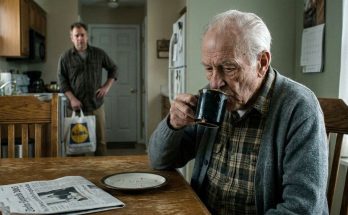
The older Arthur got, the more careful his movements became.
He took the stairs one at a time, holding the railing even though there were only a few steps to the porch.
He lowered himself into his aluminum lawn chair with both hands gripping the arms.
When he stood, he paused before walking, as if he needed to make sure his legs would cooperate.
I noticed all of it.
I just didn't think about what it meant.
I saw another task waiting to happen.
Another possible fall.
Another trip to a doctor.
Another expense that would eventually land on our kitchen table.
Sarah worried about his health in a different way.
She checked whether he had eaten.
She asked if his medicine was making him dizzy.
She reminded him to bring a sweater outside when the evening air cooled.
Arthur answered her with the same few words.
"I'm all right, sweetheart."
He said it even when he wasn't.
I knew that much, although I rarely admitted it.
His hands sometimes shook when he lifted his coffee cup.
His eyesight had improved after the cataract operation, but he still leaned close to read the newspaper.
And every so often, he would stop halfway through a sentence because he had lost the thought he meant to finish.
Sarah never rushed him.
I did.
"Take your time, Dad," she would say.
I would look at the clock.
There were mornings when I wished I could leave the house without hearing the washing machine, without seeing his cap on the kitchen counter, without finding another empty place in the bread bag.
Then I'd feel ashamed.
Then I'd get angry at myself for feeling ashamed.
It became a routine of its own.
Our boys grew taller.
Their voices changed.
The toys disappeared from the shared bedroom, replaced by schoolbooks, laundry baskets, and the clutter of two young people trying to have separate lives in one small space.
Arthur stayed in the back room.
His bed was made every morning.
His slippers sat beneath it, toes facing outward.
A little radio rested on the dresser, its plastic casing scratched and yellowed with age.
He kept the volume low enough that I could barely hear it through the laundry room door.
I rarely entered his room.
When I did, it was usually because something needed fixing.
A loose drawer handle.
A lamp that wouldn't turn on.
A window latch that had become stiff.
Arthur would watch me work, his fingers folded over the curved handle of his cane.
"You don't have to do that right now," he would tell me.
"If I leave it, nobody else will."
He would lower his gaze.
"Thank you, son."
There it was again.
Thank you.
For years, I had treated those words as the cheapest currency in the world.
He could say them whenever he wanted.
I was the one who had to buy the replacement parts.
I never considered that he might have felt just as powerless as I did.
One winter, I found him standing beside the kitchen sink, looking at a grocery bag Sarah had just brought home.
He was holding a carton of eggs.
"These yours?" he asked.
"They're for everybody."
He nodded and put them away.
A few minutes later, I opened the refrigerator and saw him making himself a sandwich.
He had taken two slices of bread, a little cheese, and some leftover meat.
Nothing extravagant.
Nothing that should have mattered.
Still, I heard myself say, "We're going to have to start watching what we use around here."
Arthur stopped with the knife in his hand.
He looked at the sandwich.
Then he looked at me.
"I can make do with less."
I wanted him to understand the problem.
I wanted him to tell me he had savings somewhere, or a pension, or some other way to help.
I wanted him to stop being so agreeable and make the conversation easier by giving me something concrete to argue about.
Instead, he wrapped the sandwich in a paper towel.
"I'll be more careful."
He took it into his room.
I stood in front of the open refrigerator long after he had gone.
The eggs were still there.
The cheese was still there.
The meat had barely made a dent in the container.
I shut the door harder than I needed to.
That evening, Sarah asked why her father had eaten alone.
I told her he wanted some quiet.
She looked toward the hallway.
"Did you say something to him?"
"Nothing he hasn't heard before."
She put her fork down.
"That's not an answer."
I didn't reply.
We ate without talking.
Later, I heard her knock on his door.
Their voices were too low for me to make out the words, but I heard him laugh once.
It was a small, surprised sound.
I couldn't remember the last time I had heard him laugh with me.
That thought stayed with me longer than the argument.
I pushed it aside.
There were always more immediate problems.
The credit card balances crept upward.
The roof still needed work.
The transmission shop paid me enough to keep us going, but not enough to make me feel safe.
Whenever the boys needed something for school, I calculated whether we could manage it before I answered.
Sometimes I said yes.
Sometimes I told them we would have to wait.
I hated the look on their faces when I said that.
It was easier to blame Arthur than to admit I was afraid.
Sarah never denied the strain.
She cut coupons, planned meals, and stretched leftovers into another dinner.
She wore the same winter coat year after year.
She stopped mentioning small things she wanted for herself.
I knew she was sacrificing, too.
But when I looked at her, I saw someone who had chosen this arrangement and expected me to accept it.
She looked at me and saw a husband who was supposed to understand what family meant.
Neither of us knew how to bridge that distance.
Once, after a particularly long day at the shop, I found her sitting on the edge of our bed with a stack of bills.
She had separated them into piles.
Paid.
Due soon.
Not yet possible.
The last pile was the smallest, but she kept looking at it.
"How much do we have left?" I asked.
She told me.
I did the math in my head.
It wasn't enough.
I sat beside her and rubbed the grease stains from my thumb with a tissue.
"We can't keep doing this forever."
She folded one bill in half.
"We're not going to put him out on the street."
"I never said we should."
"You keep talking as though that's what you want."
I looked at the carpet.
I didn't want Arthur sleeping outside.
I didn't want Sarah to lose her father.
I didn't want our sons to remember their childhood as a string of shortages and arguments.
I wanted a solution that didn't require anyone to lose something.
There wasn't one.
"He's getting older," Sarah said quietly. "We don't know how much time he has."
I heard the words as another reason I couldn't make a change.
She meant them as a reminder that the time we had with him was limited.
I couldn't hear that part.
I went downstairs and found Arthur in his chair.
His radio was on.
The little speaker crackled whenever the announcer raised his voice.
Arthur had a shortbread cookie between his fingers, but he wasn't eating it.
He was looking through the window at the yard.
I stood there for a moment.
Then I said the thing I had been carrying around for years.
"You know, Arthur, it would help if you could contribute something."
The radio continued talking.
Arthur slowly turned his head.
"I know."
I waited.
He didn't explain.
"Anything," I added. "Even a little."
He placed the cookie on a napkin.
"I'm sorry, David."
I hated the way my name sounded in his mouth just then.
Not angry.
Not defensive.
Just tired.
I walked away before he could say anything else.
That night, I lay awake listening to the rain hit the roof.
Water dripped into the bucket in the hallway.
Every few seconds, the sound repeated.
Sarah slept facing the wall.
I stared at the ceiling and thought about the truck I had sold, the repair I had postponed, and the bills waiting on the counter.
I thought about Arthur saying he would be out of my hair soon.
He had said it more than once over the years.
Whenever I complained about a cost.
Whenever he overheard us arguing.
Whenever I looked at him too long and forgot to hide what I was thinking.
I had always taken the words as an admission that he understood he was a burden.
I had never asked what he meant by soon.
The next morning, I found his coffee cup beside the sink.
A thin brown ring marked the bottom.
His oatmeal bowl sat next to it, rinsed clean.
I put both in the dishwasher.
Then I went to work.
Nothing changed that day.
Nothing changed the next week, either.
Payday came.
The bills were paid in the order they had to be paid.
Sarah bought groceries.
Arthur ate breakfast at the kitchen table.
The boys argued over space in their bedroom.
And I continued telling myself that I was the only person in the house who understood the cost of keeping everyone together.
Years passed that way.
Not dramatically.
Not all at once.
One ordinary morning after another, with Arthur's cap hanging beside the back door and his black coffee cooling on the kitchen table.
I didn't know that he had been paying attention to me all those years.
I didn't know that the man I considered careless with money had kept track of things I had never thought to count.
All I knew was what I could see.
And what I could see was an old man who never seemed to have anything to give.
Click here to continue reading: PART 3: The Tuesday Morning When His Porch Chair Stopped Being a Source of Resentment and Became Something I Couldn’t Look At
The Man in the Back Bedroom Who Made Every Payday Feel Like Another Bill I Could Never Afford
Part 2 of 6