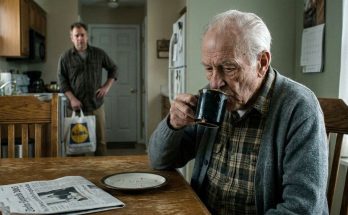
Arthur's death happened on an ordinary Tuesday.
There was no warning that I recognized.
No final conversation.
No sudden change that made me look back afterward and realize I should have understood.
The morning began like any other.
The house was quiet, and the light coming through the kitchen window fell across the table where Arthur usually sat with his coffee.
I don't remember whether I saw his cap that morning.
I remember the porch.
I remember the chair.
And I remember Sarah's scream.
Arthur had gone outside and settled into his aluminum lawn chair.
His cap was resting on his knees.
His portable radio was still switched on, but the sound had broken into a thin wash of static.
From inside the house, it might have seemed that he was simply enjoying the morning.
He often sat there after breakfast.
He liked the air before the day grew warm.
Sometimes he listened to the radio.
Sometimes he watched the yard without saying anything.
That was where we found him.
Sarah reached the porch first.
I heard her cry out and ran toward the back door.
For one confused second, I thought she had seen him fall.
Then I saw the way he was sitting.
His hands were still.
His head was slightly lowered.
The cap lay across his knees as neatly as if he had placed it there on purpose.
"Arthur?"
I moved closer.
I said his name again.
He didn't respond.
Sarah was beside him, calling for her father and touching his shoulder.
I stood there, unable to make myself accept what my eyes were telling me.
I had imagined his absence countless times.
Usually, it appeared in my thoughts as a list of expenses that would finally disappear.
No more prescription refills.
No more grocery bills for another person.
No more worrying about what would happen if he needed another procedure or fell in the bathroom.
I had imagined the extra bedroom becoming available.
I had imagined the pantry lasting longer.
I had imagined coming home and finding my recliner empty.
I had never imagined the stillness of his hand.
Arthur was gone.
The thought arrived without any useful instructions attached to it.
I didn't know what to say to Sarah.
I didn't know what to do with the cap on his knees or the radio making that broken noise beside him.
I only knew that nothing I had complained about could be fixed by standing there.
The house felt different before we even brought him inside.
Sarah cried until her voice became hoarse.
I stayed close to her because I didn't know what else a husband was supposed to do.
The boys learned what had happened, and the news changed the look of their faces.
They had grown up with Arthur.
They had shared a room because he occupied the spare one.
They had watched him sit on the porch, shuffle cards, and listen to his radio.
They knew him in ways I had spent years overlooking.
Nobody asked about the grocery bills that morning.
Nobody mentioned the roof.
The stack of envelopes on the kitchen counter remained exactly where it had been.
I looked at them once.
Then I looked away.
There were arrangements to make.
People to call.
Questions that had to be answered, even though none of us felt ready to answer them.
The funeral was simple.
I remembered the quietest moments more clearly than the service itself.
Sarah holding a tissue in both hands.
Our sons standing close together.
The flowers arranged near the front.
The faces of relatives I hadn't seen in years.
Arthur had other children, and some of them arrived late.
They came in looking distressed, and they spoke loudly about how much they would miss him.
I watched them embrace one another.
I heard them exchange memories.
I couldn't tell whether their grief was deeper than mine or merely easier for them to show.
I knew I was grieving.
I also knew that another part of me had been waiting for this day for a long time.
That was the part I couldn't forgive.
During the service, I thought about the back bedroom.
I thought about the washing machine rattling beside his wall.
I thought about his coffee cup and the worn slippers beneath his bed.
I thought about how many times I had walked past him without asking how his day had gone.
I remembered the way he moved his sandwich away from the kitchen table after I complained about the groceries.
I remembered telling him that his contribution would help.
He had said he understood.
I had mistaken that for agreement.
After the burial, the family gathered for a short reception.
People spoke in small groups.
The conversations rose and fell around the room.
Sarah remained quiet, and I stayed beside her.
Kevin, one of Arthur's other children, approached me.
He put a hand on my shoulder and gave it a firm pat.
"Well, David, you can finally breathe a little easier now."
He smiled as though he had offered me something comforting.
I looked at him.
For a moment, I couldn't tell whether he was being cruel or simply saying what he thought everyone already knew.
He had not spent twenty years watching Arthur eat breakfast at our table.
He had not listened to the washer shake against the wall of the back bedroom.
He had not sold his truck to cover the cost of Arthur's operation.
And yet, there was something about Kevin's words that made them impossible to dismiss.
Because I had thought the same thing.
Not in those exact words, perhaps.
But close enough.
I had imagined the freedom that would come when Arthur was no longer there.
I had treated that imagined freedom as a practical matter, something I was entitled to after years of sacrifice.
Now Kevin had said it aloud, and I felt as though he had opened a door to a room inside me that I had been trying to keep locked.
I didn't answer him.
He moved away to speak with someone else.
I stood still for a while, watching people return to their conversations.
The guilt was not dramatic.
It didn't arrive with tears or a sudden collapse.
It settled into me like a weight I could no longer shift from one shoulder to the other.
I had resented a man for needing help.
I had measured his life against my expenses.
And now I would never have the chance to hear him say thank you again.
That evening, Sarah and I returned home.
The house was quiet in a way I had never experienced before.
For twenty years, there had always been some small sign of Arthur's presence.
A radio murmuring in the back room.
A cup near the sink.
The slow movement of his slippers down the hallway.
Even when I had been irritated by those sounds, I had known what they meant.
Now they were gone.
I walked past the back bedroom.
The door stood open.
His bed was still made, and his belongings remained where they had been.
The faded cap wasn't there.
Neither was the radio from the porch.
I stood in the doorway, looking at the room he had occupied for so many years.
It seemed smaller than I remembered.
I had spent years thinking of it as space taken away from our sons.
Now I could see the room without imagining what it had cost me.
There was a bed.
A dresser.
A lamp.
A few ordinary belongings.
That was where Arthur had slept.
That was where he had spent his evenings when the house became too loud.
That was the place he returned to after hearing me complain about the food he ate.
I stepped inside.
I didn't open drawers or examine his things.
I just stood there, feeling the absence of someone whose presence I had treated as a problem.
Sarah came up behind me.
She didn't say anything.
I turned toward her, but I couldn't find the right words.
She had lost her father.
I had lost the chance to make peace with mine-in-law.
Those were not the same loss, and I knew better than to pretend they were.
Still, she reached for my hand.
I held it.
We remained there for a while.
Later, I went outside.
The aluminum lawn chair was still on the porch.
Its metal frame had a dull shine where the paint had worn away, and one of its feet rested unevenly against a crack in the concrete.
I sat down in the chair next to it.
For years, I had seen Arthur there and thought about all the things he wasn't paying for.
That evening, I could only think about how often he had sat alone while I went inside angry.
The yard was quiet.
The house stood behind me with its lights on.
I stayed outside until the air cooled.
I didn't feel relieved.
I felt ashamed.
And for the first time in twenty years, I understood that a person could be gone from a home and leave behind more than the space he had occupied.
He could leave behind every unkind thought you had never bothered to correct.
Click here to continue reading: PART 4: Three Days After the Funeral, a Stranger Arrived With a Folder That Made My Family Question Everything We Thought We Knew
The Man in the Back Bedroom Who Made Every Payday Feel Like Another Bill I Could Never Afford
Part 3 of 6