
The attorney placed the letter beside the blue ledger.
He opened the folder to the financial documents and began explaining what Arthur had left behind.
I listened carefully.
For once, I did not interrupt with questions about what something might cost or who had paid for it.
The records showed that Arthur had kept track of his finances over many years.
The bank receipts, the dated entries, and the other papers had been preserved together.
They were not random scraps collected by a man who had forgotten why he kept them.
They belonged to a larger record of his life.
The attorney explained that Arthur had made arrangements to leave his assets under my name.
That was why my name had appeared on the envelope.
That was why he had insisted that the letter be read in front of the family.
He wanted the people who had judged his dependence to understand what he had been doing quietly in the background.
I looked at Sarah.
She seemed stunned.
She had brought her father into our home because she believed it was the right thing to do.
She had defended him through our arguments.
But she had not known the full extent of his financial arrangements, either.
"Dad never told me," she said.
The attorney acknowledged that Arthur had kept those matters private.
His instructions were to explain the estate after the letter had been read.
Kevin rubbed his hands together.
"How much are we talking about?"
The attorney turned to the relevant documents.
He reviewed the estate arrangements and explained the assets recorded there.
I won't pretend that the numbers didn't matter to me.
They did.
I had spent twenty years watching every dollar.
I had sold my truck.
I had postponed repairs.
I had worried over the cost of medicine and groceries.
Hearing that Arthur had preserved money while living in our house forced me to confront a question I had never thought to ask.
How much of my resentment had come from the actual burden of supporting him, and how much had come from believing he had never considered the burden at all?
I couldn't answer that immediately.
The attorney continued explaining the legal arrangements.
He made clear that Arthur's instructions identified me as the person who was to receive the assets covered by those arrangements.
Kevin's face tightened.
"What about the rest of us?"
The attorney explained that he was following the instructions Arthur had left.
He did not argue with Kevin.
He did not criticize the other children.
He simply referred to the documents and continued.
Kevin shook his head.
"This doesn't make sense. He's our father, too."
I understood why he was upset.
I also remembered his words at the reception, when he had patted my shoulder and told me I could finally breathe easier.
He had not been there every morning when Arthur made coffee.
He had not paid for the cataract surgery.
He had not stood in our hallway listening to water drip into a bucket because the roof had to wait.
He had arrived after Arthur's death and expected to share whatever might be left.
I didn't feel triumphant about that.
I felt tired.
The attorney explained that Arthur had made his decision deliberately and had left records to support his instructions.
He had not asked us to guess what he wanted.
He had put it in writing.
Kevin looked toward Sarah.
"Did you know anything about this?"
She shook her head.
"No."
He turned back to me.
"And you?"
"No."
The answer came out quietly.
I had no secret arrangement with Arthur.
I had not known that he had preserved these records.
I had not known that my name would be on his letter.
I had not known that the man whose groceries I counted had spent years considering the sacrifices I made.
I had simply lived beside him, believing I understood his circumstances.
The attorney gathered the documents into a neat stack.
He explained which papers belonged to the estate and which required further handling.
He made sure we understood that the letter, ledger, and financial records were part of the materials Arthur had wanted us to see.
I looked at the blue cover.
It seemed impossible that something so ordinary could hold so much meaning.
I thought about all the times Arthur had sat at the kitchen table with his pen.
He had never asked me to read his notes.
I had never asked what he was writing.
We had shared a home for twenty years without learning this important part of each other's lives.
I had mistaken privacy for indifference.
He had mistaken silence, perhaps, for the best way to avoid adding to my worries.
Neither of us had known how to talk about what was happening between us.
The attorney finished reviewing the principal documents.
He explained the next steps for handling the estate, and he made clear that the family would have to rely on the written instructions rather than on assumptions about what Arthur might have wanted.
Kevin was unhappy.
I could see that he wanted an explanation that would make the outcome feel fair to him.
He wanted his father to have spoken differently.
He wanted the years of distance to count for something.
But Arthur was gone, and no argument could bring him back to explain himself in person.
Sarah sat beside me, staring at the letter.
Her face was pale.
She had spent years worrying about her father.
Now she was learning that his life had contained something she had never seen.
I wanted to tell her that she had done the right thing by taking him in.
I wanted to tell her that I was sorry for every argument that had made her feel trapped between us.
But the words felt too small.
The attorney eventually closed the folder.
He left the family with the appropriate documents and explained what would happen next.
When he stood to leave, I rose with him.
I thanked him.
My voice sounded unfamiliar to me.
After the door closed, nobody spoke for several seconds.
Kevin was the first to move.
He stood, adjusted his jacket, and looked at the table.
"This isn't over," he said.
He did not explain what he meant.
He left with the others.
I watched them go.
The house grew quiet again.
Sarah remained on the sofa, her hands resting in her lap.
I sat beside her.
Neither of us knew what to say about the money.
Neither of us knew what to say about the years we had spent believing Arthur had nothing.
At last, Sarah picked up the letter.
She read the first lines again, slowly.
Then she lowered it.
"He knew you were struggling."
I nodded.
"He knew about the truck," she said.
"Yes."
"And the roof."
"Yes."
She looked at me.
"Why didn't he tell us?"
I thought about that question for a long time.
I couldn't answer for Arthur.
Perhaps he had wanted to avoid making our home feel like a place where every act of kindness carried a price.
Perhaps he had feared that telling us about his money would change the way we treated him.
Perhaps he had believed that leaving the explanation until after his death was the only way to make sure we heard it without arguing.
I didn't know.
The letter gave us his intentions, but it couldn't give us every conversation we had failed to have.
"I wish I'd asked him more questions," I said.
Sarah nodded.
"So do I."
I looked down at my hands.
For years, I had believed that being a provider meant keeping the household running.
I had thought that if I worked hard enough, paid enough bills, and sacrificed enough possessions, I had earned the right to be angry when life asked for more.
I still believed that providing for my family mattered.
I still knew how hard those years had been.
But I could no longer use my sacrifices as proof that Arthur had contributed nothing.
He had lived in our home.
He had accepted our help.
He had also seen what that help cost.
And in his own quiet way, he had tried to acknowledge it.
I thought of his words about being out of our hair.
For years, I had heard them as an admission that he was unwanted.
Now I wondered whether they had also been his awkward way of acknowledging that he knew we were tired.
I wished I had told him he didn't need to apologize every time he ate a meal.
I wished I had asked what he was writing in his notebooks.
I wished I had sat with him on the porch without turning every quiet moment into a list of expenses.
I wished I had known him better while there was still time.
Those wishes did not change what had happened.
They did not return the truck to my driveway.
They did not repair the roof.
They did not give Sarah another afternoon with her father.
They simply became things I would have to carry.
Later, I walked down the hallway to the back bedroom.
The room was still as we had left it.
The bed was made.
The dresser stood against the wall.
The old radio was among his belongings, silent now.
I looked at the slippers beneath the bed.
For twenty years, I had passed them without thinking much about the person who wore them.
I bent down and straightened them.
It was a small thing.
Too small to make up for anything.
But I did it carefully.
Then I sat on the edge of the bed and looked around the room.
I could see where the sunlight fell across the floor in the morning.
I could hear the washing machine through the wall.
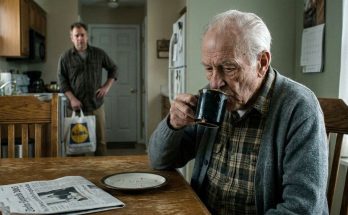
I could imagine Arthur sitting at the kitchen table, writing in his blue ledger while his coffee cooled beside him.
I could imagine him watching me come home from work, noticing the oil on my hands and the tired set of my shoulders.
I could imagine him wanting to say something that would make my life easier, and choosing instead to keep his thoughts to himself.
I could never know exactly what had gone through his mind.
But I knew enough to stop pretending that I had understood him.
When I returned to the porch, the aluminum chair was still where we had found him.
I sat in my own chair beside it.
The yard looked ordinary.
The house behind me was the same house where I had raised my sons, argued with my wife, and counted every expense that seemed to fall on my shoulders.
Nothing about the walls or the porch had changed.
I had changed.
I no longer looked at Arthur's chair and saw only the cost of keeping him alive.
I saw a man who had spent his last years in a small room beside the laundry, drinking black coffee and trying not to make himself a greater burden than he already felt he was.
I saw the father Sarah had refused to abandon.
I saw the grandfather who had sat quietly with our boys when they needed company.
And I saw the man who had understood my sacrifices better than I had ever understood his.
I could not go back and make those twenty years different.
I could not ask him why he had kept his records private.
I could not hear him answer when I apologized.
All I could do was live with what I now knew.
For years, I had believed that Arthur's quietness meant he had nothing to say.
His letter taught me that silence could hold a whole life I had never bothered to learn about.
I still remembered the bills.
I still remembered the sacrifices.
But when I thought of Arthur after that, I no longer counted the meals he had eaten.
I remembered the man who had eaten them.
The End
Read more original stories on Feel Every Story.
The Man in the Back Bedroom Who Made Every Payday Feel Like Another Bill I Could Never Afford
Part 6 of 6

One Comment on “PART 6 – When the Attorney Finished Explaining Arthur’s Estate, I Finally Understood What His Quiet Years Had Been Trying to Tell Me”