FINAL PART
“The taxi is waiting.”
Wade said it again, louder this time.
I stood at the bottom of the stairs holding a thick folder against my chest.
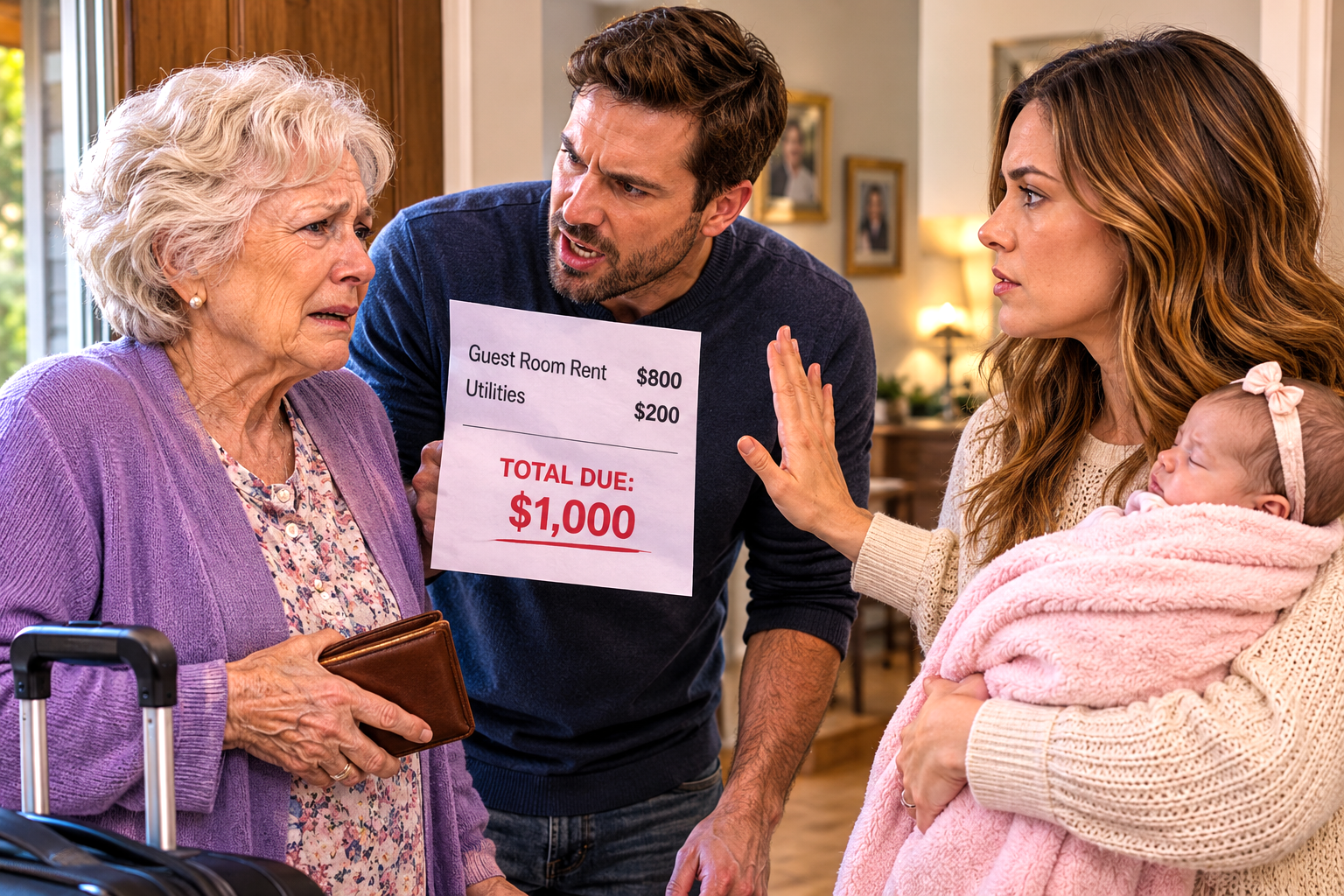
My mother was still beside the front door, her wallet open in her hands.
The thousand-dollar bill lay on the small table between them.
Wade looked from the folder to me.
“What took you so long?”
“Ten minutes,” I replied.
“Jenna, your mother needs to get going. We can finish this later.”
“No. We’re finishing it now.”
I placed the folder on the table, directly on top of his ridiculous invoice.
Then I turned to my mother.
“Mom, please close your wallet.”
She looked uncertainly at Wade.
“Sweetheart, I don’t want to cause trouble.”
“You haven’t caused anything.”
I gently folded her fingers around her wallet and handed it back to her.
“Not one dollar, Mom. You’re not paying him.”
Wade let out an irritated breath.
“Can we stop making this dramatic?”
I looked at him.
“You wrote an invoice charging a seventy-three-year-old woman eight hundred dollars for a bedroom and two hundred dollars for utilities after she spent a month taking care of our newborn daughter.”
“I didn’t force her to stay.”
“No. I invited her. And you agreed.”
“She stayed longer than a few days.”
“Because I needed help. Because you went back to work and left me to handle everything else.”
“I was earning money for this family.”
“And she was taking care of this family.”
He shook his head.
“This is exactly what I mean. Nobody can have a reasonable conversation with you.”
I opened the folder.
“Then let’s have a reasonable conversation with these.”
The first document was a printed bank statement.
The second was a collection of receipts.
The third was a spreadsheet I had prepared during the ten minutes upstairs.
Wade glanced at them.
“What is all that?”
“Expenses.”
“What expenses?”
“Everything your mother-in-law supposedly owes us.”
He gave a short laugh.
“My mother-in-law?”
“Yes. My mother. The woman you just tried to charge rent.”
I placed the first receipt in front of him.
It was from the grocery store.
The date was three days after Lorraine had arrived.
The total was $186.42.
I pointed to the items.
Milk.
Eggs.
Chicken.
Vegetables.
Rice.
Fruit.
Baby supplies.
“Mom bought these.”
“So?”
“So you said our food spending went up because she was another person living here.”
I placed another receipt beside it.
Then another.
And another.
Over the month, my mother had purchased groceries, cleaning supplies, laundry detergent, paper towels, and several things we had run out of.
She had also bought the ingredients for most of the dinners Wade had eaten.
He looked at the receipts.
“I never asked her to buy groceries.”
“She didn’t ask you to charge her rent, either.”
He pushed the papers away.
“Groceries aren’t the point.”
“Then let’s talk about the utilities.”
I turned to the next page.
“Before Mom arrived, our average electricity bill was $142. This month, it was $149.”
He stared at me.
“Seven dollars.”
“Yes.”
“That’s not the point.”
“Water went up by four dollars. Gas went up by three. That’s fourteen dollars in additional utilities, not two hundred.”
He rubbed his forehead.
“Jenna, you’re missing the bigger picture.”
“No, Wade. I’m finally looking at it.”
I lifted another sheet.
It was a handwritten list of things my mother had done during her stay.
Not because I had asked her to keep track.
Because I had watched her do them every day.
She had woken up with Sadie when I was too exhausted to stand.
She had prepared breakfast.
She had washed bottles.
She had folded tiny clothes.
She had cooked dinner.
She had cleaned the kitchen.
She had changed the bedding.
She had taken the stroller outside so I could shower.
She had stayed awake when Sadie developed a mild fever one evening, sitting beside her crib while I called the pediatrician.
And she had done all of it while her knees hurt.
I looked at Wade.
“You want to calculate what a month of newborn care costs?”
He shrugged.
“She was helping her daughter.”
“Exactly.”
“And that’s supposed to mean something?”
The question came out of his mouth so casually that I almost couldn’t believe I had heard it.
My mother lowered her eyes.
I felt something inside me become very still.
“Yes,” I said.
“It means everything.”
Wade crossed his arms.
“Families don’t get to use that as an excuse for everything.”
“Families also don’t send invoices to elderly relatives who come to help with their newborn grandchildren.”
He looked toward the front door.
“Fine. Don’t pay it. I don’t care.”
But I wasn’t finished.
I opened the folder to the last section.
“This is the document I wanted you to see.”
He leaned forward.
It was a bank statement from an account I had opened several years earlier.
Before I married Wade.
Before we bought our house.
Before Sadie was born.
The account contained money my mother had helped me save when I was younger, along with money I had earned and deposited over the years.
It wasn’t an enormous fortune.
But it was mine.
And I had kept it separate from our household accounts.
Wade knew I had savings, but he had never been interested in the details.
He had always assumed the money was simply sitting there.
I pointed to the account information.
“Do you remember when we discussed buying the house?”
“Of course.”
“Do you remember that I contributed part of the down payment?”
“Yes.”
“Do you remember where that money came from?”
He frowned.
“Your savings.”
“Some of it.”
I pulled out a copy of the original transfer.
“Mom gave me money toward my future when I was younger. She wanted me to have something of my own. I kept it separate because she told me never to become completely dependent on someone else.”
Wade looked at the paper.
“What does this have to do with anything?”
“Everything.”
I placed another document beside it.
“This is the account I used to pay for Sadie’s hospital expenses that weren’t covered by our insurance.”
He looked up.
“Why are you bringing that up?”
“Because you told me we couldn’t afford to have someone help after the birth.”
“I never said that.”
“You did. You said hiring someone would be a waste of money.”
“I was talking about a full-time nanny.”
“And when I asked if we could arrange temporary help, you said we’d manage.”
He was silent.
I continued.
“Mom came because she heard me crying on the phone. She didn’t ask for money. She didn’t ask for anything. She brought one suitcase and spent a month making sure I could sleep.”
My voice started shaking.
I stopped for a moment.
Then I looked at him again.
“And today, you stood beside her with a bill.”
Wade’s expression hardened.
“I thought it was fair.”
“Fair?”
“Yes. If someone lives in a house, they contribute.”
I stared at him.
Then I picked up his invoice.
“Fine. Let’s apply your rule consistently.”
I turned the paper around and placed it in front of him.
“Mom stayed for thirty days. She paid for groceries. She cooked. She cleaned. She cared for our daughter.”
I took a pen from the folder.
“Let’s say we calculate her work at a very modest rate.”
I wrote a number.
“Thirty days of daytime newborn assistance, meal preparation, laundry, and household cleaning. Even at a discounted rate, that’s worth considerably more than a thousand dollars.”
Wade rolled his eyes.
“I’m not paying her.”
“Of course not. She wasn’t here to earn money.”
“Then why are you calculating it?”
“Because you seem to understand invoices better than kindness.”
My mother made a small sound.
“Jenna, sweetheart.”
I turned toward her.
“I’m sorry, Mom.”
Her eyes filled with tears.
“Don’t apologize.”
“I should have stopped this before it happened.”
She reached for my hand.
“You were exhausted. You had a newborn.”
“I know. But I should never have let you feel like you had to earn your place in this house.”
She shook her head.
“I never felt that way until today.”
Those words hurt more than anything Wade had said.
I looked at him.
He was staring at the floor.
For a moment, I thought he might finally apologize.
Instead, he said, “So now I’m the villain?”
I closed the folder.
“I’m not interested in deciding what you are. I’m interested in deciding what happens next.”
He looked at me sharply.
“What does that mean?”
“It means Mom isn’t paying you anything.”
“I already heard that.”
“And it means we’re going to discuss how you’ve treated her.”
He scoffed.
“She’s your mother. I was trying to establish boundaries.”
“Boundaries don’t involve inventing rent after someone has already stayed in your home.”
“I didn’t invent anything. That’s what a room costs.”
“Then you should have mentioned it before she arrived.”
He had no answer.
I looked at the taxi driver through the window.
The man was waiting patiently beside the car.
My mother had already delayed her journey long enough.
I picked up her suitcase.
“Come on, Mom. I’ll walk you out.”
Wade stepped aside.
But just as I opened the door, he spoke.
“Jenna, we still need to settle this.”
I turned around.
“No, Wade. We need to settle something much bigger than a thousand dollars.”
Then I walked outside with my mother.
The November air was cool.
The taxi driver opened the trunk and helped me lift her suitcase inside.
Mom stood beside me, clutching her purse.
I hugged her carefully.
“Call me when you get home.”
“I will.”
“And don’t worry about any of this.”
She touched my cheek.
“I’m more worried about you.”
I swallowed.
“I’m okay.”
She gave me the same look she had given me when I was a child and tried to convince her I wasn’t sick.
“Jenna.”
“I’m going to be okay.”
She nodded slowly.
Then she got into the taxi.
I watched until the car turned the corner.
When I went back inside, Wade was standing in the living room.
He had picked up the invoice.
“Happy now?”
I closed the front door.
“No.”
“Then what do you want?”
“I want to know why you thought that was acceptable.”
“I already explained.”
“No. You gave me a slogan about people contributing to a household. You haven’t explained why you waited until she was leaving to tell her she owed you money.”
He threw the paper onto the table.
“Because I didn’t think it needed to be discussed beforehand.”
“Why?”
“Because I assumed she understood that staying here wasn’t free.”
I stared at him.
“She came to help her daughter and granddaughter.”
“And I have bills.”
“So do I.”
“I’m the one paying the mortgage.”
That stopped me.
Not because it was true.
But because it revealed something I hadn’t fully understood before.
We had always discussed the mortgage as a shared responsibility.
Wade earned more than I did, and we had agreed that he would handle the mortgage while I managed other household expenses.
I had paid for groceries, baby supplies, medical expenses, insurance contributions, and countless smaller things.
My unpaid work at home had also been part of our arrangement.
But apparently, in his mind, the mortgage gave him the right to decide who belonged in the house.
I walked to the dining table.
“Let’s talk about the mortgage, then.”
He looked annoyed.
“What now?”
I took out my phone.
I had already downloaded several months of our financial records.
I opened the spreadsheet.
“Here are the payments I’ve made toward the household since January.”
I showed him the figures.
“Groceries. Utilities. Insurance. Medical bills. Household supplies. Repairs. Baby expenses.”
He barely glanced at them.
“That’s what married people do.”
“Exactly.”
“Then why are you making it sound like I owe you something?”
“I’m not saying you owe me money. I’m saying you don’t get to pretend I’m a guest in my own home while my mother is a burden.”
He walked toward the kitchen.
“I need a drink.”
“Wade.”
He stopped.
“I need you to understand something. My mother is not coming back here to work for you. She is welcome because she is family. If she wants to visit Sadie, she can visit Sadie without being charged a fee.”
He turned around.
“And what if I don’t agree?”
I held his gaze.
“Then we have a serious problem.”
He stared at me for several seconds.
Then he walked away.
That evening, we barely spoke.
I fed Sadie, changed her, and settled her into her crib.
Wade ate leftovers from the refrigerator.
He didn’t ask whether I wanted anything.
He didn’t ask whether Sadie had slept.
He didn’t mention the invoice.
I sat beside the crib for a long time after she fell asleep.
I watched her tiny chest rise and fall.
And I thought about my mother.
At seventy-three, she had climbed the stairs in our house with a laundry basket in her arms.
She had stood over the stove preparing meals.
She had learned how to use our bottle sterilizer.
She had memorized Sadie’s feeding schedule.
She had sat on the floor because getting up from the couch hurt her knees less than getting up from the floor.
She had done all of that because she loved us.
And I had allowed her to feel embarrassed in the place where she should have felt most welcome.
I picked up my phone.
I sent her a message.
I love you. Thank you for everything. Please don’t ever think you owe us anything.
She replied a few minutes later.
I love you too. Give my little girl a kiss from Grandma.
I kissed Sadie’s forehead.
Then I made a decision.
The following morning, I contacted an attorney.
I didn’t tell Wade immediately.
I wanted to understand our financial arrangements, our property rights, and what options I had if his behavior continued.
The attorney, a woman named Melissa, listened carefully as I explained what had happened.
She didn’t interrupt.
When I finished, she asked one question.
“Has your husband ever tried to control who you can have in your home?”
I thought about it.
“Not directly.”
“Has he ever made you feel that you need his permission to spend your own money?”
I hesitated.
“A little.”
“Has he ever discouraged you from accepting help from your family?”
I looked at the calendar on my desk.
Then I remembered how Wade had reacted when I first suggested my mother stay with us.
He had agreed, but he had never sounded pleased.
“I don’t know,” I said.
Melissa explained that a single argument didn’t establish a pattern of financial abuse or coercive control.
She also advised me not to make assumptions about the legal consequences of our financial arrangements.
But she recommended gathering our financial records, reviewing the mortgage documents, and ensuring I understood which accounts and assets were jointly owned.
I agreed.
For the first time since Sadie was born, I felt as though I was doing something for myself.
Not because I wanted to punish Wade.
Because I needed to know where I stood.
Over the next week, I organized everything.
I printed bank statements.
I downloaded our mortgage records.
I collected receipts.
I made copies of the documents relating to my personal savings.
I also started writing down the household responsibilities I had been handling.
Not to calculate a bill.
To remind myself that my contribution had always been real, even when nobody acknowledged it.
Wade noticed the papers one evening.
“What are you doing?”
“Organizing our finances.”
“Why?”
“Because I want everything clear.”
He picked up one of the documents.
“Did you hire a lawyer?”
I looked at him.
“Yes.”
His expression changed.
“For what?”
“Advice.”
“About me?”
“About our finances and my legal rights.”
He dropped the paper.
“You’re seriously doing this because of a thousand dollars?”
“No.”
I put the documents away.
“I’m doing this because of what that thousand dollars showed me.”
He shook his head.
“You’re making a huge mistake.”
“Maybe. But I won’t know unless I understand my options.”
He left the room.
For the next several days, he became noticeably quieter.
He stopped mentioning rent.
He didn’t ask my mother to pay.
But he also didn’t apologize.
Then, on Saturday morning, something happened that changed the conversation.
Wade came downstairs while I was preparing Sadie’s bottle.
He had his phone in his hand.
“Your mother called.”
I looked up.
“Why?”
“She wants to talk about something.”
“What did she say?”
“She asked if we could discuss the money.”
I felt my stomach tighten.
“What money?”
“The thousand dollars.”
I put the bottle down.
“Why is she still thinking about that?”
“I don’t know. She said she wants to make things right.”
I closed my eyes.
Of course she did.
My mother had spent her entire life trying not to inconvenience anyone.
Even when someone treated her unfairly, her first instinct was to make peace.
I took my phone and called her.
She answered almost immediately.
“Hello, sweetheart.”
“Mom, Wade says you want to talk about the money.”
There was a pause.
“I’ve been thinking.”
“Mom, please don’t.”
“Listen to me. I don’t want this to create trouble in your marriage.”
I sat down.
“You didn’t create this trouble.”
“I know he shouldn’t have handed me that bill. But perhaps he was worried about the expenses.”
“Mom.”
“I can send you some money. Not necessarily the whole amount, but something.”
My throat tightened.
“Please stop.”
She became quiet.
Then I said something I had wanted to say for years.
“You spent your whole life making sure I never felt like a burden. You helped me through school. You helped me when I moved into my first apartment. You stayed up with me when I was sick. And now, when I have a baby, you come to help me, and someone makes you feel like you have to pay for being loved.”
I heard her sniffle.
“I never wanted you to fight.”
“I know.”
“I just wanted to help.”
“And you did. More than you know.”
I paused.
“Mom, I don’t want your money. I want you to come visit Sadie whenever you want. I want you to sit in the living room and hold her. I want you to eat dinner with us. I want you to feel comfortable enough to open the refrigerator without wondering whether somebody is calculating the electricity.”
She laughed softly through her tears.
“Oh, Jenna.”
“And if you ever stay here again, it will be because you’re our guest and family. Not because you’re working off some imaginary debt.”
She was quiet for a moment.
Then she said, “I love you.”
“I love you too.”
After we hung up, I found Wade in the kitchen.
“Don’t involve my mother in this again.”
He looked up.
“I didn’t ask her for anything.”
“You told her about the bill.”
“She wanted to discuss it.”
“Then you should have told her there was nothing to discuss.”
He rubbed his jaw.
“I don’t understand why this is such a big deal.”
I looked at him.
“That’s the problem.”
He didn’t answer.
A few days later, he finally brought up the subject again.
This time, he sat across from me at the dining table.
“I’ve been thinking about what happened.”
I waited.
“I shouldn’t have handed her the bill like that.”
I nodded slowly.
“No.”
“I was frustrated about the expenses.”
“You could have talked to me.”
“I know.”
“And you could have thanked her.”
He looked down.
“I know.”
It wasn’t much.
But it was the first acknowledgment that he had done something wrong.
Then he said, “I didn’t mean to make her feel bad.”
I leaned back.
“Intentions don’t erase what happened.”
He nodded.
“I understand.”
I wanted to believe him.
But I also knew that an apology was only the beginning.
So I told him what I needed.
“First, I want you to apologize to my mother directly.”
He looked uncomfortable.
“Fine.”
“Not a text. Not a message passed through me. You need to call her and tell her that the invoice was wrong.”
He nodded.
“Okay.”
“Second, we’re changing how we handle household finances.”
“What does that mean?”
“It means we’re reviewing our expenses together. Both of us. No surprise charges. No unilateral decisions about family members. And no treating my personal savings as household money unless we agree on it.”
He frowned.
“Are you saying you don’t trust me?”
“I’m saying trust requires transparency.”
He looked away.
“And third,” I continued, “I need you to understand that caring for Sadie and maintaining this home are responsibilities we share.”
“I work.”
“So do I.”
“You’re home with the baby.”
“And that is work.”
He started to respond.
Then he stopped.
For once, he didn’t have an immediate argument.
Two days later, he called Lorraine.
I was in the nursery when he made the call.
I didn’t listen to every word.
But I heard enough.
“Lorraine, I wanted to apologize for the bill.”
A pause.
“I shouldn’t have done that.”
Another pause.
“You came here to help Jenna and Sadie. You didn’t owe us rent.”
He listened.
Then he said, “I understand. I’m sorry I made you uncomfortable.”
When he hung up, he came into the nursery.
“She’s very forgiving,” he said.
I looked at him.
“She shouldn’t have had to be.”
He nodded.
That evening, my mother sent me a photograph.
She was sitting in her living room with the little blanket she had knitted for Sadie spread across her lap.
The caption read:
Grandma is making another blanket. This one will be bigger.
I smiled for the first time in days.
The following month, Wade and I began attending counseling.
It wasn’t a magical solution.
We still disagreed.
There were conversations that became uncomfortable.
There were moments when he became defensive and moments when I struggled to explain why the incident had affected me so deeply.
But I refused to let the issue disappear simply because the invoice had been withdrawn.
During one session, our counselor asked Wade why he had thought charging Lorraine was reasonable.
He sat silently for a long time.
Then he said something I hadn’t expected.
“I think I felt like I was losing control of my house.”
Our counselor asked him to explain.
Wade said that after Sadie was born, the house had become unpredictable.
My mother was in the kitchen.
The baby was crying.
There were groceries he hadn’t chosen.
Dinner was being prepared differently.
My routine had changed.
He had felt as though someone else had entered his space and disrupted his control over it.
I listened without interrupting.
Then I asked him one question.
“Did you ever stop to think about how I felt when I was alone here before Mom arrived?”
He looked at me.
I continued.
“I was recovering from childbirth. I was exhausted. I was crying on the phone because I couldn’t manage everything. I wasn’t worried about who controlled the kitchen. I was worried about getting through another night.”
He lowered his eyes.
“And when Mom came, I finally felt safe enough to sleep.”
The counselor asked him what he thought about that.
Wade didn’t answer immediately.
Then he said, “I hadn’t looked at it that way.”
I didn’t tell him that everything was fine.
I didn’t rush to comfort him.
I simply let the words sit between us.
Because that was what I had needed all along.
For him to see that my mother’s presence hadn’t been an inconvenience.
It had been a lifeline.
Several weeks later, Lorraine visited again.
This time, Wade knew she was coming.
He had even asked whether she wanted him to pick up anything from the grocery store.
When the doorbell rang, I carried Sadie to the entrance.
Mom stood outside holding a small knitted hat.
“Look at my girl,” she said.
I handed Sadie to her.
Mom settled into the armchair and held her granddaughter against her chest.
Wade came out of the kitchen carrying two cups of tea.
He placed one on the table beside Lorraine.
“Would you like anything else?”
Mom smiled.
“No, thank you.”
He hesitated.
Then he said, “I’m glad you came.”
My mother looked at him.
“Thank you, Wade.”
It wasn’t an extraordinary moment.
Nobody made a speech.
Nobody cried.
But I noticed that he didn’t mention the length of her visit.
He didn’t ask how much she had spent on groceries.
And he didn’t look at the clock.
That afternoon, we ate together.
Mom brought a casserole.
Wade washed the dishes afterward.
And when she prepared to leave, he carried her suitcase to the car without being asked.
I watched them through the window.
My mother was laughing at something he had said.
For a moment, I allowed myself to hope that we were learning how to become a family again.
But the greatest change wasn’t Wade’s behavior.
It was mine.
I stopped apologizing for needing help.
I stopped pretending that exhaustion was a personal failure.
I stopped measuring my worth by how much I could accomplish while caring for a newborn.
And I stopped allowing other people’s discomfort to make me feel guilty for accepting love.
Sadie grew quickly.
Her little hands became stronger.
She started smiling whenever she heard her grandmother’s voice.
Mom visited regularly.
Sometimes she stayed for lunch.
Sometimes she came for an afternoon and left before dinner.
Once, she stayed overnight because the weather was terrible and I refused to let her travel home in the rain.
Not once did anyone mention rent.
Not once did she open her wallet to pay for the privilege of being with us.
And I made sure she knew that.
One afternoon, several months after the incident, I found her sitting beside Sadie’s crib.
She was gently rubbing the baby’s tiny foot through her blanket.
“She’s getting so big,” Mom whispered.
I stood in the doorway.
“She’ll be crawling before we know it.”
Mom smiled.
“Then I’ll have to get stronger knees.”
I laughed.
“Your knees have done enough.”
She looked at me.
“You know, sweetheart, I never cared about that money.”
I sat beside her.
“I know.”
“What hurt was feeling like I had stayed too long.”
I took her hand.
“I’m sorry.”
She squeezed my fingers.
“You don’t have to keep apologizing.”
“I want you to know something.”
“What?”
“You will never be an unwanted guest in my life.”
Her eyes filled.
I continued.
“You were my first home, Mom. I don’t ever want you to feel like you need to pay to belong.”
She leaned over and kissed my forehead.
Then Sadie stirred in her crib.
We both turned toward her.
Mom smiled.
“She’s going to need her grandmother for a long time.”
I smiled back.
“She already has one.”
That evening, after Mom went home, I found the old invoice in the folder where I had kept our financial records.
Guest room rent: $800.
Utilities: $200.
Total due: $1,000.
I stared at it for a moment.
Then I took a pen and wrote across the bottom:
PAID IN FULL.
Not because my mother had paid Wade.
Not because her work had been converted into a financial transaction.
But because I wanted to remember that the debt had never belonged to her.
If anything, we were the ones who had received something priceless.
A month of her time.
A month of her patience.
A month of her love.
And the knowledge that even at seventy-three, with aching knees and a suitcase that was too heavy for her to lift comfortably, she would still come running when her daughter needed her.
I folded the paper and put it away.
Then I walked into the nursery.
Sadie was asleep.
Her little blanket was tucked beneath her chin.
I sat beside her and watched her breathe.
I thought about the morning Wade had handed my mother that bill.
I thought about her trembling fingers counting the money in her wallet.
And I thought about how close I had come to allowing that moment to become another memory my mother would carry quietly for the rest of her life.
I couldn’t change what had happened.
But I could make sure it never happened again.
The next time my mother came to our house, I would open the door, take her suitcase, and ask whether she wanted tea.
I wouldn’t ask how long she planned to stay.
I wouldn’t calculate the cost of the extra electricity.
And I certainly wouldn’t let her reach for her wallet.
Because some people don’t come into your home to take something from you.
They come because they love you.
And sometimes, when you’re too exhausted to stand on your own, they are the reason you make it through the day.
My mother had given me that gift.
No invoice could ever measure it.
And no amount of money could ever repay it.