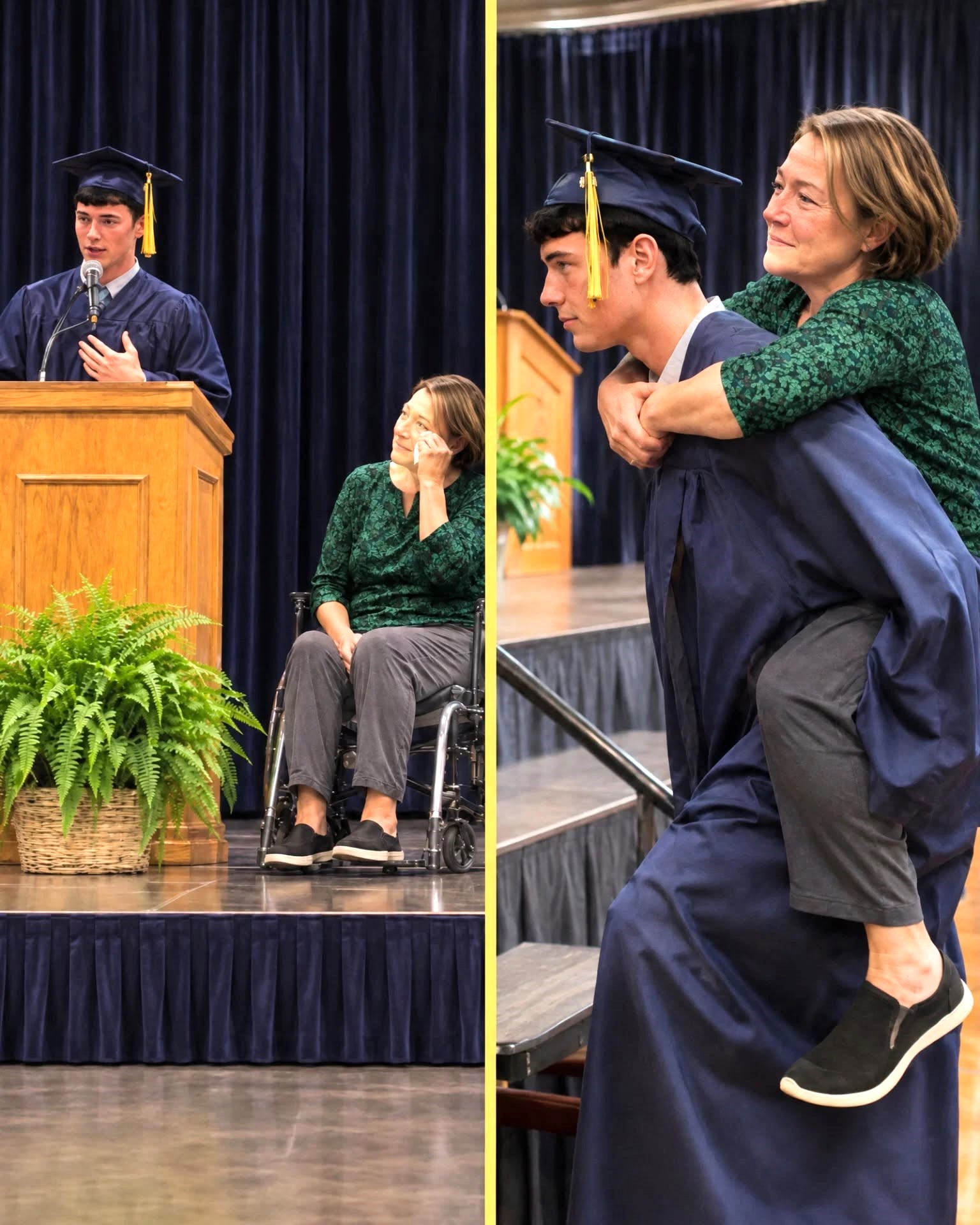
I thought my son’s high school graduation would be one of the proudest moments of my life.
But when he suddenly lifted me out of my wheelchair, carried me onto the stage, and announced that he’d been keeping a secret, I realized how much he’d been struggling without telling me.
“Mom, there’s something I’ve been hiding from you,” Caleb said into the microphone.
My heart started racing.
Then he looked directly at me and admitted:
“I came dangerously close to not graduating.”
I couldn’t believe what I was hearing.
My son had always been a hardworking, responsible student. He’d spent years preparing for college, and I’d never imagined his graduation could have been in jeopardy.
But as he began explaining what had happened during his final year of school, I realized he’d been carrying a burden far heavier than I knew.
And when he revealed why he’d kept everything secret, I couldn’t stop crying.
PART 1 — THE SECRET MY SON REVEALED AT GRADUATION
I’m fifty-one years old, and I’ve relied on a wheelchair since Caleb was twelve.
A serious car accident changed our lives forever, leaving me paralyzed from the waist down.
I’ll never forget waking up in the hospital and hearing the doctors explain that I would never walk again.
But the physical challenges weren’t the only difficulties I faced.
My husband, Daniel, decided he couldn’t handle our new reality.
“This isn’t the life I wanted,” he told me. “I deserve something different.”
Shortly afterward, he walked away from our marriage.
I was devastated.
There were nights when I lay awake wondering how I would raise Caleb while learning to navigate life with a disability.
But my little boy gave me a reason to keep going.
I still remember him sitting beside my hospital bed, holding a paper airplane he’d made while waiting for the doctors.
He didn’t fully understand what had happened, but he knew his father wasn’t coming home.
The years that followed were difficult.
I had to relearn how to prepare meals, manage household chores, and handle everyday responsibilities from my wheelchair.
Eventually, I found a job working remotely with customer accounts.
The income wasn’t especially good, but it allowed me to support us without leaving home.
Money remained a constant concern.
Some months, I had to carefully decide which expenses could wait until my next paycheck.
When Caleb was younger, he occasionally asked why we couldn’t take vacations like his classmates.
I’d explain that we needed to be careful with money.
He would simply smile.
“That’s okay, Mom. We can have fun at home.”
Then we’d make popcorn, choose a movie, and enjoy the evening together.
I always believed Caleb understood that I was doing my best.
What I didn’t realize was how deeply our financial struggles had affected him.
By his final year of high school, Caleb had become an excellent student.
He earned strong grades, took his education seriously, and had been talking about attending college for years.
He also worked part-time at a nearby grocery store.
Initially, he only worked a few afternoons and weekends.
I wasn’t particularly happy about it because I wanted him to concentrate on his studies.
But he insisted that he enjoyed earning his own money.
“Mom, I can’t expect you to pay for everything forever,” he told me.
I reminded him that supporting him was my responsibility.
He smiled and quickly changed the subject.
Looking back, I wish I’d paid closer attention.
Around October, Caleb began arriving home much later than usual.
Some evenings, he didn’t walk through the door until after nine.
He’d warm up leftovers, sit at the kitchen table, and spend hours completing school assignments.
Occasionally, I’d wake up in the middle of the night and hear him still working.
One morning, I found him asleep with his head resting on an open textbook.
“Caleb, sweetheart, you can’t keep exhausting yourself like this.”
He sat up quickly.
“I’m fine, Mom. I was just studying.”
I told him he needed more rest.
He explained that college applications, scholarship essays, and school assignments were keeping him busy.
It sounded reasonable.
I offered to help him organize everything, but he insisted he had it under control.
I even suggested that he take a break from his job until graduation.
He refused.
“Please don’t worry, Mom. My grades are fine.”
Because he’d always been responsible about school, I believed him.
But over the following months, I noticed troubling changes.
He was losing weight.
He rarely spent time with his friends.
Some mornings, he looked so exhausted that I wondered whether he was becoming ill.
Whenever I asked, he brushed off my concerns.
I had no idea how much he was hiding.
A few weeks before graduation, I received an email from his English teacher, Grace.
She wanted to speak with me about Caleb.
I immediately feared something was wrong.
When I called, she reassured me that he was on track to graduate and that several teachers wanted to recognize his extraordinary determination.
However, she also mentioned that he’d experienced an unusually demanding year.
“Please make sure he’s getting enough rest,” she told me.
I explained that I’d been encouraging him to sleep more.
Her tone sounded unusually serious, but she didn’t share any additional details.
I assumed everything was fine.
I was wrong.
Graduation morning arrived with beautiful sunshine.
I wore my favorite blue blouse decorated with tiny white flowers.
When Caleb entered my bedroom wearing his graduation gown, I almost burst into tears.
“How do I look, Mom?”
“Like someone who’s about to make me incredibly proud.”
He laughed.
“I think I’ve already done that.”
We arrived at the school early, and I found a place near the stage.
Caleb joined his classmates, occasionally whispering to his friends Ethan and Marcus.
I noticed that he seemed nervous, but I assumed he was simply excited.
When the ceremony began, I couldn’t stop taking photographs.
Then the principal started announcing the graduates’ names.
When I heard Caleb’s name, I immediately raised my phone to record.
He stood up and began walking toward the stage.
But halfway there, he suddenly changed direction.
Instead of continuing toward the principal, he came straight to me.
“Caleb? What are you doing?”
He knelt beside my wheelchair.
“Mom, I want you up there with me.”
I stared at him.
“Sweetheart, this is your moment. How am I supposed to get up there?”
He smiled.
“Then we’ll share it.”
Before I could protest, he carefully helped me onto his back.
Caleb had carried me short distances before, but never in front of an entire auditorium.
I wrapped my arms around his shoulders as he carefully carried me up the stage steps.
Ethan and Marcus followed with my wheelchair.
Once we reached the microphone, Caleb gently helped me back into my chair.
The audience began applauding.
I couldn’t decide whether to laugh or cry.
Principal Robert handed Caleb his diploma and stepped aside.
Then someone passed my son a microphone.
“Excuse me, everyone. There’s something important I’d like to share.”
The auditorium gradually fell silent.
Caleb turned toward me.
“Mom, I’ve been keeping something from you. And I think it’s time you heard the truth.”
My smile faded.
“What happened?” I whispered.
He took a deep breath.
“Mom, I almost didn’t graduate.”
I stared at him in disbelief.
“What?”
He turned toward the audience and began explaining.
Everyone assumed he’d experienced a typical senior year: attending classes, working part-time, applying to universities, and preparing for graduation.
But behind the scenes, things had been very different.
The previous summer, he’d started accepting additional shifts at the grocery store.
At first, it was only a few extra hours each week.
Eventually, he began working several evenings, sometimes staying until closing time.
“Caleb, you told me you only worked weekends,” I interrupted.
He lowered his head.
“I know, Mom. I wasn’t completely honest.”
After finishing work, he’d return home and spend hours studying.
Some nights, he barely slept.
Eventually, the exhaustion began affecting his school performance.
He fell asleep during lessons, missed assignment deadlines, and watched his grades decline.
His English teacher, Grace, noticed the problem first.
She warned him that he was putting his education at risk.
His mathematics teacher, Thomas, expressed similar concerns.
But Caleb continued pushing himself.
By the time his teachers realized how serious the situation had become, he’d fallen behind in two subjects and was dangerously close to missing graduation requirements.
They helped him develop a plan to complete his assignments and recover his grades.
“I thought I could manage everything,” Caleb admitted. “But I was wrong.”
Tears filled my eyes.
I wanted to ask why he hadn’t told me.
Why he’d allowed himself to become so exhausted.
But then he said something that made me fall silent.
“Mom, do you remember the conversation you had with Aunt Linda last spring?”
I frowned.
My younger sister had visited for coffee, and we’d discussed the cost of Caleb’s college education.
I’d told her how worried I was about tuition, accommodation, textbooks, and other expenses.
I’d also admitted how exhausted I felt from working so much.
I thought Caleb had been upstairs doing homework.
Apparently, he’d heard every word.
“You said you wished you could slow down one day,” he continued. “But you couldn’t because you still had to pay for my education.”
I covered my mouth.
“Caleb…”
“I heard you, Mom. And I decided I wanted to help.”
His voice began trembling.
He explained that the extra money he’d earned wasn’t intended for clothes, electronics, or a car.
He’d been saving it for me.
His hope was that once he left for college, I could reduce my working hours and finally have some financial breathing room.
“I know it won’t be enough for you to retire,” he said. “But I wanted you to have a little less to worry about.”
I couldn’t speak.
For years, I’d worried that my accident had deprived Caleb of opportunities other children enjoyed.
Now I was discovering that he’d nearly sacrificed his own health trying to make my life easier.
Then he reached into his graduation gown.
“But there’s something else.”
He unfolded a piece of paper.
“I knew my savings wouldn’t be enough to cover college. So I started applying for scholarships.”
He paused.
“Actually, I applied to fifty colleges.”
I blinked.
“Fifty?”
He nodded.
For months, he’d been researching universities, writing application essays, collecting recommendation letters, and tracking deadlines.
Some colleges rejected him.
Others offered financial assistance that still left substantial costs.
But he kept trying.
Grace and Thomas eventually helped him organize his applications while encouraging him to reduce his working hours and concentrate on graduating.
Caleb turned toward them.
“Thank you for helping me when I didn’t know how to ask for help.”
Grace wiped tears from her eyes.
Then he faced me again.
“Mom, I wanted to tell you when I knew everything would work out.”
He raised the paper.
“Of the fifty colleges I applied to, twenty offered me full scholarships.”
The auditorium went quiet.
I stared at him.
“Twenty?”
He smiled through his tears.
“Twenty, Mom. They cover tuition, housing, meals, and the major expenses.”
I shook my head.
“Are you serious?”
“Completely.”
He explained that he still needed to make his final decision among the schools whose offers remained available.
But whichever one he chose, I wouldn’t have to shoulder the enormous financial burden I’d been fearing.
People began applauding.
I started crying so hard that I could barely see him.
Caleb knelt beside my wheelchair.
“Mom, do you remember how you always came to my school events, even when getting there wasn’t easy?”
I nodded.
“And how you worked late but still made time to help with my homework?”
“Of course, sweetheart.”
“You did all of that for me.”
His voice cracked.
“And I know I made mistakes. I should’ve told you how exhausted I was. I shouldn’t have risked my grades.”
He squeezed my hand.
“But I wanted you to understand that everything you sacrificed mattered.”
Then he stood and addressed the audience.
“My mom raised me alone after my father left. She had to learn how to do almost everything differently after her accident, but she never stopped taking care of me.”
His eyes filled with tears.
“She made sure I had food, clothes, school supplies, and someone cheering for me.”
He paused.
“People congratulate me for working hard. But my mom worked hard for years before I was even old enough to understand what sacrifice meant.”
Then he turned back toward me.
“Mom, you spent your life making sure I had a future. Now I want you to enjoy yours, too.”
He smiled.
“This isn’t just my graduation. It’s ours.”
Then he said something I’ll remember for the rest of my life.
“We made it, Mom. Now we both have a chance to build the lives we’ve dreamed about.”
For a moment, the auditorium was silent.
Then Grace stood.
Thomas followed.
Principal Robert wiped his eyes and joined them.
Within seconds, the entire audience was standing, applauding and cheering.
Caleb put down the microphone and wrapped his arms around me.
“I’m so proud of you,” I whispered.
He hugged me tighter.
“I’m proud of you too, Mom.”
After the ceremony, his teachers approached us.
Grace explained that Caleb was one of the most determined students she’d ever taught.
But she also admitted how worried they’d been about his health and exhaustion.
I thanked her for helping him find his way back.
That evening, Caleb and I sat at our kitchen table with his scholarship letters spread out between us.
There really were twenty offers.
We carefully reviewed the tuition coverage, housing arrangements, meal plans, and other expenses.
Then I closed the folder.
“Caleb, I’m more grateful than you can imagine.”
He smiled.
“But I need you to understand something.”
His expression became serious.
“I never wanted you to make yourself sick trying to take care of me.”
He looked down.
“I know.”
I reached across the table and held his hand.
“Your responsibility was to be my son. To study, spend time with friends, and discover what you want from life. You were never supposed to take responsibility for mine.”
His eyes filled with tears.
“I just hated seeing you so tired.”
“I know, sweetheart. And I love you for caring.”
I squeezed his hand.
“But I’m still your mother. I’m capable of making decisions about my own life. If I need help, I’ll ask. And if you’re struggling, you need to tell me.”
He nodded.
“I’m sorry I kept everything secret.”
“I forgive you. But no more hiding things like this.”
“Deal.”
We spent the next hour comparing universities.
When he hesitated over one particularly good college because it was far from home, I asked whether he genuinely wanted to attend.
“A lot,” he admitted.
“Then don’t reject it because you’re worried about leaving me.”
“Are you sure?”
“Absolutely.”
Life hasn’t magically become easy.
I’m still working remotely, and we still have to be careful with money.
But knowing that Caleb can pursue higher education without overwhelming debt has changed our future.
Last weekend, we went out for breakfast.
As we were leaving, Caleb instinctively reached for the handles of my wheelchair.
“I’ve got you, Mom.”
I smiled and gently stopped him.
“I can manage, sweetheart.”
He stepped beside me.
“I know.”
That small exchange meant more to me than he probably realized.
My son had carried me onto the graduation stage because I couldn’t walk.
But the most meaningful gift he gave me wasn’t the money he’d saved or even the scholarships he’d earned.
It was knowing that after everything we’d been through, he had a future filled with possibilities.
And so did I.
But I’ve often wondered: If your child secretly pushed himself to exhaustion and almost lost his chance to graduate because he wanted to make your life easier, would you feel proud of his devotion—or heartbroken that he hadn’t trusted you enough to share the burden?