I took the letter out of the drawer the next morning.
The paper had softened where I had folded it. I read the first sentence again, then laid it beside my phone.
I had written her name at the top.
That was all I had managed without stopping.
For years, I had imagined what I would say if somebody found her. I had rehearsed apologies while washing dishes, driving to work, and standing in the grocery store with a carton of milk in my hand.
None of those rehearsals had prepared me for a photograph.
I picked up the phone and opened it.
There she was.
The woman in the picture had my daughter's eyes. I could see that even though the photograph was small, even though sixteen years had passed, even though I had no way to know what the rest of her face looked like when she laughed.
I enlarged the picture with two fingers.
The image blurred.
I returned it to its original size.
I wanted to study every detail, but I was afraid that staring too long would turn the photograph into something I had imagined.
So I put the phone down.
Then I picked it up again.
The woman who had shown me the picture had said it was taken three weeks earlier. That detail kept moving through my mind like a clock I couldn't turn off.
Three weeks.
My daughter had been somewhere in the world three weeks before I saw that bag on the boardwalk.
She had been eating meals, walking through ordinary places, perhaps buying something at a shop or waiting for a bus. She had been alive in a world that had continued without telling me.
I sat at the kitchen table until the light moved across the floor.
I had spent years thinking about the day she disappeared as if the whole world had stopped there.
It hadn't.
She had kept living somewhere beyond the reach of my questions.
I didn't know whether she had been happy.
I didn't know whether she had been afraid.
I didn't know if she ever thought about the house she left at seventeen.
The only thing I knew was that she had been seen recently, and a stranger had somehow connected that sighting to the bag I had made with my own hands.
I called the woman.
She answered after the fourth ring.
"Hello?"
"It's me. From Ocean City."
"I know."
Her voice sounded tired, and I wondered whether she had slept any better than I had.
"I looked at the picture again," I said.
There was a pause.
"I thought you might."
"Can I ask you something?"
"Of course."
"Are you certain about when it was taken?"
"Yes. Three weeks ago."
I closed my eyes.
I had wanted confirmation, but hearing it again hurt in a way the first telling hadn't.
"Did she know you took it?"
"Yes."
I opened my eyes.
That answer mattered. I didn't yet know why, but it mattered that my daughter had known about the picture.
"Did she know you had the bag?"
The woman hesitated.
"She knew I had it."
I pressed my palm flat against the table.
"Did she say anything about it?"
"Not much."
I waited, but she didn't continue.
I wanted to ask what not much meant. I wanted to ask whether my daughter's face had changed when she saw the bag, whether she had touched the handle, whether she had asked where it came from.
Instead, I took a breath.
"I don't want to pressure you," I said. "I know you don't owe me anything."
"I understand."
"But if you remember something else, even something small, please tell me."
"I will."
I believed that she meant it.
I didn't know how much she could tell me, and I had learned what happened when hope ran ahead of facts.
Before we ended the call, I asked whether I could contact her again.
"Yes," she said. "You can."
I thanked her.
Afterward, I wrote down what I knew on a clean sheet of paper.
The date my daughter disappeared.
The date I had seen the bag.
The date the photograph had been taken.
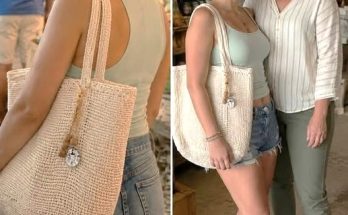
I wrote the description of the bag beneath those dates: cream-colored yarn, uneven handle, one misplaced stitch near the bottom, small brass keychain on the strap.
I didn't write what I hoped those facts meant.
I didn't write what I feared they meant.
I left a blank space beneath them.
For sixteen years, I had filled empty spaces with possibilities. This time, I wanted to leave room for the truth.
I took the old photographs from their envelope and spread them across the table.
There was one of my daughter at six, holding the brass keychain in both hands. She had wanted it attached to everything she owned, and I had finally clipped it to the bag when she was old enough to carry it herself.
There was another photograph from a summer afternoon when she was twelve.
She was squinting into the sun, one hand raised to shield her face.
At seventeen, she had stood in the hallway wearing the green tank top we'd argued about.
I had not taken a photograph of her that day.
I had no picture of her leaving.
I had only the memory of the door opening, the quiet sound of her footsteps, and my own voice telling her to go.
I returned the photographs to the envelope.
Then I put the letter back in the drawer.
I wasn't ready to send it.
I wasn't even sure where I would send it if I could.
But I had stopped treating the letter as a way to bring the past back. It was simply something I needed to say, whether or not she ever read it.
That evening, I went into the bathroom.
Her toothbrush was no longer there. I had thrown it away years earlier, after finally admitting that keeping it wouldn't bring her home.
The cup where it had stood was still beside the sink.
I picked it up and washed it.
I don't know why I had waited so long to do that.
Maybe I had believed that changing one small thing meant accepting something I wasn't ready to accept.
I dried the cup and placed it back on the shelf.
Nothing dramatic happened.
The bathroom looked exactly the same.
For the first time, that felt like a relief.
The next day, I returned to the photograph.
I looked at my daughter's face without enlarging it.
I tried to imagine her at seventeen and then at thirty-three, not as two different people but as the same person who had lived through all the years between them.
I couldn't fill in those years.
I couldn't pretend that I knew what they had contained.
But I could stop insisting that the girl who left was the only version of my daughter that mattered.
She had become someone I didn't know.
And if I ever got the chance to meet her, I would have to let her introduce herself.
Click here to continue reading: PART 10: The Hardest Question Was Not Where She Had Gone, but Whether She Would Ever Want to Hear My Voice Again
The Last Thing I Said to My Seventeen-Year-Old Daughter Was Something I Would Spend the Rest of My Life Wishing I Could Take Back
Part 9 of 12