
I stood still long enough for several people to pass between us.
The woman kept walking.
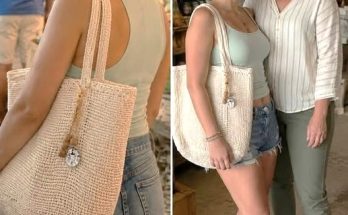
The cream-colored bag rested against her side, its uneven handle pulled slightly out of shape by the weight inside it.
I could see the crooked stitch whenever the bag swung forward.
It was such a small thing.
Most people would never have noticed it.
I had spent years wishing I could go back and fix it.
Now I was afraid to look away.
The brass keychain moved against the strap as she walked.
I knew its little shape.
I knew the way it hung.
I knew it because my daughter had carried it for eleven years before she disappeared.
My daughter.
I hadn't seen her in sixteen years.
I didn't know whether she was alive.
I didn't know whether she was safe.
I didn't know whether she had thought of me at all during the years we had been apart.
But I knew that bag.
I began following the woman.
At first, I tried to keep a little distance.
I was afraid she would turn a corner and disappear into the crowd before I could speak to her.
I was also afraid that if I approached her, she would tell me I was mistaken.
Both possibilities seemed impossible to bear.
She walked past a group of people gathered near the boardwalk railing.
The afternoon sun fell across her shoulders.
Her skin was reddened from the sun, and her dark hair rested against the back of her neck.
She looked to be around forty.
I tried to study her face from behind, though there was little I could learn that way.
She was a stranger.
I had never seen her before.
Yet the bag on her shoulder had belonged to the person I had spent half my life trying to find.
I hurried to catch up.
My knees felt weak.
I reached a parked car and put one hand against it to steady myself.
For a second, I considered letting the woman go.
What if the bag was not the one I had made?
What if another person had knitted something similar?
What if the keychain only looked like the one my daughter owned?
I had spent years learning not to trust every possibility.
I had learned how easily hope could make an ordinary thing look extraordinary.
But I couldn't ignore the stitch.
I couldn't ignore the keychain.
I pushed away from the car and caught up with her.
Then I reached out and took hold of her arm.
She jerked away.
“What's going on?”
Her voice was sharp with surprise.
I released her immediately, but I didn't step back.
I couldn't.
I pointed toward the bag.
“Where did you get that?”
She looked down at it, then back at me.
“What are you talking about?”
“The bag.”
I heard how strange I sounded.
My mouth was dry, and I couldn't seem to get enough air.
“That bag you're carrying.”
She drew it closer to her side.
“Why?”
I tried to answer.
The words came out unevenly.
“I made it.”
She stared at me.
For a moment, neither of us said anything.
People moved around us, some walking past without a glance, others looking briefly at the two women standing in the middle of the boardwalk.
I forced myself to continue.
“I knitted that bag for my daughter.”
The woman's expression changed.
It was a small change at first.
Her eyebrows lifted slightly.
Then she looked at the bag again, as though she were seeing something different in it.
I pointed toward the strap.
“And the little brass charm belonged to her, too.”
She touched the keychain with her fingers.
It made a faint metallic sound.
I had heard that sound in my house a thousand times.
I had heard it when my daughter came down the stairs.
I had heard it when she reached into the bag for something.
I had heard it on July 12, 2008, when she turned toward the front door and left me standing behind her.
The woman looked at me.
All the color seemed to leave her face.
“Your daughter?”
“Yes.”
I said my daughter's name.
I had said it so many times over the years that the sound should have been ordinary.
It wasn't.
The name came out of my mouth like something I had been holding inside for sixteen years.
The woman stepped backward.
I saw the recognition before she said anything.
She knew the name.
Or at least, she knew something connected to it.
My heart began beating so hard that I felt it in my throat.
“Where did you get the bag?”
She gripped the strap.
“I bought it.”
“From whom?”
She looked away.
I followed her gaze, expecting to see someone approaching us.
There was only the crowd.
People carrying drinks.
People walking toward the beach.
A family trying to keep a child from wandering too close to the edge of the boardwalk.
Ordinary life moving past us while I stood there trying to understand why a stranger was carrying the last object I had seen on my daughter's shoulder.
“Please,” I said.
My voice cracked on the word.
The woman looked at me again.
I tried to keep my hands still.
“My daughter went missing when she was seventeen. She had that bag with her when she left.”
I didn't tell her about the argument yet.
I couldn't bring myself to explain that the last thing I had said to my daughter was a cruel challenge I had intended to take back later.
I couldn't explain that I had spent years wondering whether those words had mattered.
I only repeated the date.
“July 12, 2008.”
The woman stopped moving.
Her fingers tightened around the strap.
For several seconds, she seemed unable to look at me.
Then she raised one hand to her mouth.
“What year did you say?”
“Two thousand eight.”
Her eyes widened.
“Oh my God.”
She covered her mouth more firmly.
I watched her, waiting for an explanation that didn't come.
My legs felt unsteady.
I put a hand against the parked car beside me.
“What is it?”
She glanced toward the people walking nearby.
Then she looked back at me.
Her face had changed from surprise to something more complicated.
Fear, perhaps.
Or disbelief.
I couldn't tell.
“Please tell me what's happening,” I said.
She reached for my hand.
Her fingers were cold despite the warm afternoon.
“We shouldn't talk here.”
I looked around.
The boardwalk was crowded, but nothing about it seemed threatening.
People were laughing and talking.
A couple passed with their arms linked.
Someone called to a child farther down the walkway.
“Why not?” I asked.
She didn't answer.
Instead, she took out her phone.
Her hands were shaking so badly that she had trouble unlocking it.
I watched her scroll through a collection of photographs.
She moved past one image, then another.
I wanted to ask what she was looking for.
I wanted to demand that she stop making me wait.
But something in her expression held me still.
She was searching for something specific.
When she found it, she stopped scrolling.
Then she turned the phone toward me.
“Look at this.”
I stared at the screen.
At first, I couldn't understand what I was seeing.
The image showed a woman.
Her hair was different from the hair I remembered.
Her face had changed.
There were lines near her eyes, and the years had altered the shape of her features in ways I had never had the chance to witness.
She looked older than the girl who had walked away from my house.
Of course she did.
Sixteen years had passed.
I had spent those years imagining her as seventeen because that was the last age at which I had known her.
The woman in the photograph was no longer a teenager.
But her eyes—
I knew those eyes.
I knew the way they looked when she was trying not to show what she felt.
I knew the shape of her face when she was concentrating.
I knew the expression around her mouth.
My hand rose toward the phone.
I didn't touch the screen.
I was afraid that if I moved too quickly, the image might disappear.
“Is that her?” the woman asked.
I tried to answer.
Nothing came out.
I swallowed and tried again.
“Yes.”
The word was barely audible.
I looked closer.
There was no mistaking her.
I had spent sixteen years searching through descriptions, reports, rumors, and photographs that turned out to mean nothing.
I had looked at strangers and tried to find my daughter in their faces.
I had been wrong so many times that I had become afraid of being right.
But I wasn't wrong this time.
I was looking at my child.
Older.
Changed.
Alive in a photograph.
I felt my breath catch.
Then I looked at the woman holding the phone.
“Where did you get this picture?”
Her eyes filled with tears.
She looked down at the screen again before answering.
She told me when she had taken it.
Three weeks earlier.
Three weeks.
I repeated the words silently, trying to make them fit inside my mind.
The photograph was not from some distant year.
It wasn't an old picture someone had found in a drawer.
It had been taken only three weeks before I met this stranger on the boardwalk.
My daughter had been alive three weeks earlier.
I looked at the cream-colored bag hanging from the woman's shoulder.
The crooked handle.
The misplaced stitch.
The brass keychain that had survived all those years.
Then I looked at my daughter's face on the phone.
For sixteen years, I had asked the world to give me one answer.
Now I had proof that she had lived beyond the day she disappeared.
And I still didn't know where she was.
Click here to continue reading: PART 5: Three Weeks Earlier, My Daughter Had Been Standing Somewhere in the World, and I Needed to Know Why This Woman Had Found Her
The Last Thing I Said to My Seventeen-Year-Old Daughter Was Something I Would Spend the Rest of My Life Wishing I Could Take Back
Part 4 of 12

One Comment on “PART 4 – I Followed the Woman Through the Ocean City Crowd Until She Looked at My Face and Realized the Bag Was Not Just a Bag”