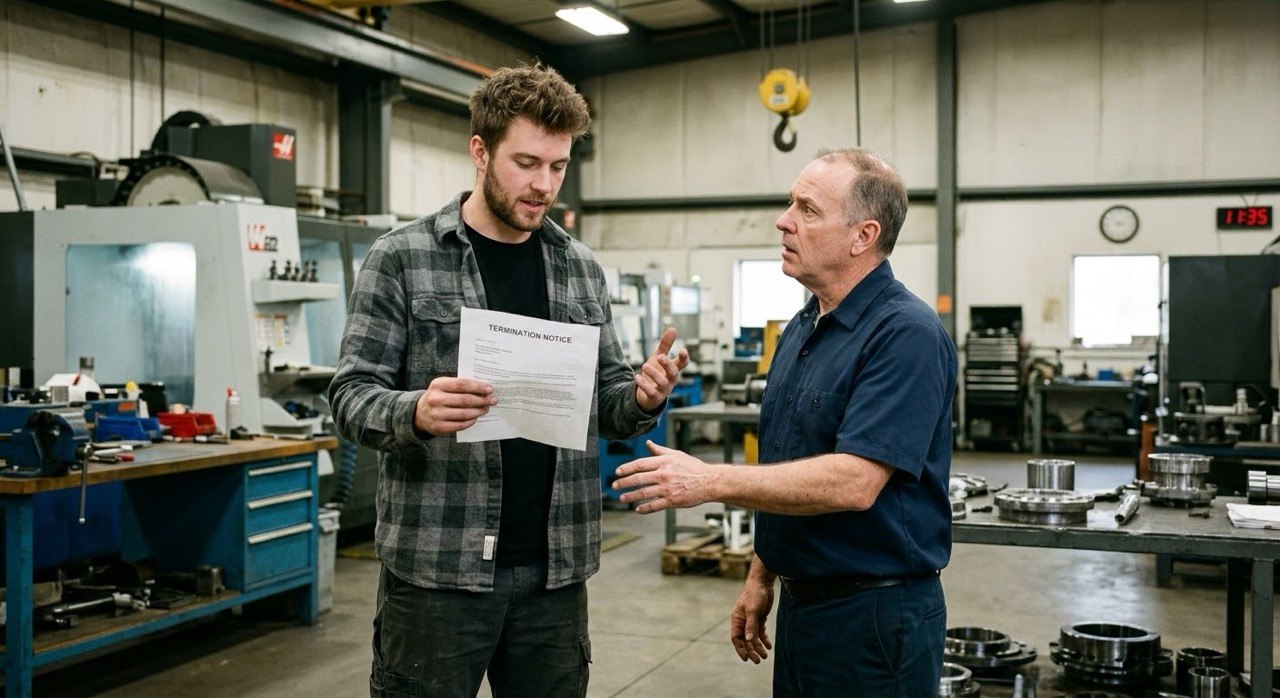
At 11:07 on a Thursday morning, Richard Cole watched me sign the last page of my termination packet and told me my position at Horizon Precision no longer existed. At 11:12, while I was carrying eleven years of my life toward the parking lot in a cardboard box, he came after me and said the machine in Bay Three had gone down.
I stopped with one hand on the lobby door.
For several seconds, neither of us spoke. The security turnstiles clicked behind Richard as employees moved through them, pretending not to look at us. My framed photograph of my father leaned against a coffee mug inside the box. Beside it were two engineering notebooks, a screwdriver set Walter had given me years ago, and the little brass nameplate that had sat outside my cubicle: ETHAN PARKER — SENIOR CONTROLS ENGINEER.
Richard pointed toward the production floor. “The Meridian machine is faulting. We need you back there.”
I looked at the temporary red mark where security had removed my badge from its clip.
“You just fired me.”
“I’m aware of that.”
“Then you don’t need me.”
His jaw tightened. Richard had been Horizon’s operations director for four years, long enough to develop the habit of treating disagreement as a delay rather than an answer. He lowered his voice. “This isn’t the time, Ethan.”
That almost made me laugh.
Twenty minutes earlier, Claire Donnelly from HR had sat across from me while Richard explained that Horizon was restructuring. My performance wasn’t the issue. My conduct wasn’t the issue. My eleven years of service weren’t the issue. The company was eliminating redundancies, and apparently I had become one.
They had disabled my email before Claire finished speaking.
Security had collected my badge.
Richard had given me fifteen minutes to clear my desk.
Now the same man wanted me to walk back through the door as though none of that had happened.
“What alarm?” I asked.
His expression relaxed slightly. He mistook the question for surrender.
“Axis instability. Then servo overload. Walter reset it twice. It comes back as soon as they start the qualification sequence.”
That changed something, though not in the way Richard expected.
Bay Three contained Horizon’s newest machining center, a German-built five-axis system that had cost a little over two million dollars before installation, tooling, and commissioning. For six weeks, I had spent more time with that machine than with my own furniture. I knew which cables had arrived mislabeled, which sensor had required a revised bracket, which firmware revision the manufacturer had warned us not to install, and which servo parameters we had adjusted during final calibration.
More importantly, the machine was supposed to run Meridian Industries’ qualification parts that afternoon.
If Horizon passed, Meridian’s production program could transform the company.
If Horizon failed badly enough, Meridian could walk.
Richard glanced at my box. “Put that down and come with me.”
“No.”
He blinked.
It was such a small word, but I don’t think he had expected to hear it.
“Ethan.”
“My employment ended five minutes ago.”
“We need ten minutes.”
“You needed me ten minutes ago too.”
His face hardened. “This is exactly the kind of attitude that makes these situations difficult.”
I shifted the cardboard box against my hip. “Which situation? Firing me or discovering afterward that I knew something you still needed?”
A security guard near the desk suddenly became fascinated by his monitor.
Richard stepped closer. “You commissioned that machine.”
“I helped commission it.”
“You know the controls better than anyone here.”
“Probably.”
“Then act professionally.”
That word did it.
Professional.
For eleven years, professional had meant answering calls during dinner because a line had stopped. It had meant driving through snow at two in the morning because a spindle encoder was dropping counts. It had meant training junior engineers who later received titles I had been told weren’t available. It had meant fixing emergencies without asking whether they belonged to my job description.
Apparently professionalism lasted longer than employment.
I set the box carefully on the floor.
Richard nodded toward the production doors.
I took out my phone instead.
“What are you doing?”
“Starting a company.”
He stared at me.
I opened the state business-registration website. I had already done most of the preliminary work months earlier, during one of those nights when frustration had outweighed exhaustion. The name had been reserved but unused.
Parker Precision Services.
Richard gave an impatient breath. “Ethan, stop playing games.”
“I’m not.”
“You cannot seriously expect us to stand here while you—”
“You asked me to repair equipment after terminating my employment. That makes this contract work.”
“You don’t have a contract.”
“Correct.”
I finished the registration, then opened the simple invoice template I had saved months earlier.
Richard watched my thumbs move.
“What exactly are you doing?”
“Preparing terms.”
His eyes narrowed. “For ten minutes of work?”
“Maybe ten minutes. Maybe ten hours. You don’t know what failed.”
“That’s why I’m asking you.”
“Exactly.”
I entered Horizon Precision as the client.
Emergency diagnostic service.
One-hour minimum.
Richard looked over my shoulder until the number appeared.
Then he stared at me.
“Six hundred thousand dollars?”
“Per emergency diagnostic hour.”
For a moment, the factory seemed quieter.
Richard’s face went through disbelief, anger, and something close to amusement.
“You’re insane.”
“Then don’t hire me.”
He laughed once. “You made seventy-two thousand dollars a year this morning.”
“That was my employee rate.”
“You expect me to pay eight years of your salary for an hour?”
“No. I expect you to decide what one hour is worth when Meridian’s qualification depends on it.”
His amusement vanished.
That was the part neither of us needed to say aloud.
The machine wasn’t worth six hundred thousand dollars for an hour.
The contract might be.
Richard pulled out his phone. “I’m calling legal.”
“Good.”
“And finance.”
“Even better.”
“They’ll tell you to leave.”
“Then I’ll leave.”
I picked up my box.
“Wait.”
I stopped again.
Richard turned away and made three calls. The first lasted less than a minute. The second involved more arguing. During the third, he walked nearly twenty feet from me, although the lobby acoustics still carried fragments of his voice.
Meridian.
Qualification.
No internal resource.
Critical.
Emergency authority.
I looked down at the photograph in my box.
My father, Michael Parker, stood beside me in front of an old milling machine. I had been fourteen. He had one grease-darkened hand resting on my shoulder and the faint, reluctant smile he wore whenever someone pointed a camera at him.
He had died two years later.
I had kept that photograph on every desk I had ever occupied.
Richard returned.
“Finance wants a proper invoice.”
“I have one.”
“Legal wants a scope.”
“Diagnostics only.”
“What does that mean?”
“It means I identify the failure. Repair is separate.”
His eyes widened. “You’re charging six hundred thousand dollars and that doesn’t include fixing it?”
“Correct.”
“That is extortion.”
“No. You can say no.”
His phone rang.
He answered, listened, and looked at me.
“Fine.”
“Fine what?”
“Approved.”
I didn’t move.
Richard’s irritation sharpened. “What now?”
“Written approval.”
He typed an email.
My Horizon account was dead, so I gave him the address I had created for Parker Precision Services. Thirty seconds later, the message arrived.
Emergency diagnostic engagement approved. One-hour minimum. Six hundred thousand dollars.
I read it twice.
“Payment first.”
Richard stared at me as though he might actually lose control.
“Ethan.”
“You fired me without notice. I’m not extending Horizon credit five minutes later.”
“We are a company with hundreds of employees.”
“And I’m a company with one.”
His mouth compressed into a line.
Another call.
Another argument.
Finance sent confirmation eleven minutes later.
I looked at the transaction notice for several seconds.
Six hundred thousand dollars.
That morning, I had worried about how many months I could cover my mortgage without a paycheck.
Now my new company had more revenue than I had earned during years at Horizon.
The absurdity should have felt satisfying.
It didn’t.
Something about the timing bothered me.
Richard had fired me at 11:07.
The machine had failed at approximately 11:12.
Five minutes was too little time for anyone to discover I was indispensable after all.
It was almost enough time to make me wonder whether someone had expected the failure.
Richard held out a visitor badge. “Can we go?”
I clipped it to my shirt.
The word CONTRACTOR was printed across the bottom.
For eleven years, I had walked through those doors without thinking about the badge on my belt.
This time the turnstile opened differently.
Or maybe I did.
The production floor smelled of coolant, warm aluminum, and hydraulic oil. Machines hummed behind transparent guarding. Forklifts moved slowly between painted lanes. People looked up as Richard and I passed.
Some had seen me leave.
Now they saw me returning beside the man who had fired me.
Walter Briggs met us at Bay Three. He was fifty-six, broad-shouldered, permanently unimpressed, and capable of diagnosing a failing bearing by putting two fingers against a housing.
His eyebrows rose when he saw my badge.
“Thought you left.”
“I did.”
Walter looked at Richard.
Then back at me.
“You come back because you forgot something?”
“Apparently Horizon did.”
Walter’s mouth twitched.
Richard ignored him. “Show Ethan the alarms.”
Mason Lee stood beside the controller. At twenty-seven, he was one of the younger engineers I had trained. He looked uncomfortable enough to apologize for something he hadn’t done.
“Sorry,” he said quietly.
“For what?”
He glanced at Richard.
I understood.
“Not your decision.”
The machine sat motionless behind its safety glass. A half-finished aluminum test block remained clamped to the table. The spindle had stopped several inches above it.
I placed my folder on the workstation.
“Tell me exactly what happened.”
Walter answered. “Warmup was normal. We loaded the qualification program. First axis move sounded wrong.”
“What kind of wrong?”
“Chatter. Not mechanical.”
Mason nodded. “Position deviation jumped on axis three.”
“Then?”
“Servo warning. We stopped, checked lubrication, restarted.”
“Second attempt?”
“Worse.”
Richard interrupted. “Can you fix it?”
I ignored him.
“Any programs changed?”
“No,” Mason said.
“Tool offsets?”
“No.”
“Firmware?”
“No.”
“Maintenance?”
Walter shook his head.
I looked through the glass.
Something was wrong with the pattern.
Mechanical failures rarely arrived politely. A damaged bearing produced heat. A loose coupling produced backlash. A bad encoder left traces.
But an axis becoming unstable immediately after a successful commissioning cycle suggested something else.
I opened the alarm history.
Servo deviation.
Following error.
Axis synchronization warning.
Overcurrent.
I scrolled backward.
Yesterday’s history was clean.
This morning’s was clean until 11:12.
I opened the diagnostics page.
Richard leaned over my shoulder.
“How long?”
“I’ve been here four minutes.”
“We have Meridian people arriving this afternoon.”
“I know.”
“Then move.”
I turned around.
Yesterday, that tone would have worked.
Today, it didn’t.
“Stay behind the yellow line.”
He stared at me.
“What?”
“You’re inside my work area.”
Walter looked down, perhaps to hide his expression.
Richard stepped backward.
I returned to the controller.
Axis-three feedback looked normal while stationary.
I enabled a low-speed diagnostic move.
The motor began turning.
Almost immediately, the current climbed.
I stopped it.
Mason leaned closer. “Mechanical resistance?”
“No.”
“How can you tell?”
“The feedback is fighting the command.”
I opened the servo configuration.
My fingers stopped.
There it was.
Third-axis servo gain.
184.
I stared at the number long enough that Walter noticed.
“What?”
“That should be 122.”
Mason moved beside me. “You sure?”
“I entered it myself.”
Richard folded his arms. “Could have been changed during commissioning.”
“No.”
I opened the spindle compensation table.
Two values were wrong.
Then acceleration parameters.
Four more.
Not random.
Not corrupted.
Selected.
Someone had changed the machine in ways designed to let it start normally and become unstable under load.
I felt the excitement of solving the technical problem disappear.
This wasn’t a broken machine anymore.
I looked at the timestamp.
Then at Richard.
“What?”
he asked.
I turned the screen toward him.
“These parameters didn’t fail.”
His eyes moved across the values.
“What are you saying?”
“I’m saying somebody changed them.”
Walter went still.
Mason’s face tightened.
Richard’s reaction was different.
He didn’t ask who.
He didn’t ask how.
He didn’t even look surprised enough.
His first question was the one that made the hair rise along my arms.
“How quickly can you put them back?”
That was when I stopped thinking about the machine.
And started wondering whether my termination five minutes before its failure had been planned down to the minute.
PART 2 – The Wrong Numbers Inside Bay Three Were Too Precise to Be Accidental, and Richard Wanted Them Erased Before Anyone Looked Backward
I kept my hands away from the keyboard.
Richard stood on the opposite side of the yellow floor line, waiting for me to restore the parameters. Walter remained near the coolant tank. Mason watched the controller with the strained concentration of someone who had just realized the problem in front of him might have consequences far beyond production.
“Well?” Richard said.
“I can probably restore it.”
“Then do it.”
“No.”
His face tightened. “We paid you.”
“For diagnostics.”
“You found the problem.”
“I found altered configuration values. That isn’t the same thing.”
Richard stepped forward, remembered the yellow line, and stopped.
“What else is there to diagnose?”
“Who changed them. When they were changed. Whether anything else was touched.”
“That isn’t your job.”
I lifted the temporary contractor badge hanging from my shirt.
“My job is the scope you approved.”
I opened the invoice on my phone.
Emergency diagnostic service.
One hour.
Nothing about restoration.
Richard stared at it.
“You are unbelievable.”
“Maybe. But the numbers are still wrong.”
Walter cleared his throat.
“What makes you sure it wasn’t a commissioning error?”
I appreciated the question because Walter was asking about the machine rather than the politics.
I pointed to the servo gain.
“If somebody entered the wrong value by mistake, I’d expect one bad entry. Maybe a transposed digit. Maybe an imported parameter set from another axis.”
I opened the acceleration table.
“These are coordinated.”
Mason leaned closer.
I showed him how the altered acceleration values interacted with the higher servo gain.
“The controller tries to correct faster than the mechanical system can respond. Then compensation pushes against the correction. Under light movement, it looks acceptable.”
“Under load,” Mason said, “it starts oscillating.”
“Exactly.”
Walter’s expression darkened.
“So somebody knew what they were doing.”
“Enough to create a failure without producing an immediate hard fault.”
Richard gave an impatient shake of his head. “Or somebody made several mistakes.”
I looked at him.
“Several mistakes that complement each other?”
“People make mistakes.”
“They do.”
I opened another parameter group.
“Machines preserve them.”
That was when I decided not to change anything yet.
I took out my phone and began photographing the controller.
Richard reacted immediately.
“No pictures.”
I looked over my shoulder.
“Excuse me?”
“You cannot photograph equipment inside Horizon.”
“You hired an outside contractor to diagnose it.”
“You’re still subject to confidentiality requirements.”
“Show me the clause preventing a contractor from documenting equipment condition.”
“I’m not debating legal language with you.”
“Then call legal.”
His mouth tightened.
I photographed the machine serial number first.
Then the alarm history.
Then every altered parameter.
Date.
Time.
Control revision.
Walter picked up the printed alarm report and held it beside the controller so I could capture both together.
Richard watched.
With every photograph, he seemed less comfortable.
That bothered me.
If somebody had deliberately interfered with a two-million-dollar machine on the morning of Horizon’s most important qualification run, an operations director should have wanted evidence preserved.
Richard wanted the evidence overwritten.
I lowered the phone.
“Where’s Tyler?”
Mason looked at Walter.
Richard answered first.
“I don’t know.”
Tyler Brooks was a junior technical employee who had joined Horizon a little over a year earlier. He liked machinery more than he understood it and often volunteered for tasks beyond his training.
“Was he in Bay Three today?”
Richard’s eyes shifted.
Barely.
But I saw it.
“Tyler has maintenance responsibilities.”
Walter frowned.
“No, he doesn’t.”
Richard looked at him.
Walter didn’t back down.
“He helps sometimes. He doesn’t own maintenance.”
Richard turned back to me. “What does Tyler have to do with this?”
“I asked whether he was here.”
Mason swallowed.
“I saw him earlier.”
“What time?”
“Before lunch.”
“Doing what?”
Richard interrupted. “Ethan, focus on the machine.”
“I am.”
“No, you’re interrogating employees.”
“I’m asking who accessed equipment I’ve been paid to diagnose.”
Richard lowered his voice.
“You are not Horizon management anymore.”
“Correct.”
That sentence seemed to irritate him more than it irritated me.
Maybe because he intended it as a reminder of lost authority.
To me, it sounded like freedom.
I turned to Mason.
“Can you get IT?”
Richard answered before Mason could move.
“No.”
Nobody spoke.
I looked at him.
“Why not?”
“We don’t need them.”
“I want the controller access history.”
“The machine needs to run.”
“The access history may tell us why it doesn’t.”
Richard folded his arms.
“Meridian is expecting a qualification run tonight.”
“That’s an operations problem.”
“It becomes your problem if you don’t finish what we hired you to do.”
“No. My problem is destroying evidence while performing contracted work.”
Walter removed his gloves slowly.
Mason looked toward the aisle.
Richard’s voice became colder.
“There is no evidence.”
That sentence settled over Bay Three.
I studied him.
“How do you know?”
His expression changed by a fraction.
“I mean there’s no evidence of sabotage.”
“We haven’t checked.”
“You’re making this dramatic.”
“I’m being careful.”
“You’re wasting time.”
“Then cancel the engagement.”
He said nothing.
I nodded toward Mason.
“IT.”
Mason hesitated.
Richard said his name.
Just once.
“Mason.”
The young engineer stopped.
I understood immediately.
Mason had a mortgage. He had gotten married recently. He had spent years trying to move from technician work into engineering.
And he had watched Horizon remove me in nine minutes despite eleven years of experience.
Richard didn’t need to threaten him.
The example was standing beside the machine.
“It’s okay,” I told Mason.
I took out my phone.
“I’ll request IT myself.”
Richard laughed without humor. “You don’t have authority to order our employees around.”
“I’m not ordering anyone.”
“What would you call it?”
“Requesting information necessary to perform the service Horizon purchased.”
For several seconds, we stared at each other.
Then Richard walked away.
Before reaching the end of the bay, he already had his phone against his ear.
Walter waited until Richard was far enough away.
Then he came closer.
“There’s something I should tell you.”
“What?”
“Tyler was here.”
“When?”
“About ten-thirty.”
“Where?”
Walter pointed at the machine.
“Control cabinet.”
A pressure formed beneath my ribs.
“Open?”
“Yes.”
“What was he doing?”
“I don’t know. I was checking coolant pressure on Bay Four. Came back and saw him standing here.”
“At the controller?”
“Yeah.”
“Did you ask?”
Walter nodded.
“He said Richard told him to verify commissioning values.”
I looked across the floor.
Richard was still talking on his phone.
“Does Richard normally send Tyler to verify commissioning parameters?”
Walter gave me a look.
“Tyler once asked me which direction to turn an encoder coupling to tighten it.”
Despite everything, I almost smiled.
Then the implication returned.
Tyler could have entered numbers if someone handed them to him.
But selecting these numbers required more knowledge than Tyler possessed.
“Did you see him change anything?”
“No.”
“Did you tell anyone?”
“Mason.”
“When?”
“Before lunch.”
“Anyone else?”
Walter rubbed the side of his jaw.
“Claire came down looking for you not long afterward.”
“Claire from HR?”
“Yeah.”
“What time?”
“Ten-fifty, maybe a couple minutes later.”
My termination invitation had appeared at 10:52.
QUICK DISCUSSION.
No agenda.
No warning.
At 10:58, I had walked toward HR.
At 11:07, I was unemployed.
At 11:12, the machine failed.
The sequence arranged itself differently now.
I had assumed the timing was cruel.
I was beginning to suspect it was precise.
“Walter.”
“Yeah?”
“When did Tyler leave Bay Three?”
“Not sure.”
“Before I went upstairs?”
“I think so.”
“Did Richard talk to him?”
“I saw them together near Bay Two.”
“When?”
Walter thought.
“Ten-forty something.”
I looked at the altered values on the screen.
“Don’t touch anything.”
“I wasn’t planning to.”
Twenty minutes later, Nadia Patel from IT arrived carrying a laptop.
She had been at Horizon almost as long as I had. Nadia possessed two qualities that made her unusually valuable in corporate emergencies: she understood networks, and she had almost no patience for hierarchy.
Richard followed several steps behind her.
Nadia looked at my contractor badge.
“I heard you were fired.”
“Apparently.”
“And now you’re back.”
“Apparently.”
“That seems efficient.”
Walter coughed.
Richard didn’t react.
Nadia set down her laptop.
“What do you need?”
“Controller access logs. Parameter write events from eight this morning onward.”
Richard said, “We only need a quick check.”
Nadia glanced at him.
“Then why did you tell me not to export anything?”
Silence.
I turned toward Richard.
He looked at Nadia.
“I said a full export wasn’t necessary.”
“That isn’t what you said.”
“Nadia.”
She shrugged.
“I’m here now.”
She connected to the isolated machine network and began pulling the controller history.
Rows of events filled her screen.
Login sessions.
Maintenance commands.
Parameter access.
System resets.
She frowned.
“What?”
I asked.
“More write events than normal.”
“How many?”
She counted.
“Twenty-three.”
Walter muttered something under his breath.
“Show me.”
Richard moved closer.
“Before everybody starts interpreting raw logs—”
Nadia turned the screen toward us.
The first parameter change had occurred at 10:43:17.
My pulse slowed.
Not because I was calm.
Because suddenly every detail mattered.
10:43:17.
Six seconds later, another parameter changed.
Then another.
The sequence continued until shortly after 10:47.
I compared the log with my photographs.
Every altered value was there.
Every one.
I looked at Nadia.
“User account?”
She expanded the column.
Then stopped moving.
“What?”
Her eyes lifted toward me.
“That’s strange.”
“What is?”
She turned the laptop farther.
The username appeared in plain text.
EPARKER.
For several seconds, I simply stared.
My employee login.
My credentials.
Twenty-three parameter changes.
All attributed to me.
Walter spoke quietly.
“Ethan?”
“I wasn’t here.”
Richard answered immediately.
“The system says you were.”
I looked at him.
Something had changed in his voice.
The urgency was gone.
So was most of the irritation.
He sounded steadier now.
As though the conversation had finally reached the place he had been waiting for.
I turned back to Nadia.
“Where was the session initiated?”
She checked.
“Machine terminal.”
“Authentication method?”
“Network login plus badge verification.”
My mouth went dry.
“Badge?”
“Yes.”
Richard folded his arms.
“Well.”
I looked at him.
“Well what?”
“You’ve spent the last hour implying somebody sabotaged the machine. According to the records, your credentials changed it.”
“I didn’t.”
“Then explain how your login got used.”
“I don’t have to explain something I didn’t do.”
“You invoiced Horizon six hundred thousand dollars to diagnose a failure apparently created using your own account.”
There it was.
Clean.
Ready.
Almost rehearsed.
I looked at Richard for several seconds.
Then I understood why his earlier lack of surprise had bothered me.
He hadn’t been waiting to discover what happened.
He had been waiting for us to discover what the records said happened.
“Nadia,” I said, “pull my workstation activity.”
Richard frowned.
“Why?”
“Because at 10:43 I wasn’t in Bay Three.”
“Where were you?”
“Engineering Conference Two.”
The Meridian readiness meeting.
Operations.
Quality.
Engineering.
Richard himself had attended the beginning.
Nadia began searching.
Richard said, “That doesn’t prove you couldn’t access the machine remotely.”
“You just said the session originated from this terminal.”
Nadia nodded.
“It did.”
Richard stopped talking.
My workstation appeared in the network history.
Active in Conference Two.
10:39.
10:41.
10:44.
10:46.
I remembered what I had been doing.
Editing the Meridian qualification checklist while everyone argued about delivery schedules.
Nadia stared at the two logs.
“So your laptop was active in the conference room while your account was active here.”
“Yes.”
Richard recovered.
“You could have given someone your password.”
I looked at him.
“That’s your theory now?”
“I’m saying there are explanations.”
“Good.”
I pointed at Nadia’s laptop.
“Check the badge system.”
This time Richard didn’t object.
Nadia opened physical-security records.
My badge ID appeared.
Employee 0417.
She entered the relevant time.
A result populated.
10:41:36.
BAY THREE EAST ACCESS.
Credential: ETHAN PARKER.
The air seemed to leave the room.
My badge had opened the Bay Three entrance two minutes before someone using my login began altering the machine.
Except at 10:41 my badge had been clipped to my belt.
Inside Conference Two.
I remembered using it to enter that room shortly before the meeting.
Richard spoke carefully.
“Your badge entered Bay Three.”
“No.”
“The record says it did.”
“My badge was with me.”
“Records don’t lie, Ethan.”
I looked directly at him.
“People who manipulate them do.”
His expression sharpened.
“Careful.”
“No.”
I stepped toward the yellow line.
“You be careful.”
For the first time since returning to the building, Richard looked uncertain.
I pointed at the screen.
“Someone used my network credentials.”
Then at the badge record.
“Someone used my badge identity.”
Then at the machine.
“And somebody altered the Meridian system twenty-four minutes before you fired me.”
Nobody spoke.
“Do you want me to believe all three things happened accidentally?”
Richard looked at Nadia.
“We’re done.”
Nadia didn’t close her laptop.
Instead she said, “Actually, there’s one more thing.”
Richard’s head turned.
“What?”
“The east entrance has a camera.”
Walter straightened.
“Pull it.”
Richard answered immediately.
“Security footage requires authorization.”
Nadia nodded.
“Operations director or higher.”
Richard relaxed.
“I’m operations director.”
“Or the owner.”
His face changed.
It was small.
But I saw it.
So did Nadia.
I asked, “Where’s Samuel Langford?”
Horizon’s founder and owner rarely came onto the floor anymore. His office overlooked the production bays from the second level.
Richard said, “Unavailable.”
Mason spoke before he could stop himself.
“He’s upstairs.”
Richard turned toward him.
Mason looked down.
I reached for my phone.
Richard frowned.
“What are you doing?”
“Calling Samuel.”
“You don’t have his number.”
That was Richard’s second mistake.
Three years earlier, Samuel had brought me the drive system from his restored 1968 Mustang after two specialty shops failed to repair it. I had rebuilt the control module on a Saturday because I enjoyed the problem.
When I returned the car, Samuel had given me his personal number.
Call if you ever need anything.
I never had.
Until now.
His name appeared on my screen.
SAMUEL LANGFORD.
Richard stepped closer.
“Think very carefully before you turn this into something it isn’t.”
I pressed the call button.
“I’m beginning to think somebody already did.”
Samuel answered on the fourth ring.
“Ethan?”
“Yes, sir.”
A pause.
“I heard about this morning.”
“I imagine you did.”
“What do you need?”
“Authorization for Bay Three east-entrance footage from 10:35 through 10:50.”
Silence.
Then Samuel asked, “Why?”
“Because somebody altered the Meridian machine using my credentials before Horizon terminated me.”
The silence lasted longer.
“Put me on speaker.”
I did.
Samuel’s voice filled the bay.
“Richard.”
Richard straightened.
“Yes, Sam.”
“Authorize the footage.”
“I don’t think—”
“I didn’t ask what you think.”
Richard’s face went blank.
Samuel continued.
“Nobody touches that machine until I get downstairs.”
The call ended.
Walter exhaled.
Nadia reopened the security archive.
Richard walked several feet away.
And for the first time all day, I saw something on his face that wasn’t irritation, arrogance, or calculation.
Fear.
Whatever the camera had recorded, Richard did not want us to see it.