FINAL PART
For several seconds, I couldn’t make sense of Gideon’s question.
I stood in the middle of the hospital corridor, holding a lunch bag containing Owen’s favorite sandwich and a slice of apple pie.
The little handwritten note was still tucked beneath his fork.
“You don’t have to take care of everyone. Let me have a turn.”
I suddenly felt foolish for writing it.
“What exactly is Owen supposed to have told me?”
Gideon glanced toward the nurses’ station.
Then he looked back at me.
“Can we sit somewhere private?”
“No.”
My voice came out sharper than I’d intended.
“You’ve just asked me whether my husband has told me something. Now you’re asking me to sit down. I think you should tell me what’s happening.”
He swallowed.
“It’s about Owen.”
“I know that. He’s my husband.”
Gideon closed his eyes briefly.
When he opened them, there were tears resting along his lower eyelids.
“Your husband has been trying to protect you.”
The words sent a chill through me.
“Protect me from what?”
He didn’t answer immediately.
Instead, he motioned toward a small consultation room beside the corridor.
I followed him inside.
The moment the door closed, I put the lunch bag on the table.
My hands were trembling.
“Gideon, please.”
He pulled out a chair but didn’t sit.
“About fourteen months ago, Owen started experiencing some unusual symptoms.”
I stared at him.
“What symptoms?”
“Persistent headaches. Dizziness. Occasional blurred vision.”
My stomach tightened.
“He gets migraines. He’s always had headaches.”
“This was different.”
Gideon rubbed his forehead.
“He collapsed in the operating room during a procedure. Fortunately, another surgeon was there to take over.”
I felt the blood drain from my face.
“When?”
“Fourteen months ago.”
I shook my head.
“No. That can’t be right.”
“I’m sorry.”
“Owen never told me.”
“I know.”
I gripped the edge of the table.
“What happened after he collapsed?”
Gideon hesitated.
“He underwent several examinations. The scans revealed a mass near an area of his brain that controls certain neurological functions.”
For a moment, the room seemed to tilt.
“A mass?”
He nodded.
“They eventually confirmed it was an aggressive brain tumor.”
I couldn’t breathe properly.
The words seemed to reach me one at a time, each one heavier than the last.
“Cancer?”
Gideon lowered his eyes.
“Yes.”
I covered my mouth.
My first thought wasn’t about death.
It wasn’t even about the hospital.
It was about Owen sitting on the edge of our bed, his shoulders shaking while he believed I was asleep.
I remembered how quickly he’d wiped his face.
How he’d told me to go back to sleep.
I had thought he was exhausted.
He had been crying because he knew something I didn’t.
“How long?” I whispered.
“His diagnosis was confirmed shortly afterward.”
“How long have you known?”
“I’ve known since the beginning.”
“And nobody thought I deserved to know?”
Gideon looked genuinely ashamed.
“Owen asked us not to tell you.”
I stood up.
“He asked you to keep a cancer diagnosis from his wife?”
“He was terrified.”
“Of what?”
“Of becoming someone you had to care for instead of the husband you married.”
I laughed once, but there was no humor in it.
“He thought keeping me ignorant was protecting me?”
Gideon didn’t argue.
He simply sat down.
I lowered myself into the opposite chair.
My eyes were fixed on the lunch bag.
The apple pie.
The sandwich.
The little note.
Everything I had brought suddenly seemed painfully small.
“Does our daughter know?”
“No.”
“Does anyone in our family know?”
“Not that I’m aware of.”
I pressed my palms against my eyes.
“What’s happening to him now?”
Gideon took a breath.
“His condition has progressed. The treatment has been difficult, and there have been complications.”
I looked up.
“Is he dying?”
Gideon didn’t answer quickly enough.
That was all I needed.
“Tell me.”
“His prognosis is serious. But there are still treatment options. The doctors are discussing the next steps.”
“Where is he?”
“Not in the operating wing.”
“Then where?”
“On the oncology floor.”
I stood so quickly that the chair scraped backward.
“Take me to him.”
Gideon nodded.
Before we left, he stopped beside the door.
“There is something else you should understand.”
I turned.
“Owen has been keeping a journal.”
“What kind of journal?”
“Not a medical one. Personal things. Notes, mostly. Things he wants to say but hasn’t been able to.”
“Why are you telling me this?”
“Because I think he needs to hear from you before you read any of it.”
I didn’t understand.
But I followed him.
We walked through a quieter section of the hospital.
The smell of disinfectant became stronger.
A nurse passed us carrying a tray of medication.
At the end of the corridor, Gideon stopped outside a room.
“He’s awake,” he said.
I placed my hand on the door handle.
For eleven years, I had known exactly how to enter a room where Owen was waiting for me.
I knew how to smile when he was tired.
How to tease him when he forgot something.
How to kiss his cheek when he came home after a difficult shift.
But now I didn’t know what expression to wear.
I didn’t know whether I should be angry or frightened.
I didn’t know whether he would recognize me as the woman who had shared his life or the woman he had spent fourteen months trying to keep outside this part of it.
I opened the door.
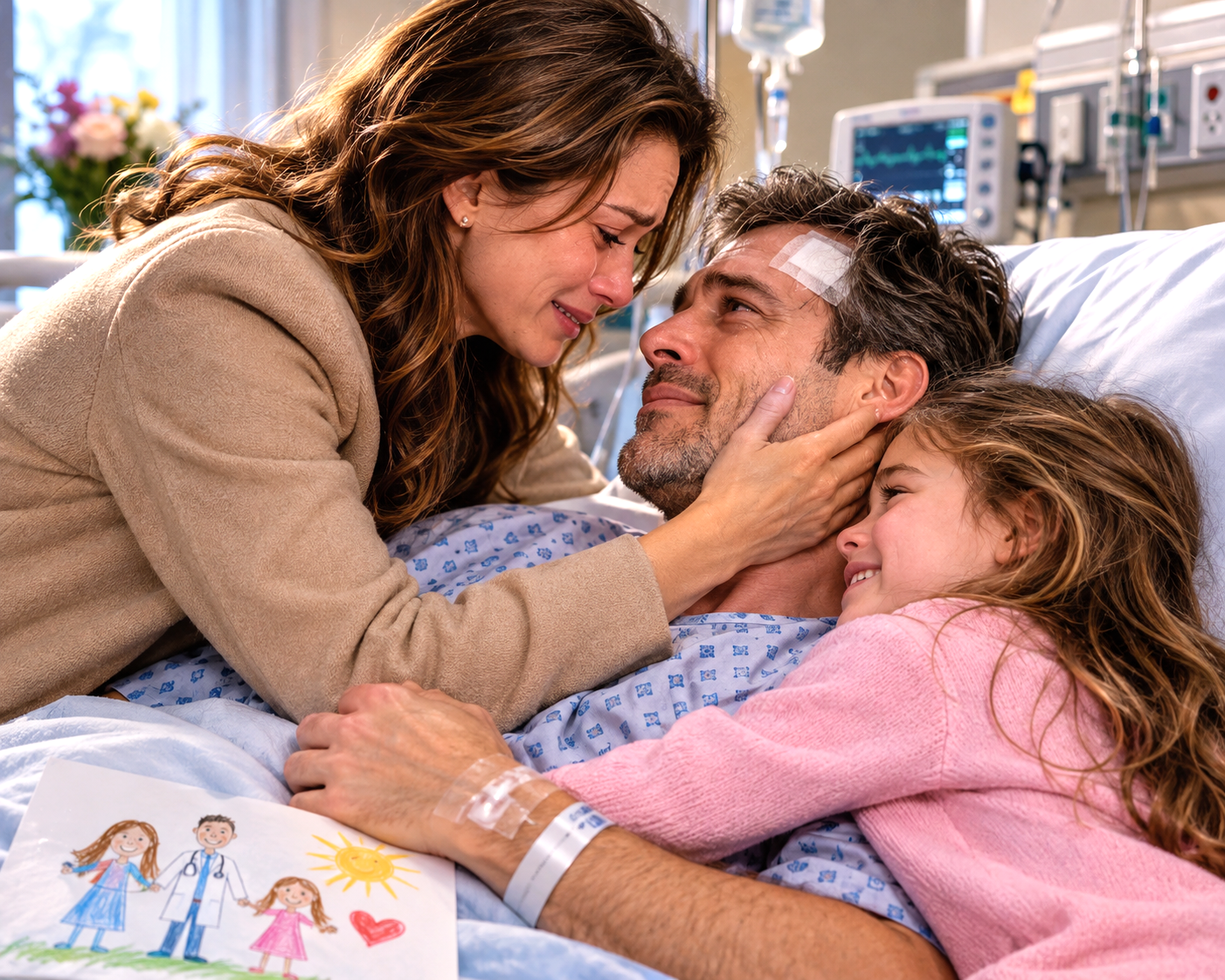
Owen was sitting in bed.
His hair was shorter than I remembered.
His face looked thinner.
There were dark circles beneath his eyes, and a small medical dressing covered part of his scalp.
He was looking toward the window.
Then he turned.
His eyes landed on me.
For a second, neither of us moved.
Then the color disappeared from his face.
“Sarah?”
I couldn’t speak.
He looked at the lunch bag in my hand.
Then at my face.
“Oh, no.”
His voice broke.
“Who told you?”
I walked toward him.
“Does that really matter?”
He looked away.
I reached the side of his bed.
“Fourteen months, Owen?”
His lower lip trembled.
“I wanted to tell you.”
“But you didn’t.”
“I know.”
“You let me believe you were working late. You missed our anniversary. You missed our daughter’s birthday.”
“I know.”
“You sat beside me in bed crying, and you told me to go back to sleep.”
He closed his eyes.
“I didn’t want you to see me like this.”
I stared at him.
“Like what?”
He gestured weakly toward his body.
“Like someone who can’t do the things he used to do.”
I pulled a chair close to the bed.
“Owen, look at me.”
He did.
“You are my husband. Not your job. Not your hands. Not your ability to stand in an operating room for twelve hours.”
His eyes filled.
“I thought I could handle it.”
“Handle what?”
“Everything.”
He looked down at his fingers.
“I thought if I kept working, kept going through treatment, and kept everything normal at home, maybe I could get through it without changing your lives.”
I shook my head.
“You don’t get to decide that alone.”
“I was scared.”
That was the first time he had said it.
Not that he was tired.
Not that he had a difficult shift.
Not that the hospital needed him.
He was scared.
And suddenly, the anger inside me had nowhere to go.
I reached for his hand.
It was colder than I remembered.
“How bad is it?”
He stared at our joined hands.
“Bad enough that I should have told you.”
“That’s not an answer.”
He swallowed.
“The treatment hasn’t worked as well as we hoped. The tumor has grown.”
I felt tears running down my cheeks.
“Can they treat it?”
“They’re reviewing another option.”
“Then we review it together.”
He looked at me.
“You shouldn’t have to spend your life watching me get worse.”
I leaned closer.
“Do you remember what you said when we got married?”
He frowned slightly.
I continued.
“You said you wanted to grow old with me, even if we ended up arguing about which television program to watch.”
A faint smile appeared.
“I still want that.”
“Then stop making decisions about our future without me.”
He began crying.
Not quietly this time.
His shoulders shook, and he covered his face.
I moved closer and wrapped my arms around him as carefully as I could.
For a long time, neither of us spoke.
Then he whispered something against my shoulder.
“I’m sorry.”
I closed my eyes.
“I know.”
“I should have trusted you.”
“Yes.”
“I was trying to spare you.”
“You hurt me more by leaving me alone with questions.”
He nodded.
I kissed his forehead.
“We’ll figure out what happens next. But you don’t have to hide from me anymore.”
I stayed with Owen until late afternoon.
Gideon returned with a nurse and explained the treatment plan they were considering.
There were more tests.
More consultations.
A specialist who would review the latest scans.
Nothing was certain.
But there were possibilities.
For the first time, I listened to everything as Owen’s wife rather than someone waiting at home for a telephone call.
I asked questions.
I wrote down medication names.
I requested copies of his reports.
And I made sure Owen understood that I intended to be involved in every decision.
At one point, Gideon entered with a folder.
“Owen, the specialist wants to see you tomorrow morning.”
Owen nodded.
Gideon glanced at me.
“It’s good that you’re here.”
I looked at him.
“Why didn’t you tell me earlier?”
He lowered his head.
“I should have encouraged Owen to bring you into this from the beginning.”
“Did you ever tell him he needed to?”
“Several times.”
I looked at my husband.
He was staring at the blanket.
“I kept refusing,” he admitted.
Gideon placed the folder on the table.
“I’m sorry, Sarah.”
I nodded.
I wasn’t ready to forgive everyone.
But I was beginning to understand how fear had shaped the silence around me.
Before Gideon left, Owen called him back.
“There’s something I need you to do.”
Gideon turned.
“What’s that?”
“Give Sarah the journal.”
I looked at Owen.
“What journal?”
He pointed toward the small cabinet beside his bed.
Gideon opened the drawer and removed a worn blue notebook.
Its corners were bent.
A hospital identification sticker was attached to the back.
Owen looked embarrassed.
“I wrote things down when I couldn’t sleep.”
I took it carefully.
“Do you want me to read it?”
He nodded.
“Not necessarily all at once.”
I held the notebook against my chest.
“I’ll read it when you’re ready.”
He looked relieved.
Then he said something that made my heart ache.
“There’s a page about Emma.”
Our daughter.
“What about her?”
“I wrote down things I wanted to remember.”
I opened the cover.
The first page contained a date.
Fourteen months earlier.
Beneath it, Owen had written:
Today I forgot where I was for several seconds during a procedure.
I looked at the clock and couldn’t remember whether it was morning or afternoon.
Gideon says I need more tests.
I haven’t told Sarah.
I don’t know how to tell her that the man she married might not be able to do the things he loves anymore.
I closed the notebook.
My eyes were burning.
Owen watched me.
“I didn’t want you to read that.”
“Why?”
“Because I sound pathetic.”
I reached over and touched his cheek.
“You sound like a man who was frightened and needed his wife.”
He looked away.
I opened the notebook again.
The next pages contained notes about our daughter.
The first time she rode her bicycle without training wheels.
The song she had performed at school.
The missing tooth she had proudly shown him over breakfast.
He had written down the dates.
Little details.
Things he wanted to remember.
One sentence appeared several times.
I hope I’m there for the next one.
I pressed the notebook against my chest.
“You should have told me.”
“I know.”
“You should have let me hold you through this.”
“I know.”
He reached for my hand.
“Can I ask you something?”
“Anything.”
“Can you bring Emma tomorrow?”
I nodded.
“Of course.”
He hesitated.
“I want to tell her myself.”
I squeezed his hand.
“We’ll do it together.”
That evening, I went home.
Not because I wanted to leave Owen.
But because our daughter was waiting.
Emma was sitting on the living-room rug when I walked through the door.
Her schoolbag lay beside her.
She was drawing a picture of our family.
I stopped when I saw it.
There were three people in the picture.
Emma.
Me.
Owen.
He was standing in the middle wearing a white coat.
She had drawn a red heart above his head.
“Mommy!”
She jumped up.
“Did you see Daddy?”
I put my bag down.
“Yes, sweetheart.”
“Was he busy?”
I knelt in front of her.
“He’s at the hospital because he’s sick.”
Her smile faded.
“Like when I had the flu?”
“Not exactly.”
I held both her hands.
“Daddy has an illness that needs special doctors and treatment. He’s been dealing with it for a while.”
She stared at me.
“Is he coming home?”
I swallowed.
“I don’t know when, sweetheart.”
Her eyes filled.
“Did he do something wrong?”
That question nearly broke me.
I pulled her into my arms.
“No. Absolutely not. Daddy hasn’t done anything wrong.”
“Then why is he sick?”
“Sometimes people become sick even when they’ve done nothing wrong.”
She started crying.
I held her tightly.
“Can I see him?”
“Tomorrow.”
“Can I bring my picture?”
I smiled through my tears.
“He would love that.”
She ran to the rug and carefully picked up the drawing.
Then she returned and held it against her chest.
“Can I make another one for his room?”
“Of course.”
That night, I tucked her into bed.
She asked me to leave the hallway light on.
I did.
Then I sat at the kitchen table and opened Owen’s journal.
I read slowly.
Some entries were only a few sentences.
Others were several pages long.
There were descriptions of his first treatment.
His fear of losing his ability to operate.
His frustration when he couldn’t remember small things.
And there were pages about me.
One entry was dated three months earlier.
Sarah asked whether I wanted to go away for the weekend.
I told her I had another shift.
The truth is that I was afraid of becoming sick while we were away.
I hate that I’m turning every ordinary moment into something complicated.
Another entry appeared two weeks later.
Emma asked why I don’t come home for dinner anymore.
I told her the hospital needs me.
I wanted to tell her that I need to come home too.
I wiped my face.
Then I turned another page.
The handwriting was shakier.
If I don’t get better, I hope Sarah knows that the happiest part of my life was never the hospital.
It was coming home and finding her in the kitchen.
It was Emma running down the hallway.
It was hearing them argue about whose turn it was to choose a movie.
I spent years saving strangers’ lives and somehow forgot that the people waiting for me at home needed me too.
I stopped reading.
I couldn’t continue.
I put the notebook down and cried.
Not because I had stopped loving him.
Because I finally understood how much of his suffering he had carried alone.
And how much time we had lost pretending everything was normal.
The following morning, Emma and I returned to the hospital.
She carried two drawings.
One showed our family standing in front of our house.
The other showed Owen wearing a superhero cape.
He laughed when he saw it.
A real laugh.
The first one I had heard from him in months.
“That’s quite an outfit,” he said.
Emma climbed carefully onto the chair beside his bed.
“Because you’re my superhero.”
Owen’s eyes filled.
He reached for her hand.
“I don’t feel very heroic right now.”
“You still are.”
She placed the drawing on his bedside table.
Then she asked the question I had been dreading.
“Daddy, why are you staying here?”
Owen looked at me.
I nodded.
He took a slow breath.
“Daddy has an illness in his brain. The doctors are helping me get better.”
“Will you get better?”
He looked down at her small hand.
“The doctors are trying very hard.”
She thought for a moment.
“Can I help?”
Owen smiled.
“You already are.”
She leaned forward and kissed his cheek.
Then she told him about her class.
About a spelling test.
About a girl who had borrowed her pink pencil and forgotten to return it.
For twenty minutes, the hospital room sounded like our home.
And Owen listened to every word.
When Emma finally became tired, I took her to the cafeteria with Gideon’s help arranging for a family member to stay with Owen.
On our way out, she turned back.
“Daddy?”
“Yes, sweetheart?”
“I’ll bring another picture tomorrow.”
“I’ll be waiting.”
She waved.
Owen waved back.
But when the door closed, I saw him turn his face toward the window.
I knew he was crying.
The next several weeks were difficult.
There were consultations.
Additional scans.
Medication adjustments.
And long conversations about treatment options.
Some days Owen felt well enough to sit up and talk.
Other days, even answering a question exhausted him.
I learned the names of his medications.
I learned how to recognize when he was becoming overwhelmed.
I learned which nurses he trusted and which questions he preferred to ask Gideon.
But more importantly, I learned to stop treating every difficult conversation as something that needed to end with reassurance.
Sometimes Owen needed to talk about being afraid.
Sometimes he needed to be angry.
Sometimes he simply wanted me to sit beside him without saying anything.
One afternoon, he asked me to bring him a photograph from our wedding.
I found it in the hallway cabinet.
It showed us standing beneath a large oak tree.
Owen was laughing.
I was holding his arm.
Neither of us looked particularly polished.
My hair was slightly messy, and his tie was crooked.
He studied it for a long time.
“You look beautiful,” he said.
I smiled.
“You look like you forgot how to tie a tie.”
He laughed softly.
“I probably did.”
Then he looked at me.
“Do you remember what you said that day?”
I shook my head.
“You said you didn’t care what happened as long as we kept choosing each other.”
I sat beside him.
“I meant it.”
He looked down at the photograph.
“I haven’t made that easy.”
“No, you haven’t.”
He nodded.
“I don’t expect you to forgive everything immediately.”
“Good.”
He looked surprised.
I took his hand.
“Because I love you, Owen. But I was hurt. And I don’t want us to pretend that didn’t happen.”
“I understand.”
“We can work through that. But I need you to be honest with me.”
“I will.”
I rested my head against his shoulder.
For the first time in months, neither of us was hiding anything.
Three weeks later, the specialist gave us an update.
The latest scans showed that the tumor had responded poorly to the treatment Owen had received.
The medical team discussed another approach.
It involved additional risks.
There were no guarantees.
But there was still a reasonable option worth considering.
Owen listened quietly.
When the consultation ended, he asked for some time alone with me.
I closed the door.
He looked at the papers in his lap.
“I think I want to try.”
I nodded.
“Then we’ll talk through it with the doctors.”
He looked up.
“Are you afraid?”
“Yes.”
He waited.
I continued.
“I’m terrified. But I’m not going to let fear make every decision for us.”
He smiled faintly.
“I used to think being brave meant not telling anyone I was afraid.”
I squeezed his hand.
“Maybe being brave means telling someone and letting them stand beside you.”
He looked at me for a long time.
Then he nodded.
We agreed to proceed with the treatment plan after discussing the benefits and risks with his specialists.
It wasn’t a miracle.
It wasn’t a promise.
It was a decision made together.
And that mattered.
Several months passed.
The treatment was harder than either of us expected.
There were setbacks.
There were days when Owen felt too weak to speak.
There were nights when I sat beside his bed and watched the monitor while trying not to imagine the worst.
But there were also small victories.
A morning when he managed to eat breakfast.
An afternoon when he walked a short distance with assistance.
A day when he asked whether Emma had finished her school project.
Eventually, the doctors allowed him to spend a few hours at home under their guidance.
The first time we brought him through the front door, Emma ran toward him.
Then she stopped.
She looked at his thinner face and the walking support beside him.
“Daddy?”
Owen opened his arms.
“Come here, sweetheart.”
She approached carefully.
Then she hugged him.
He closed his eyes.
I stood in the hallway watching them.
The house was quiet except for the sound of the clock above the kitchen doorway.
It was the same house.
The same furniture.
The same family photographs.
But everything felt different.
Owen looked around.
“You kept the flowers.”
I glanced at the vase near the window.
“They’re artificial.”
He laughed.
“I should have known.”
Emma pulled his sleeve.
“Daddy, I made you something.”
She handed him a folded piece of paper.
He opened it.
Inside was a drawing of three people holding hands beneath a yellow sun.
At the bottom, she had written:
We are still a family.
Owen pressed the paper to his chest.
I looked away.
Some moments were too precious to interrupt.
One evening, after Emma had gone to bed, Owen asked me to sit beside him.
He had been unusually quiet.
I pulled a chair closer.
“What is it?”
He looked toward the kitchen.
“I want to apologize for something.”
I sighed.
“Owen, we’ve talked about this.”
“Not this.”
He reached toward the small cabinet where his blue journal now rested.
“I wrote something on the last page.”
He handed it to me.
I opened it.
The final entry was dated only a few days earlier.
I used to believe that if I kept my illness to myself, I could protect my family from it.
I thought I was giving them peace.
Instead, I took away their chance to stand beside me.
Sarah deserved the truth.
Emma deserved to know why I wasn’t always there.
And I deserved to be loved even when I couldn’t be the man I had been before.
If I have learned anything, it is that being needed is not the same as being loved.
I don’t want to spend whatever time I have left trying to prove that I’m useful.
I want to spend it being present.
I closed the journal.
Owen was watching me.
“I don’t know how much time I have,” he said.
I took his hand.
“Neither of us knows that.”
“I don’t want you to feel obligated to put your life on hold.”
I looked at him.
“Do you think loving you is an obligation?”
“No.”
“Then don’t describe it that way.”
He lowered his head.
I continued.
“I don’t know what the next year will look like. I don’t know what the next month will bring. But I know I want to be part of the decisions we make.”
He nodded.
“And I want you to promise me something.”
“What?”
“Don’t disappear behind that hospital badge again. Not emotionally. Not from us.”
He looked at the badge lying on the table.
He hadn’t worn it since his diagnosis became known to the family.
Then he picked it up.
“I don’t know whether I’ll ever return to surgery.”
“That’s not what I’m asking.”
He looked at me.
“Then what are you asking?”
“I’m asking you to come home to us whenever you can.”
His eyes filled.
“I promise.”
The following morning, Owen asked Gideon to visit.
When Gideon arrived, he stood awkwardly beside the bed.
“Good morning.”
Owen smiled.
“Come in.”
Gideon looked at me.
Then back at Owen.
“How are you feeling?”
“Better than yesterday.”
“That sounds promising.”
Owen nodded.
Then his expression became serious.
“I owe you an apology.”
Gideon frowned.
“For what?”
“For putting you in the position of keeping secrets from my wife.”
Gideon shook his head.
“You don’t have to apologize for being afraid.”
“Maybe not. But I should have trusted her.”
I looked at Owen.
He continued.
“I also need to thank you.”
Gideon sat down.
“For what?”
“For being there when I couldn’t be there for myself.”
Gideon’s eyes became wet.
He looked down at his hands.
“You were always a good doctor, Owen.”
Owen gave a faint smile.
“I hope I was a good friend too.”
“You were.”
For several moments, neither spoke.
Then Gideon looked at me.
“I’m glad you know now.”
I nodded.
“So am I.”
And I meant it.
Not because knowing made the situation easier.
But because it meant we could finally face it together.
Owen’s recovery did not follow the neat path we had hoped for.
There were encouraging periods followed by difficult ones.
His doctors continued monitoring the tumor.
Some treatments helped manage his symptoms, while others had to be adjusted because of side effects.
He never returned to operating.
That was a loss he struggled with deeply.
For a while, he avoided looking at his old photographs from the hospital.
Then Gideon suggested something.
The hospital had a patient-support program where experienced doctors could mentor younger medical professionals and speak with patients about navigating difficult diagnoses.
Owen wasn’t ready immediately.
But eventually, he agreed to participate in a limited capacity when his health allowed.
He began meeting with young doctors.
He talked about communication.
About admitting when something wasn’t right.
About remembering that patients were people with families waiting at home.
One afternoon, I accompanied him to the hospital.
We passed the nurses’ station where I had first encountered the uncomfortable silence.
The same nurse looked up.
Her expression changed when she saw us.
“Sarah.”
I smiled.
“Hello.”
She came around the desk.
“How is he doing?”
Owen answered before I could.
“Taking things one day at a time.”
She smiled.
“That’s good.”
Then she looked at me.
“I never forgot that afternoon.”
“Neither did I.”
She lowered her eyes.
“We were all worried.”
“I understand.”
I glanced toward the corridor.
The consultation room was still there.
For a moment, I remembered standing inside it with the lunch bag in my hands.
I remembered Gideon’s tears.
I remembered the question that had changed everything.
He hasn’t told you anything, has he?
I had arrived expecting a pleasant surprise.
Instead, I had discovered that my husband was fighting an illness alone.
But I had also discovered something about our marriage.
Love wasn’t simply the dinners we shared.
It wasn’t the holidays or the photographs or the promises we made when life was easy.
It was the willingness to tell the truth when the truth was frightening.
It was allowing someone to see you when you were no longer strong.
And it was understanding that protecting someone from pain could sometimes create a deeper wound.
On our wedding anniversary, Owen was well enough to sit at the dining table for dinner.
I prepared his favorite meal.
Roasted chicken.
Mashed potatoes.
And apple pie.
Emma helped set the table.
She placed three forks beside the plates.
Then she brought the little handwritten note I had written on the day I visited the hospital.
I had kept it in a drawer.
The paper was slightly wrinkled.
The words were still there.
You don’t have to take care of everyone. Let me have a turn.
Owen read it.
He smiled.
Then his eyes filled.
“I remember this.”
“I know.”
“I never got to eat that lunch.”
“You weren’t exactly available.”
He laughed.
Emma looked between us.
“What does it say?”
Owen handed her the note.
She read it slowly.
Then she looked at me.
“Mommy, that’s nice.”
I smiled.
“It’s something I wanted Daddy to remember.”
Owen folded the note carefully.
Then he reached across the table and took my hand.
“I think I finally understand it.”
I squeezed his fingers.
“Good.”
He looked at Emma.
Then back at me.
“I don’t know what the future holds.”
I nodded.
“Neither do I.”
“But I know I don’t want to spend another day pretending I can handle everything alone.”
I smiled through my tears.
“Then don’t.”
He lifted my hand and kissed it.
Emma leaned across the table and placed her small hand over ours.
“Can we eat now?”
We both laughed.
And for a moment, the room felt wonderfully ordinary.
The dinner was warm.
The apple pie was slightly overbaked.
Emma talked too much.
Owen listened.
I watched him as he sat across from me.
He wasn’t the same man who had walked out of our house with his hospital badge clipped to his pocket fourteen months earlier.
And I wasn’t the same woman who had believed every late-night shift was simply another demanding day at work.
We had both changed.
But we were still here.
Still choosing each other.
Still learning how to live with uncertainty.
Later that night, after Emma had fallen asleep, Owen and I sat together by the living-room window.
He rested his head against the cushion.
I covered his legs with a blanket.
“Sarah?”
“Yes?”
“Thank you for coming to the hospital that day.”
I looked at him.
“Even though I discovered something terrible?”
“Especially because of that.”
He reached for my hand.
“If you hadn’t come, I might have kept hiding.”
I thought about the lunch bag.
The apple pie.
The note.
The frightened nurses.
Gideon’s tear-filled eyes.
And the husband I had found in that hospital bed.
“I didn’t come because I thought something was wrong,” I said.
“I know.”
“I came because I missed you.”
He closed his eyes.
“I missed you too.”
I rested my head against his shoulder.
Outside, the streetlights illuminated the quiet road.
There was no guarantee that tomorrow would be easier.
There was no promise that treatment would work.
There was only the present moment.
Owen’s hand in mine.
Our daughter’s drawings on the refrigerator.
And a family that had finally stopped keeping its fears secret.
I used to believe that the strongest marriages were the ones where neither person needed help.
I no longer believe that.
Sometimes strength is admitting that you’re frightened.
Sometimes love is asking someone to stay.
And sometimes the most important thing you can do for the person you love is not to protect them from the truth.
It’s to trust them enough to face it together.
That afternoon, I had walked into a hospital carrying lunch, expecting to surprise my husband.
Instead, I discovered how desperately he needed someone to surprise him by staying.
And I did.
END