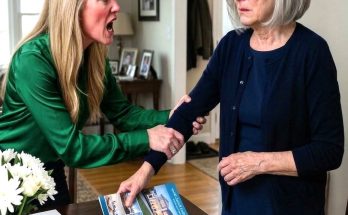
After Madison left the kitchen, I remained at the table.
Andrew stayed a little longer.
He looked toward the doorway through which his wife had disappeared.
Then he turned to me.
"Mom, I'm sorry."
I looked at him.
"For what?"
He lowered his eyes.
"For the way she talked about the money."
I didn't answer immediately.
I knew he was embarrassed.
I also knew he had been trying to avoid an argument.
"Did you know she'd quit her job?"
He shook his head.
"No. Not until she told me."
I studied his face.
"She really resigned?"
He nodded.
"She said she'd already decided."
I leaned back in my chair.
That explained the confidence in her voice.
She hadn't been discussing a possibility.
She had made a decision based on an assumption about my financial situation.
Andrew rubbed his hands together.
"She thinks everything is going to be okay."
"Does she?"
He looked uncomfortable.
"She just gets excited about things."
I almost smiled.
There was nothing amusing about the situation, but I recognized the way he was trying to soften what had happened.
Madison hadn't simply become excited.
She had decided that my money was available for her plans.
And she had announced it while I was still grieving.
I looked toward the kitchen counter.
Robert's coffee cup was still there.
I hadn't moved it.
He used to put it near the edge of the counter when he finished his morning coffee.
I had told him more than once that he should place it farther back.
He always forgot.
That little habit suddenly seemed more important than anything else in the room.
Andrew followed my gaze.
"Do you want me to talk to her?"
I looked back at him.
"No."
"Mom, I don't want you thinking we're expecting anything."
I believed that he didn't want me to think that.
But I wasn't entirely sure what he expected.
There was a difference.
"I understand."
He nodded.
Then he stood.
He looked as though he wanted to say something else, but eventually he left the kitchen.
I listened to his footsteps.
A few moments later, the house became quiet again.
I sat alone.
That was when I began thinking about the assumptions Madison had made.
For years, she had believed Robert and I were simply an ordinary retired couple.
We lived comfortably.
We didn't show off.
We didn't spend money to impress people.
We weren't the sort of people who discussed investments over dinner or casually mentioned the value of their property.
Robert preferred privacy.
He believed that financial matters were best handled quietly.
He had never been interested in making people aware of what we owned.
Neither had I.
When Madison entered our family, she had never asked detailed questions about our finances.
She knew Robert had been a teacher.
She knew I had worked in architectural design.
She knew we had retired.
That was enough information for her.
And we had never felt the need to provide more.
But there was something she didn't understand.
My professional life had not ended with a retirement party.
Six years earlier, I had sold my architectural design business.
It had taken years to build.
It hadn't appeared overnight.
I had started with a great deal of work, a great deal of patience, and the willingness to spend long days solving problems that other people didn't even notice.
I knew how buildings worked.
I knew how people moved through rooms.
I understood the difference between something that looked impressive in a photograph and something that actually functioned.
My business had grown steadily.
Eventually, it became valuable enough that selling it made sense.
The sale had produced the majority of our fortune.
And the proceeds were already legally mine.
Robert had been proud of what I had accomplished.
He had never treated my business as something that belonged to him simply because we were married.
We had discussed our finances carefully.
He had his own separate savings.
He had organized his estate.
We had made arrangements that reflected what each of us owned and what we wanted to happen to it.
None of those arrangements gave Madison the right to spend my money.
None.
I had never hidden anything out of shame.
I simply didn't believe that everyone needed to know.
There was a difference between being secretive and being private.
Robert understood that difference better than anyone.
He also understood people.
He had spent decades teaching teenagers.
He knew when someone was listening because they cared and when someone was listening because they wanted something.
Sometimes he would notice a person's behavior long before I did.
He never made a big production out of it.
He would simply say something like, "People usually tell you who they are if you give them enough time."
I remembered those words while sitting in the kitchen.
I wished I could ask him what he would have thought about Madison's announcement.
I could almost picture him sitting across from me.
He would probably have taken off his glasses, rubbed the bridge of his nose, and asked me whether I wanted another cup of coffee.
He wouldn't have rushed me.
That was one of the things I missed most.
Robert never made me feel that I had to hurry through my feelings.
Now I was expected to hurry through his death and start discussing property purchases.
I wasn't ready.
And I wasn't going to pretend otherwise.
Later that day, I went through the house.
I didn't have a particular reason.
I simply needed to move.
The quiet was becoming difficult to sit with.
I passed the living room.
Robert's chair was still in its usual place.
I looked at the room and remembered how often he had sat there watching old movies.
He liked films that I had seen dozens of times.
Sometimes he would tell me what was about to happen before the scene reached it.
I would tell him to stop spoiling the movie.
He would laugh.
Those memories came without warning.
I stopped beside the chair.
For a moment, I wanted to sit down and tell him about the conversation in the kitchen.
I wanted to tell him that Madison had quit her job.
That she was choosing beach houses.
That she had offered me permission to visit a property she intended to purchase with money she believed I would give her.
Instead, I stood there quietly.
I was angry.
But beneath the anger was sadness.
Not just because of what Madison had said.
Because Robert wasn't there to hear it.
He had always been the person I could turn to when something didn't make sense.
Now I had to decide what to do without him.
I returned to the kitchen.
The coffee cup was still where I'd left it.
I picked it up and washed it.
It was a small task.
An ordinary task.
But ordinary things were all I could manage that day.
The following morning, Madison's plans were still on my mind.
I didn't bring them up.
Neither did Andrew.
We exchanged ordinary words.
There were no arguments.
No direct questions about money.
Madison behaved as though the conversation had been perfectly normal.
She didn't seem embarrassed.
She didn't seem worried.
If anything, she appeared more cheerful than she had been in the days immediately after Robert died.
I noticed that.
I also noticed how easily she returned to the subject of what the family might do next.
She spoke about the future with a certainty that made me wonder how much she had already decided.
I didn't challenge her.
I had no intention of announcing my financial situation simply to stop her from making plans.
If I corrected every assumption she made, I would spend the rest of my life explaining things that were none of her business.
For the moment, I preferred silence.
Not because I agreed.
Because I wanted to see what she would do next.
By then, I had begun to understand that the beach house was not just an idea.
It was becoming a promise.
And Madison was beginning to treat that promise as something already settled.
Click here to continue reading: PART 3: By Friday, She Had Found the House, Chosen the Future, and Started Acting as Though the Money Was Already Hers
Three Days After I Buried My Husband, My Daughter-in-Law Made a Decision That Changed the Way I Saw Her Forever
Part 2 of 8