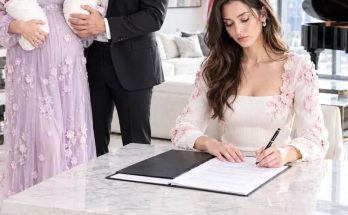
I used to believe that if you loved someone long enough, they would eventually understand what you had sacrificed for them.
I was wrong.
I learned that at a dinner table in Manhattan, with a plate of food I hadn't touched and a divorce agreement sitting beside my husband's hand.
Fifty million dollars.
That was what Grant Whitmore thought eleven years of marriage were worth.
He didn't even look embarrassed when he said it.
"Madison is having twins. My family needs those children to have a legitimate name."
I looked at him.
Then I looked at the woman standing beside the fireplace.
Madison Lane.
Twenty-four years old.
My husband's former executive assistant.
And now, apparently, the woman who would take my place.
She wore a pale cream maternity dress that stretched across her stomach. One hand rested beneath her belly, as though she needed to remind everyone in the room that she was carrying something precious.
Twins.
Two children.
The word had become almost sacred in that house.
I had spent six years trying to give Grant one.
The dining room was exactly as I'd left it that morning.
The silver candlesticks were polished. The crystal glasses were arranged evenly. The chandelier above us had been purchased during a trip to Venice eight years earlier.
I'd chosen it.
I'd remembered how Grant had laughed when I insisted on buying something so expensive.
He'd kissed my forehead and told me that if it made me happy, we would take it home.
I wondered when that man had disappeared.
Or whether I'd simply spent too many years pretending he was still there.
Grant sat opposite me in his charcoal suit.
He had placed the divorce papers beside my dinner plate.
His mother, Evelyn, occupied the chair at the head of the table.
She always sat there.
Even when the house belonged to me as much as it belonged to her son, she behaved as though every room was an extension of her authority.
Madison remained near the fireplace.
She didn't sit.
Perhaps she didn't want to appear too comfortable in a house that still had my photographs on its walls.
I noticed that.
I noticed everything that evening.
The small movement of Grant's fingers against the table.
The way Evelyn kept examining the agreement.
The way Madison avoided looking directly at me.
And the diamond brooch pinned to her dress.
My brooch.
I had received it from Grant on my thirty-third birthday.
He'd given it to me in a small velvet box and told me it reminded him of the first time he saw me.
Several months later, it disappeared.
I searched the bedroom drawers, the jewelry cabinet, and the safe.
Grant told me it might have been misplaced during an exhibition where I'd worn it.
I'd believed him.
Now it was resting against another woman's chest.
I looked at it for a long moment.
Then I turned toward my husband.
"Did you give her that?"
Grant followed my eyes.
His expression changed slightly.
"Give her what?"
"The brooch."
He glanced at Madison.
She touched it instinctively.
"It isn't important, Claire."
That answer told me more than he intended.
"It was important when you told me it had gone missing."
Grant leaned back.
"We're not going to spend tonight discussing jewelry."
I almost smiled.
Eleven years of marriage had been reduced to a financial transaction, and he couldn't spare five minutes for a missing birthday present.
Evelyn interrupted before I could answer.
"Let's not make this more difficult than it needs to be."
She tapped the divorce agreement with one fingernail.
"Claire, you should understand how fortunate you are."
I turned toward her.
"Fortunate?"
"Fifty million dollars is an extraordinary settlement. Many women would be grateful for an arrangement like this."
I looked at the papers.
The amount was printed clearly.
$50,000,000.
It was enough to buy houses, businesses, and nearly anything else a person could want.
But money had never been the thing I wanted from Grant.
I had wanted him beside me in a hospital room.
I had wanted him to hold my hand after another failed treatment.
I had wanted him to tell his mother to stop humiliating me.
I had wanted a husband.
Not a payment.
Evelyn's eyes moved briefly toward my stomach.
"After all these years, you must understand that the Whitmore family has responsibilities."
I knew what she meant.
I had heard versions of it at family gatherings, charity events, and private dinners.
The Whitmore name needed an heir.
Their business needed a future.
Their family needed children.
And somehow, my inability to carry a pregnancy had become a public failure.
I had never forgotten the Thanksgiving dinner when Evelyn described me as a woman who couldn't fulfill the simplest responsibility of marriage.
Grant had been sitting beside her.
He had continued eating.
That was his way.
He disliked arguments.
He disliked uncomfortable conversations.
He disliked defending his wife when doing so might upset his mother.
But he had apparently never disliked spending nights with his assistant.
For six years, I had endured fertility treatments.
There were injections that left bruises across my abdomen.
There were surgeries that required weeks of recovery.
There were appointments where I sat alone, listening to doctors explain probabilities and possibilities.
Three embryo transfers.
Three occasions when I let myself believe things might finally be different.
Grant attended some appointments.
Not all.
Sometimes he sent a driver.
Sometimes he said work had become impossible to rearrange.
I had learned to sign medical forms without him.
I had learned to swallow disappointment in hospital corridors.
I had learned to answer questions about children with a smile that grew more difficult every year.
And through all of it, Evelyn continued to remind me that time was running out.
Now Madison was seven months pregnant.
And suddenly everyone in the Whitmore family had discovered compassion.
"Stress isn't good for the babies," Evelyn said, looking toward Madison.
Madison lowered her eyes.
"I really didn't want things to happen this way."
Her voice was quiet.
For a moment, I believed she might actually feel sorry.
Then I looked at the brooch again.
Perhaps she was sorry.
Perhaps she was frightened.
Perhaps she simply wanted me to leave without making the evening unpleasant.
I couldn't know.
"What exactly do you want me to sign?" I asked.
Grant pushed the agreement closer.
"You receive the fifty million. The townhouse remains with me. You resign from your position on the Whitmore Luxe board, and you waive any additional financial claims."
"And I leave."
"Yes."
"Quietly?"
His jaw tightened.
"That's preferable for everyone."
I looked at him.
Everyone.
He hadn't said it would be better for me.
He hadn't asked whether I was all right.
He hadn't even asked whether I wanted to stay married.
He had already decided that the next chapter of his life would begin without me.
There was something almost impressive about how little effort he made to disguise it.
I picked up the agreement.
Grant watched me carefully.
"You should read it before signing."
"My lawyer has already reviewed it."
That surprised him.
He hadn't expected me to come prepared.
Evelyn stopped tapping her fingernail.
"Then there's no reason to delay."
I turned the pages.
The legal language was precise.
Every responsibility had been assigned.
Every claim had been addressed.
The board resignation was included.
The townhouse was excluded.
The money would be transferred immediately.
There was one line about confidentiality that I read twice.
I didn't object.
I had no intention of spending the rest of my life explaining the Whitmores to strangers.
I reached for the pen.
Grant watched my hand.
For a moment, he looked uncertain.
Perhaps he had expected me to cry.
Perhaps he thought I would demand more money.
Maybe he believed I would ask him to reconsider.
I signed the first page.
Then the second.
Then the remaining pages.
My handwriting looked ordinary.
That surprised me.
I had imagined that when the moment finally arrived, my hand would shake.
It didn't.
When I finished, I removed my wedding ring.
I had worn it for eleven years.
The small diamond caught the light as I placed it on top of the agreement.
Nobody spoke.
I stood.
Evelyn leaned forward and examined the signatures.
"Good," she said.
There was satisfaction in her voice.
"At least you understand the situation."
I picked up my handbag.
Madison moved slightly away from the fireplace.
Grant looked at me.
"Where are you going?"
"Home."
He frowned.
"This is your home."
I looked around the dining room.
The chandelier.
The silverware.
The photographs.
The flowers I'd arranged that morning.
"No," I said. "Not anymore."
He appeared confused.
Then his eyes moved toward the hallway.
"Did you pack?"
I nodded.
"When?"
"Three days ago."
His expression changed.
He had believed he was dismissing me.
He hadn't understood that I had already decided to leave.
That difference mattered.
I had not spent the evening waiting for permission to go.
I had been waiting for the last piece of paperwork.
My suitcases were already in the car.
My travel arrangements were complete.
My attorney had reviewed everything.
The only thing left was to walk out of a house where I had spent eleven years trying to earn a place I should never have had to earn.
As I reached the doorway, Evelyn called my name.
"Claire."
I stopped.
"You should be grateful. Fifty million dollars is more than enough compensation for eleven comfortable years."
I turned around.
Comfortable.
That word stayed in my head.
I looked at her, then at Grant.
"Do you really think those years were comfortable?"
Evelyn's expression hardened.
"I think you had every material advantage."
"Was it comfortable when I woke up alone after surgery because your son sent someone else to sign my discharge papers?"
Grant looked down.
"Claire…"
I continued.
"Was it comfortable when your mother told everyone at Thanksgiving that my body had failed this family?"
Evelyn's lips pressed together.
"That isn't what I said."
"It was close enough."
Madison shifted her weight.
I looked toward her.
"Was it comfortable when I lost a pregnancy and Grant stayed in Dallas for a conference?"
The room went still.
Not quiet.
Still.
There is a difference.
Grant slowly raised his head.
"What did you just say?"
I looked at him.
He seemed to have heard the words but couldn't understand how they belonged in the same conversation.
I had never told him.
I had never told anyone in his family.
And now, after everything, I was finally saying it.
"I lost a child."
His face changed.
"What child?"
I didn't answer immediately.
For eleven years, I had waited for him to ask questions about my pain.
Now he was finally asking one.
It was too late.
"The one you never knew about."
Evelyn's hand moved toward the table.
Madison gripped the mantel.
Grant stared at me as though the room had shifted beneath his feet.
I left before he could ask anything else.
Click here to continue reading: PART 2: I Left Behind My Wedding Ring and the House I Had Helped Build, But the Message I Sent Changed Everything
Fifty Million Dollars Sat Between My Husband and Me, But the Thing That Hurt Most Was What He Refused to Say
Part 1 of 3