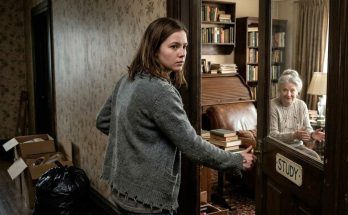
Evelyn asked everyone to listen carefully.
The room grew quiet.
Even my father stopped shifting in his chair.
Robert remained beside the desk, his briefcase open and the documents arranged in front of him.
I could hear the moving truck outside.
Its engine was still running.
That small sound made the whole situation feel unreal.
My parents had arrived expecting to empty the house.
The movers had come prepared to carry away the furniture.
Chloe had already chosen a bedroom.
And now all of us were sitting in the one room Grandpa had specifically told me to open.
Evelyn explained that Arthur had made arrangements for his estate before his death.
She had been asked to help ensure those arrangements were handled according to his instructions.
Robert was there because he had responsibility for the trust.
My father leaned forward.
He asked again whether the house was his.
Evelyn said she would address the matter through the documents rather than through assumptions about family relationships.
My father frowned.
He said he was Arthur's only son.
Evelyn acknowledged that he was.
Then she reminded him that being the deceased person's child did not, by itself, answer every question about an estate.
My mother looked at Robert.
She asked whether the process had to be so formal.
Robert told her that they needed to follow the arrangements Arthur had made.
There was no anger in his voice.
He sounded like a man explaining that a locked door could not be opened simply because someone wanted to enter.
Chloe crossed her arms.
She asked how long all of this was going to take.
No one answered her immediately.
I sat near the door with my hands resting in my lap.
I was still grieving.
That fact had not disappeared just because my parents had arrived with a plan.
I had spent the previous evening looking at Grandpa's empty chair and wondering how I was supposed to live in a house where his voice would never come from the next room again.
Now I was being asked to watch strangers decide what would happen to the things he had left behind.
I wanted the meeting to be over.
I also wanted to understand why Grandpa had been so certain that this moment would come.
Evelyn opened a folder.
She checked the papers inside before setting it on the desk.
She explained that Arthur had anticipated questions about the property and had left instructions for how those questions should be handled.
My father asked whether those instructions meant he couldn't take possession of the house.
Evelyn said they needed to complete the review before anyone made decisions about removing belongings or changing the property.
He looked toward the window.
I recognized that expression.
It was the face of someone who had arrived expecting the world to cooperate and had discovered that it had other plans.
My mother tried a different approach.
She said the house had belonged to Arthur for many years and that the family needed to decide what to do with it now that he was gone.
Evelyn replied that Arthur had already taken steps to address what would happen after his death.
Mom fell silent.
I looked at the desk.
Grandpa's papers were stacked neatly, as if he had expected someone to need them.
He had always liked things to be in order.
When I was younger, I used to tease him about the labels he put on storage boxes.
He would tell me that a little organization saved a lot of trouble later.
I had never thought those words might apply to the worst day of my life.
Robert turned a page.
He checked a detail with Evelyn, and she nodded.
Neither of them rushed.
They seemed determined to get everything right.
My father asked whether they were suggesting that he had done something wrong.
Evelyn said she was not there to judge anyone's past behavior.
Her responsibility was to explain the arrangements Arthur had made and to see that they were handled properly.
That answer seemed to irritate my father more than an accusation would have.
He wanted to make the conversation about what he believed he deserved.
Evelyn kept bringing it back to what Grandpa had actually arranged.
I thought about the years my parents had been absent.
I thought about the school ceremonies, the birthdays, and the Christmas mornings when Grandpa had been the only adult waiting for me.
I had spent much of my childhood trying to understand why my parents had chosen not to be there.
For years, I had believed that if I found the right explanation, I would finally be able to stop wondering what was wrong with me.
But sitting in that study, I began to see something different.
Their absence had not been a puzzle I was required to solve.
It had been a choice they had made.
I had spent seventeen years living with its consequences.
I didn't have to spend the rest of my life pretending it had never happened.
My mother turned toward me.
She asked whether I had known that Grandpa was making these arrangements.
I told her he had asked me to follow his instructions.
She wanted to know whether he had explained anything about the property.
I said he hadn't given me details.
That was true.
He had told me what to do when my parents returned, but he hadn't explained what Evelyn and Robert would say.
My mother studied my face.
I could tell she was looking for something she could use to make sense of the situation.
I didn't have anything to give her.
I had no secret document.
No hidden plan.
No clever answer.
I had only kept my promise.
My father shifted his chair closer to the desk.
He asked Evelyn to tell him plainly what was going to happen.
Evelyn looked at Robert, then back at my father.
She said she would explain the relevant provisions in the order they had been prepared.
My father pressed his lips together.
For a moment, I thought he might stand up and leave.
Instead, he stayed where he was.
The movers were still waiting outside.
The furniture remained where Grandpa had left it.
His glasses were still upstairs.
His books were still beside the bed.
And the two garbage bags my mother had handed me remained on the kitchen floor.
I could picture them there.
Black plastic folded over itself, empty and waiting.
I had thought they represented the end of my place in the house.
Now they seemed to represent something else.
My parents had arrived with a decision already made.
They had never asked what Grandpa wanted.
They had never asked what I needed.
They had simply assumed that the house would become theirs and that I would disappear from it as easily as I had been removed from their lives when I was five.
But Grandpa had not left everything to their assumptions.
He had made arrangements of his own.
Evelyn continued reviewing the documents.
She explained that the estate would need to be administered according to the instructions Arthur had left.
Robert confirmed the responsibilities he had accepted as successor trustee.
They discussed the steps required before anyone could make changes to the property.
I listened, trying to keep track of what each explanation meant.
Some of it was unfamiliar.
There were legal terms I didn't fully understand.
But the important point was clear.
My father's certainty had never been the same thing as a legal decision.
He had walked into the house believing that being Arthur's son settled everything.
Now he had to listen while the people responsible for the estate explained why the actual arrangements mattered more than his expectations.
My mother sat very still.
Chloe no longer looked toward the hallway.
For the first time since arriving, she seemed to understand that she could not simply announce what she intended to take and expect everyone to agree.
I watched her glance at my father.
He didn't look back.
I wondered whether they had discussed any of this before arriving.
Had they assumed the house would pass directly to him?
Had they imagined that I would be too upset to challenge them?
I couldn't know.
I could only see what was happening in front of me.
They had come prepared to give orders.
Now they were waiting for answers.
Evelyn paused to arrange the documents.
She looked at me and asked whether I was comfortable continuing.
I nodded.
I didn't want to leave.
This was the room Grandpa had told me to open.
Whatever the next part of the meeting involved, I wanted to hear it.
I wanted to understand the decision he had made before he died.
And I wanted to stop living as though the people who had abandoned me still held the final say over my life.
Robert resumed the review.
The conversation remained calm, though my father grew more impatient whenever the answers failed to match his expectations.
Evelyn didn't raise her voice.
She didn't need to.
She returned to the papers whenever someone tried to move the discussion away from them.
The room was filled with the ordinary sounds of documents being moved, pages turning, and chairs shifting against the floor.
I had expected a dramatic confrontation.
Instead, I watched the people who had raised me in different ways confront the difference between what they wanted and what had actually been arranged.
Grandpa had never been a man who enjoyed arguments.
He had preferred to fix a problem quietly, often before anyone else noticed it existed.
He had also understood that some problems could not be fixed by asking people to be kinder.
Sometimes, the only thing you could do was prepare carefully and make sure the truth had somewhere to stand.
I thought about the last time I had seen him awake in the hospital.
He had been tired.
He had known his time was short.
Even then, he had used what strength he had left to make sure I knew what to do.
He hadn't asked me to fight my parents.
He hadn't asked me to punish them.
He had asked me to let them speak.
Then he had asked me to open the study.
I had done both.
Now I understood at least part of what he had wanted from me.
He hadn't wanted me to win an argument.
He wanted me to wait long enough for the truth to be heard.
My father finally stopped interrupting.
He looked down at the documents and asked Evelyn to explain the next step again.
She did.
Robert answered a question about his role.
My mother listened without speaking.
Chloe moved away from the bookshelf and took the empty chair beside her.
Nobody mentioned the master bedroom.
Nobody asked me to pack.
The moving truck remained outside, its purpose suddenly uncertain.
I didn't feel triumphant.
That surprised me.
I had imagined, in small private moments, what it might feel like if my parents ever understood what they had done.
I had imagined making them listen to the story of my childhood.
I had imagined telling them how many times I had waited for a phone call that never came.
But none of those imagined conversations had taken place.
They had not apologized.
They had not explained their absence.
And I had not suddenly stopped wishing they had been different parents.
What changed was smaller than that.
I stopped believing that their approval was necessary for my life to make sense.
Grandpa had given me a home when my parents had left me without one.
He had given me years of ordinary care.
He had shown up for the things that mattered, even when nobody else did.
Those years were real.
No decision my parents made that morning could erase them.
I looked once more at the graduation photograph.
I remembered Grandpa standing beside me after the ceremony, telling me he was proud.
He hadn't said it because I had earned the right to be loved.
He had said it because he loved me.
I wished I could tell him I finally understood the difference.
The meeting continued.
Evelyn and Robert worked through the documents and the responsibilities that came with them.
My parents had to listen.
The movers had to wait.
And I remained in the room where Grandpa had told me to go, no longer standing outside the decisions that concerned my own life.
When I finally looked toward the door, I could see the hallway beyond it.
The house was still the same house.
The kitchen drawer still stuck.
The old mark remained on the wall.
The vegetable garden waited behind the house.
Grandpa was gone, but the life we had built there had not vanished with him.
I couldn't tell what my relationship with my parents would become after that morning.
I couldn't make them regret the years they had missed.
I couldn't recover the birthdays, school events, or quiet evenings when I had wondered what it would be like to have a mother and father who wanted me around.
There was no way to return to the child I had been and give her the answers she needed.
But I could stop asking that child to keep waiting.
I could stop measuring my worth by the people who had left.
I could remember the man who had stayed.
When my mother had handed me those garbage bags, I had felt the old shame rise in me.
I had wanted to ask what I had done to deserve being sent away again.
Now I understood that I hadn't done anything.
I had been five when they left me.
I was twenty-two when they returned.
The years between those two moments belonged to me and Grandpa.
They were full of small things that would never appear in an estate inventory.
A bicycle in the driveway.
A hand on my shoulder before an exam.
A mug beside the sink.
A photograph on a bookshelf.
The sound of someone coming to the school auditorium because he had promised he would be there.
Those were the things I had inherited, whether or not anyone had written them down.
My parents had arrived expecting the house to answer their needs.
Grandpa had prepared for their arrival without asking me to become cruel in return.
He had trusted me to remain calm long enough for his arrangements to be understood.
So I stayed.
I listened.
And I let the people responsible for his estate do the work he had asked them to do.
By the time the morning had moved on, I no longer felt like the little girl standing at the window, hoping a car would turn into the driveway.
I was still grieving.
I was still hurt.
I still wanted answers that might never come.
But I was no longer waiting for my parents to decide whether I deserved a place in the world.
Grandpa had given me that place long before they returned.
And whatever happened next, I would not forget it.
The End
Read more original stories on Feel Every Story.
I Was Still Standing in the House That Raised Me When My Family Returned to Claim Everything I Had Left
Part 4 of 4