
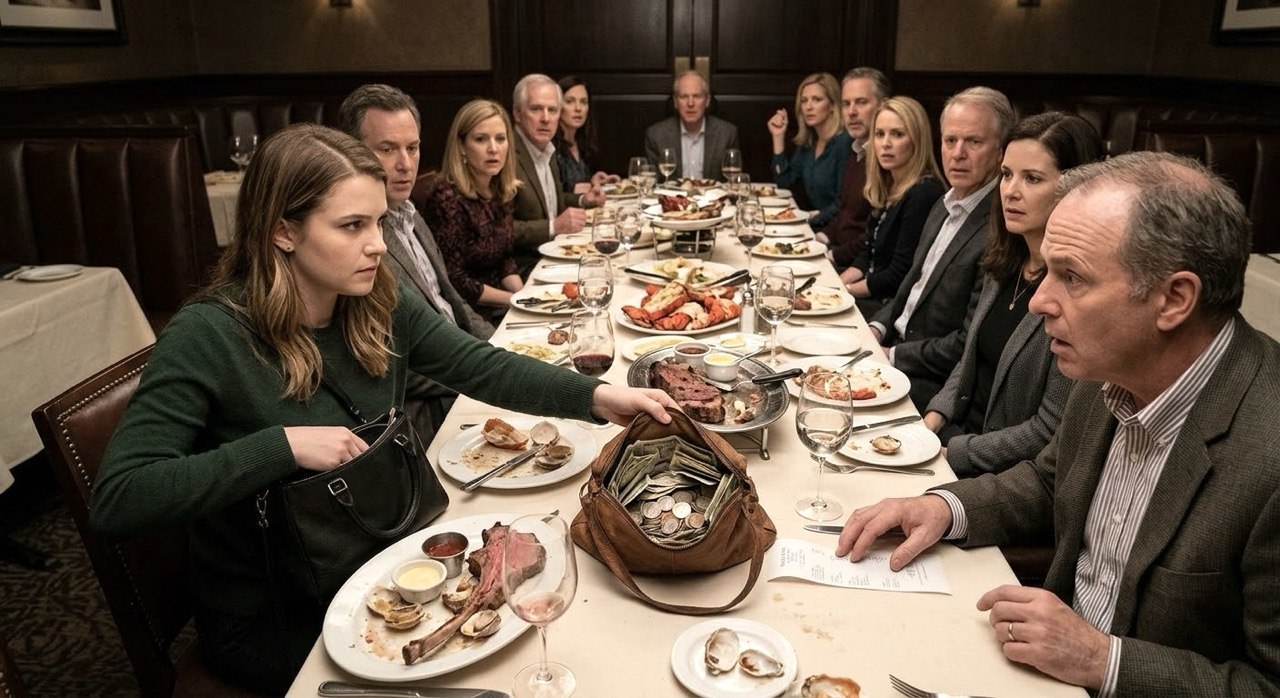
The message arrived on a Tuesday afternoon while I was sitting at my desk, staring at a spreadsheet that had stopped making sense twenty minutes earlier.
Mom’s name appeared on my phone.
For several seconds, I simply watched it glow against the dark screen. My mother hadn’t called me in three years. Not on my birthday, not at Christmas, not even when a storm had knocked out power across half of Maine and the news reported widespread damage. The last time we’d spoken, she’d been standing in my grandmother’s kitchen, insisting that I was destroying the family over a piece of property.
Now she was calling as if nothing had happened.
I let it ring twice more before answering.
“Chloe?”
Her voice sounded smaller than I remembered. There was a slight tremor at the end of my name, the familiar one she’d used when I was a child and she’d found me crying after a nightmare.
“Hi, Mom.”
“Oh, sweetheart. I’m so glad you picked up.”
I leaned back in my office chair. Through the glass wall, I could see two colleagues arguing over a presentation. Their voices were muffled, and the fluorescent lights hummed overhead.
“Is everything okay?”
“Yes. Everything’s fine. I just…” She paused. I heard dishes clinking in the background. “Your father and I have been talking, and we think it’s time we stopped letting the past come between us.”
The word past landed awkwardly between us.
I looked down at my left hand, where a thin silver ring caught the office light. Grandma Helen had given it to me when I turned twenty-one. She’d worn it for decades before passing it along, telling me that the most important things in life weren’t necessarily the most expensive.
“That’s a pretty big conversation to start over the phone,” I said.
“I know. That’s why we wanted to see you.”
My shoulders tightened.
Three years earlier, my parents had made it clear that seeing me was conditional. They wanted access to the lake house my grandmother had left me, and they wanted me to transfer ownership or sell it so my brother, Liam, could have a larger financial cushion for his growing family.
I’d refused.
My grandmother had made her wishes unmistakable. The property was mine. She’d also left me a substantial investment portfolio, which my parents considered another family asset that had somehow ended up in the wrong hands.
After I refused to change the arrangements, the arguments became vicious. My father accused me of being selfish. Liam called me an ungrateful daughter. Mom cried and said I was choosing an empty summer house over the people who had loved me my entire life.
Eventually, I stopped answering their calls.
They stopped making them.
For three years, silence became the only boundary they couldn’t talk their way around.
“What exactly are you proposing?” I asked.
“Dinner. Just a proper family dinner. Somewhere nice. We could talk things through without all the old anger.”
“Who’s going?”
“Your father and me, of course. Liam and his family might come. Maybe a few relatives.”
I closed the spreadsheet on my computer.
“A few relatives?”
She laughed lightly. “You know how your father is. He likes having everyone together.”
That was true. My father, Howard Miller, enjoyed being the center of a room. He liked long speeches, expensive restaurants, and the particular kind of attention that came from having people agree with him. He also had an uncanny ability to turn every family gathering into an occasion where somebody owed him something.
Still, I couldn’t deny that part of me wanted to believe her.
I missed my mother. I missed the ordinary things: the Sunday calls, the recipes she’d send me, the way she used to remember which flowers I liked and bring them home without being asked.
I even missed Liam sometimes, though the brother I remembered seemed increasingly distant from the man he’d become.
“When?” I asked.
“This Friday. Seven o’clock.”
“That’s soon.”
“Your father thought it would be better not to give everyone too much time to get nervous.”
I almost smiled at that. It sounded like something my mother would say when she wanted to make a questionable decision seem harmless.
“Where?”
“The Harborside. You remember it, don’t you? Near the water in Boston.”
I did. The restaurant had tall windows overlooking the harbor, white tablecloths, and a reputation for serving seafood that cost more than my first car payment. It was the kind of place my father loved because the menu required no explanation of the prices.
“That’s an expensive restaurant.”
“Your father chose it.”
Naturally.
“Mom, I’m agreeing to dinner. I’m not agreeing to anything else.”
There was a short silence.
“Of course not. Nobody expects anything from you.”
I wanted to ask whether she understood the significance of that sentence. Whether she remembered how many times I’d heard similar assurances before being presented with a demand.
Instead, I said, “All right. I’ll come.”
Her relief was immediate.
“Oh, Chloe. Thank you. You have no idea how much this means to me.”
I wasn’t sure whether that was true. But I didn’t challenge her.
After we hung up, I sat motionless for a while, looking at the blank spreadsheet on my monitor. A strange mixture of hope and apprehension settled in my chest.
Then my phone buzzed.
A text from an unknown number appeared.
Friday should be interesting. Looking forward to seeing you.
I stared at it before recognizing the number as my cousin Claire’s. We hadn’t spoken much since the family dispute, although she had always been quieter and less confrontational than the others.
I typed a polite response and returned to work.
That evening, I drove home through Boston traffic with the radio turned low. The sky was turning a bruised shade of purple above the buildings, and headlights stretched into long reflections on the wet pavement.
My apartment was quiet when I arrived. I dropped my keys into the ceramic bowl by the door, changed into comfortable clothes, and heated leftover soup.
The lake house crossed my mind while I ate.
It sat in a small town in Maine, tucked among pines beside a cold, clear lake. The porch boards creaked in three familiar places. The kitchen cabinets had chipped wooden handles, and one bedroom window never closed properly unless you lifted it before pulling the latch.
It wasn’t a luxurious property. Its value came from its location and the fact that Grandma Helen had spent most of her happiest years there.
I’d learned to swim off its dock. I’d fallen asleep listening to rain strike the metal roof. I’d spent entire summers helping Grandma tend a vegetable garden that never produced quite enough tomatoes.
When she died, she’d left the house to me.
My parents hadn’t taken the news well.
They’d expected the property to pass to my father, or at least to be divided between him and Liam. Grandma had other plans. She’d also left financial assets to several family members, but the largest portion of her investments and the lake house had gone to me.
I understood why. I’d spent years helping her with errands, repairs, appointments, and the countless small tasks that become difficult when age begins to narrow a person’s world.
My father saw it differently. He believed I had benefited from a relationship that should have been shared equally among the family.
The last argument had taken place in that same Maine kitchen.
He’d stood beside the refrigerator, his face flushed, demanding that I reconsider the inheritance. Liam had been beside him, arms crossed, looking at me as if I’d personally emptied his children’s college funds.
I remembered my own voice, unusually steady.
“Grandma made her decision.”
Dad had slapped his palm against the counter.
“You’re going to regret putting a building ahead of your family.”
Mom hadn’t told him to stop. She’d simply looked at me with exhausted disappointment.
That was when something inside me finally gave way.
I left that afternoon and didn’t return their calls.
Now, three years later, my mother was inviting me to dinner.
I wanted to believe people could change. I wanted to think that enough time had passed for anger to soften and perspective to take its place.
But I also knew that a peaceful invitation didn’t erase the reasons peace had become impossible.
On Thursday morning, I found myself checking my bank account for no particular reason. My finances were comfortable, but I lived quietly. I drove a reliable car, maintained a modest apartment, and invested most of what I earned.
Grandma’s portfolio was another matter. A significant portion had been placed in a high-yield term investment with a maturity date scheduled for that month.
I knew the date. I’d marked it on my calendar months earlier.
I hadn’t told anyone.
There had been no announcement, no celebration, no sudden purchases. The money was simply part of a larger financial plan, and I had no intention of discussing it with relatives who had already demonstrated how they felt about my inheritance.
I closed the account page and went back to work.
That afternoon, Mom sent another message.
Wear something nice on Friday. Your father has made a special reservation.
I read it twice.
There was something about the word special that made me uneasy. Still, I told myself not to invent trouble before it existed.
For the first time in three years, I was going to sit across a table from my parents without an argument already waiting between us.
I decided to give the evening a chance.
Click here to continue reading: PART 2: The Restaurant Windows Revealed a Gathering Far Larger Than the Reconciliation Dinner I Had Agreed To Attend
Three Years of Silence Ended With an Invitation That Felt Almost Too Ordinary to Question
Part 1 of 40

