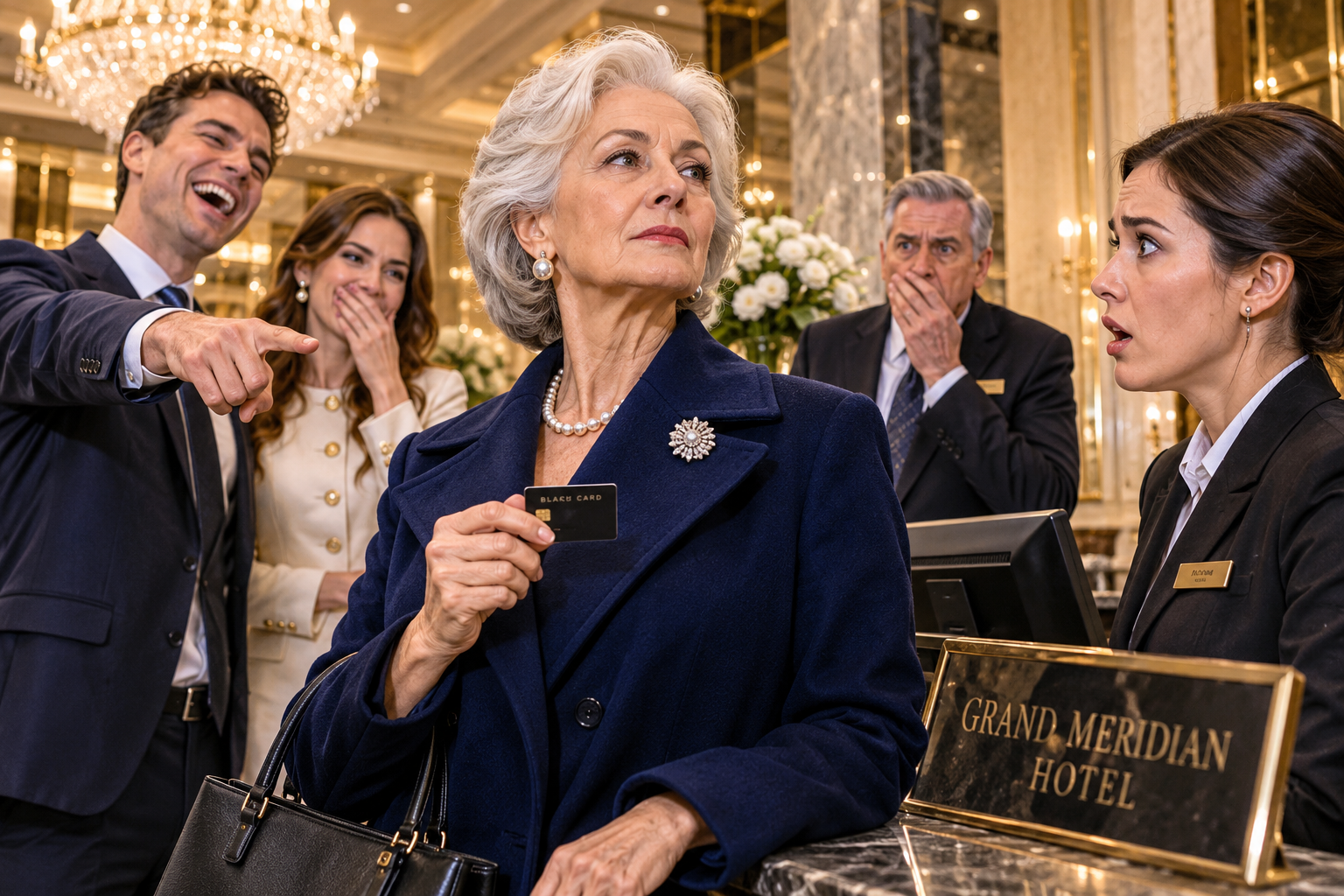
The receptionist looked at the name embossed on my black metal card.
Then she looked at her computer screen.
Then, very slowly, she looked back at me.
“Mrs. Whitmore,” she whispered.
Daniel was still laughing.
“What’s so funny?” he asked her. “Did my mother actually convince you she’s going to pay eighteen thousand dollars for a room?”
The receptionist didn’t answer.
Instead, she picked up the telephone beneath her desk.
“Mr. Harrison? I’m sorry to disturb you. We have a situation at the front desk. Mrs. Eleanor Whitmore is here.”
There was a pause.
I watched the receptionist’s expression change.
Her shoulders straightened.
“Yes, sir. She’s physically here. And there’s been an issue with her reservation.”
Another pause.
Then she said something that made Daniel stop smiling.
“Of course, sir. I’ll make sure nobody leaves until you’ve arrived.”
She hung up.
Daniel frowned.
“Who was that?”
“The general manager,” she replied.
“Good. Tell him to explain why my mother is making such a scene.”
I almost smiled.
He had no idea.
Not even the slightest idea.
Three minutes later, the private elevator opened.
A tall man in a charcoal suit stepped into the lobby, moving so quickly that his assistant struggled to keep pace.
He was in his late fifties, with silver hair and a familiar face.
His name was Thomas Harrison.
I had hired him seventeen years earlier, when the Grand Meridian was still a struggling property operating under a different ownership group.
He had been a young operations director then.
I remembered interviewing him in a small conference room, where he had nervously spilled coffee over his notes.
I had hired him anyway.
Over the years, Thomas had become one of the finest hotel executives in the country.
When he saw me, he stopped.
“Mrs. Whitmore.”
His voice carried across the lobby.
Then he walked straight toward me.
“Good heavens. Why didn’t you tell us you were coming?”
I extended my hand.
“Hello, Thomas.”
He didn’t shake it.
He took both my hands instead.
“It’s wonderful to see you. We haven’t had the pleasure of welcoming you personally in nearly two years.”
Daniel looked between us.
“Wait. You know my mother?”
Thomas turned.
For the first time, he seemed to notice Daniel standing beside me.
His expression became formal.
“Of course I know Mrs. Whitmore.”
Daniel gave a short laugh.
“She’s just my mother.”
Thomas’s eyes moved to me.
I gave him a small nod.
He understood immediately that I hadn’t told Daniel anything.
“Mrs. Whitmore,” he said carefully, “may I ask what happened?”
I glanced at the receptionist.
“She informed me that my reservation had been canceled.”
Thomas’s expression hardened.
“Canceled?”
“Yes. Apparently, my room was reassigned to accommodate my son’s in-laws.”
Thomas looked at the computer.
“Whose authorization?”
The receptionist swallowed.
“Mr. Daniel Whitmore called earlier this afternoon. He said he was handling the family’s arrangements and requested that his mother’s reservation be canceled.”
Daniel interrupted.
“That’s right. I made the change. My in-laws needed a larger room, and my mother doesn’t require anything special.”
Thomas stared at him.
“Did you have Mrs. Whitmore’s permission?”
Daniel shrugged.
“She wouldn’t mind. She’s family.”
Thomas turned toward the receptionist.
“Please bring me the reservation history.”
She immediately began typing.
Daniel sighed.
“Look, can we stop making this complicated? My wife’s parents are upstairs. They’ve already unpacked. Just give Mom another room.”
Thomas didn’t respond.
He was reading the screen.
Then he looked at me.
“Mrs. Whitmore, I sincerely apologize. This should never have happened.”
“Thank you, Thomas.”
He turned toward the receptionist.
“Restore her original reservation. And prepare the presidential suite immediately.”
Daniel laughed again.
“That’s exactly what I was trying to tell her. She doesn’t need the presidential suite.”
Thomas looked at him.
“Sir, I wasn’t asking for your opinion.”
The words landed harder than a shout.
Daniel’s mouth fell open.
Vanessa stepped forward.
“Excuse me? Do you know who you’re speaking to?”
Thomas remained perfectly calm.
“I do.”
“Then perhaps you should remember that we’re paying guests.”
Thomas nodded.
“Your reservation is registered under Mr. and Mrs. Daniel Whitmore. That is correct.”
“And?”
“And Mrs. Eleanor Whitmore is not simply another guest in this hotel.”
Daniel rolled his eyes.
“Oh, here we go.”
Thomas ignored him.
“Mrs. Whitmore is the founder and controlling owner of Whitmore Hospitality Holdings.”
Silence.
The lobby seemed to grow strangely quiet.
Daniel blinked.
Once.
Twice.
Then he laughed.
Not because anything was funny.
Because his mind had refused to accept what he had heard.
“That’s ridiculous.”
Thomas didn’t move.
“I’m afraid it isn’t.”
“My mother?”
“Yes, sir.”
“My mother owns this hotel?”
“Whitmore Hospitality Holdings owns the Grand Meridian and several other properties in its portfolio.”
Daniel looked at me.
I didn’t look away.
He seemed to be searching my face for some indication that this was a joke.
“Mom?”
I reached for my handbag.
“Daniel, I believe you have met Thomas before.”
Thomas nodded.
“Your mother introduced you to me at the Whitmore Foundation dinner three years ago.”
Daniel’s expression shifted.
That evening came back to him.
I could see it.
He had attended the dinner wearing a new tuxedo, boasting about his business connections and introducing Vanessa to several executives.
I had been seated at the head table.
He had assumed I was there as a wealthy donor.
He had never bothered to ask why everyone kept coming to me for approval.
Thomas continued.
“Mrs. Whitmore has been exceptionally generous to this hotel. She personally approved the renovation program that transformed the property into what it is today.”
Daniel stared at him.
“But she told me she was retired.”
“She is retired from daily operations,” Thomas replied. “She remains the chairwoman of the holding company.”
Vanessa’s arms slowly dropped to her sides.
I turned toward her.
“Good evening, Vanessa.”
She managed a thin smile.
“Eleanor. We didn’t know you were…”
She stopped.
I waited.
“Were what?” I asked.
Her cheeks reddened.
Daniel stepped closer.
“Mom, why didn’t you tell me?”
I looked at him for several seconds.
Then I answered honestly.
“Because you never asked.”
He opened his mouth.
Nothing came out.
I had spent years wondering whether I should tell my son the truth about my business.
I had considered explaining everything after his wedding.
Then after his first promotion.
Then when he bought his apartment.
Each time, I convinced myself that there would be a better moment.
I wanted him to love me without knowing how much money I had.
I wanted him to visit because he missed me, not because he wanted something.
I wanted to be his mother.
Not his financial resource.
And I had made a mistake.
I had protected his illusion for so long that he had begun to mistake my generosity for weakness.
Thomas stepped beside me.
“Your suite is ready, Mrs. Whitmore. We have also arranged for your luggage to be brought up.”
“Thank you.”
He hesitated.
“Would you like me to have security accompany you?”
I looked at Daniel.
My son was staring at the marble floor.
“No,” I said. “I don’t believe that’s necessary.”
Thomas nodded.
“Very well.”
Then he turned toward the receptionist.
“One more thing. Please ensure that Mrs. Whitmore’s original payment authorization remains untouched. Nobody is to access her account or modify her reservation without her direct approval.”
“Certainly, sir.”
I picked up my overnight bag.
Daniel suddenly reached for my arm.
“Mom, wait.”
I stopped.
“What?”
He lowered his voice.
“Can we talk privately?”
I studied him.
A few minutes earlier, he had been perfectly comfortable humiliating me in front of strangers.
Now he wanted privacy.
“About what?”
“About this whole misunderstanding.”
I gently removed his hand.
“There’s no misunderstanding, Daniel.”
His eyes darted toward the receptionist.
“Mom, please.”
Vanessa stepped beside him.
“Eleanor, I think everyone is a little tired. Maybe we should sit down and discuss things calmly.”
I nodded.
“That’s a reasonable suggestion.”
Daniel seemed relieved.
Then I added:
“Tomorrow morning. Not tonight.”
His expression fell.
I walked toward the elevator.
For the first time that evening, nobody laughed.
The presidential suite occupied the entire corner of the thirty-second floor.
It had a sitting room with tall windows overlooking Central Park, a dining area, a private study, and a bedroom larger than the apartment Daniel and Vanessa had once rented.
I had stayed in that suite before.
I knew the pale stone fireplace, the cream-colored furniture, and the enormous windows that made Manhattan look like a miniature city.
Yet that night, I barely noticed the luxury.
I placed my overnight bag on the luggage bench and stood beside the window.
Below me, headlights moved through the streets like tiny ribbons of light.
My phone began vibrating.
Daniel.
I let it ring.
Then it rang again.
Vanessa.
Then Daniel again.
I finally turned it off.
A soft knock came at the door.
When I opened it, Thomas stood outside with a small silver tray.
“May I come in?”
“Of course.”
He entered and placed the tray on the table.
There was a handwritten note beside a small birthday cake.
The note read:
Happy seventieth birthday, Mrs. Whitmore. Thank you for everything you’ve done for us.
I smiled.
“That’s thoughtful.”
Thomas looked uncomfortable.
“There’s something else I wanted to discuss.”
I gestured toward the sofa.
“Sit down.”
He remained standing.
“Your son has been making inquiries about the hotel’s executive development program.”
I looked up.
“Daniel?”
“Yes.”
“What kind of inquiries?”
Thomas hesitated.
“He contacted our regional director last month. He mentioned that he was interested in becoming a regional operations executive. He also said that he had received assurances from senior leadership that his application would receive special consideration.”
I slowly placed my teacup down.
“Who gave him those assurances?”
Thomas looked at me.
“He said you had discussed it with him.”
I shook my head.
“I haven’t.”
Thomas sighed.
“I suspected as much.”
I remembered something.
Three years earlier, Daniel had asked me whether I knew anyone in the hospitality industry who could help him advance his career.
He was working in commercial property management at the time.
He had complained that his employer overlooked his contributions.
I had contacted a former business associate and recommended him for an interview with one of our partner companies.
He had received the position.
I had never told him that my recommendation had helped open the door.
I wanted him to earn his place.
He had done well initially.
But over time, he began speaking about his success as though it had been achieved entirely through his own influence.
That was not necessarily a problem.
I had never expected gratitude for every opportunity.
What troubled me was the entitlement that seemed to have grown alongside his confidence.
“What position is he being considered for?” I asked.
“Regional vice president of guest operations.”
I raised my eyebrows.
“That’s a significant responsibility.”
“It is. The position oversees six properties, including staffing, budgets, guest experience, and operational compliance.”
“Does he have the experience?”
Thomas was quiet.
“Some of it. But not all of it.”
I waited.
“He has also requested access to internal financial reports and confidential operating projections.”
I turned toward him.
“On what authority?”
“He presented himself as a prospective executive candidate and claimed he had approval from the ownership office.”
I felt a familiar heaviness settle in my chest.
“Has he received anything?”
“No. Our compliance department flagged the requests because he isn’t authorized to access those records.”
“Good.”
Thomas looked relieved.
“I thought you should know before tomorrow’s meeting.”
I stood and walked toward the window.
“Thomas, I want you to do something for me.”
“Anything.”
“Do not dismiss him simply because he’s my son.”
“Of course.”
“But do not advance him because he’s my son either.”
Thomas nodded.
“I understand.”
“And please preserve every communication relating to his requests. I want the records handled according to our normal procedures.”
“Certainly.”
He hesitated.
“Mrs. Whitmore, may I say something?”
“Please.”
“I’ve known you for seventeen years. I’ve seen you handle difficult investors, dishonest contractors, and executives who believed their titles made them untouchable.”
I smiled faintly.
“That’s a rather unpleasant collection of memories.”
He smiled too.
“But I’ve never seen anyone treat you as your son treated you tonight.”
I looked down at my hands.
“No. Neither have I.”
Thomas stood.
“Happy birthday, Mrs. Whitmore.”
“Thank you, Thomas.”
After he left, I sat alone beside the birthday cake.
I didn’t cry.
Not immediately.
I simply stared at the little candles that someone had thoughtfully placed on top.
Seventy years.
I had lived through the death of my husband, the collapse of my first business partnership, the birth of my son, and the years when I worked eighteen-hour days to keep our family afloat.
I had survived things far more difficult than a canceled hotel reservation.
But there was something particularly painful about discovering that the person you had spent your life protecting had learned to use your kindness against you.
I cut a small slice of cake.
Then I made a decision.
The following morning, I would no longer pretend that everything was fine.
At eight-thirty, I dressed in a simple ivory blouse, dark trousers, and the pearl earrings my husband had given me on our twenty-fifth wedding anniversary.
I had the hotel bring breakfast to the suite.
At nine, Thomas arrived.
He carried a thin folder.
“Good morning.”
“Good morning.”
“Your son and daughter-in-law are waiting downstairs. Their request is to meet in the private conference room.”
“Then let’s go.”
Before leaving, I asked one question.
“Thomas, have you reviewed the reservation issue?”
“Yes. The original booking was made six weeks ago. It was prepaid and confirmed directly by our reservations department.”
“And Daniel canceled it?”
“Yes.”
“Did he have permission to do that?”
“No.”
“Did anyone tell him he could?”
“No.”
I nodded.
“Then let’s begin with the facts.”
The private conference room overlooked Madison Avenue.
Daniel was already seated when I entered.
He wore the same expensive jacket from the previous evening.
Vanessa sat beside him, scrolling through her phone.
Two cups of untouched coffee stood on the table.
Daniel immediately rose.
“Mom.”
I took the chair opposite him.
“Good morning.”
Vanessa put down her phone.
“Eleanor, thank you for agreeing to meet.”
Thomas remained near the door.
Daniel glanced at him.
“Could we have a few minutes alone?”
I shook my head.
“Thomas is here because this meeting concerns the hotel. He will stay.”
Daniel looked irritated.
“Fine.”
I folded my hands on the table.
“Let’s start with your decision to cancel my reservation.”
He sighed.
“Mom, I already explained that. Vanessa’s parents needed a bigger room.”
“Did you ask me?”
“No.”
“Did you inform me?”
“I thought you wouldn’t mind.”
“Why?”
He rubbed his forehead.
“Because you’re always saying you don’t care about luxury.”
I looked at him.
“Not caring about luxury is not the same as giving someone permission to take what belongs to me.”
Vanessa interrupted.
“Your reservation was just a hotel room. We didn’t steal your house.”
I turned toward her.
“You didn’t have the right to take either.”
She stiffened.
Daniel leaned forward.
“Mom, this is getting ridiculous. We were trying to accommodate everyone.”
“Were you?”
“Yes.”
“Then why did you tell me to sleep in the lobby?”
He looked away.
“I was joking.”
“Were you?”
“Yes.”
“Did you think it was funny?”
He hesitated.
“Mom…”
“Answer me.”
He exhaled.
“I shouldn’t have said it.”
“That isn’t an answer.”
Vanessa crossed her arms.
“Eleanor, we’re all adults. There is no reason to turn one comment into a family crisis.”
I studied her.
“One comment?”
She said nothing.
“You watched your husband humiliate his seventy-year-old mother in a hotel lobby. You smiled while he did it. You never once suggested that perhaps he should find another solution.”
Her cheeks reddened.
“I was trying to keep things peaceful.”
“No. You were enjoying the situation.”
Daniel pushed his chair back.
“Can we please stop attacking Vanessa?”
I nodded.
“Certainly. We can discuss you instead.”
He sat down again.
I opened the folder Thomas had brought.
Inside were copies of the original reservation, the cancellation record, and the communication from the front desk.
I placed them on the table.
“Your cancellation request stated that you were authorized to make changes on behalf of the primary guest.”
Daniel glanced at the document.
“So?”
“So, that statement was false.”
He shrugged.
“I didn’t think it mattered.”
“It mattered enough that the hotel recorded it.”
Thomas spoke for the first time.
“Our reservation policy requires the primary guest’s authorization before a prepaid booking can be canceled or transferred. We have reviewed the call recording and the written notes.”
Daniel looked uncomfortable.
“Are you accusing me of fraud?”
“No,” Thomas replied evenly. “I’m explaining the hotel’s records.”
I raised my hand slightly.
“Thomas, thank you.”
Then I looked at my son.
“Daniel, I want you to understand something. The problem isn’t the cost of the room.”
He stared at me.
“The problem is that you believed you could decide what happened to my property, my money, and my dignity without asking me.”
He shook his head.
“You’re making me sound like some terrible person.”
“No, Daniel. I’m describing what you did.”
Vanessa looked toward the windows.
For several seconds, nobody spoke.
Then Daniel asked the question I had expected.
“So what happens now?”
I closed the folder.
“That depends on what you’re asking.”
He looked confused.
“What do you mean?”
“Are you asking what happens to your hotel reservation? Or what happens to your position in the company?”
His eyes widened.
“My position?”
I nodded.
Thomas placed another folder on the table.
Daniel looked at it.
“What is that?”
“Your application for the regional vice president position,” I answered.
His face changed.
“You’ve been looking into that?”
“I’ve been informed of it.”
“I applied through the normal process.”
“That is your right.”
He glanced at Thomas.
“Is there a problem?”
Thomas answered carefully.
“Your application is being reviewed. However, certain statements you made during your preliminary discussions require clarification.”
Daniel frowned.
“What statements?”
“You indicated that the ownership office had guaranteed your advancement.”
Daniel looked at me.
“I said you supported my career.”
“Did I promise you that position?”
“No.”
“Did I authorize you to represent my approval as a guarantee?”
He hesitated.
“I didn’t mean it that way.”
“Then you should have chosen your words more carefully.”
Vanessa leaned forward.
“Surely family members are allowed to help each other.”
“Of course,” I replied. “But a senior executive position is not a family favor.”
Daniel’s jaw tightened.
“Mom, I’ve worked hard for years.”
“I know.”
“I have qualifications.”
“I know.”
“Then why are you treating me like I don’t deserve an opportunity?”
I paused.
“Because deserving an interview and being entitled to a promotion are two different things.”
He looked furious.
I continued.
“You will be evaluated according to your experience, your performance, and the same standards applied to every other candidate. I will not interfere with that process.”
Daniel laughed bitterly.
“So you’re going to let strangers decide whether your own son gets a job?”
“Yes.”
He stared at me.
I had never seen him look quite so lost.
For years, he had assumed that if he needed something, I would eventually arrange it.
A recommendation.
A loan.
A business introduction.
A temporary solution to a permanent problem.
He had mistaken my willingness to help for an obligation.
And now, for the first time, I was refusing to make his choices easier.
The next issue came from Vanessa.
She had remained unusually quiet, but now she sat forward.
“There’s something else we need to discuss.”
I waited.
“Your son has been under tremendous pressure. He’s trying to build a future for us. We thought you might want to help.”
I looked at Daniel.
“Help with what?”
He cleared his throat.
“It’s about the property in Connecticut.”
I knew which property he meant.
Three months earlier, Daniel had told me he was considering buying a house outside the city.
He had sent me photographs of a large colonial-style home with a garden and a swimming pool.
He had mentioned the price several times.
At the time, I had assumed he was simply excited.
Now I understood.
“You want me to help purchase the house?”
Daniel shifted in his chair.
“Not purchase it entirely. We were hoping you might contribute toward the down payment.”
“How much?”
He looked at Vanessa.
She answered.
“Three hundred thousand dollars.”
I remained silent.
Daniel quickly added:
“We would pay you back.”
“When?”
“We haven’t worked out the details yet.”
I nodded.
“So you want three hundred thousand dollars without an agreed repayment schedule.”
“Mom, it’s not like that.”
“Then explain it.”
He sighed.
“It’s an investment in the family.”
I looked at Vanessa.
“Is it?”
She looked surprised.
“Of course.”
“Would the house be in my name?”
“No.”
“Would I have any ownership interest?”
Daniel shook his head.
“We would own it.”
“Would I have a written agreement protecting my contribution?”
He looked irritated.
“Why would you need that? We’re family.”
I smiled sadly.
“That sentence has become rather expensive.”
Neither of them spoke.
I continued.
“Daniel, I have spent much of my life helping people. I have financed scholarships, supported employees through difficult periods, and helped small businesses survive when banks refused to lend.”
I leaned forward.
“But I do not give away three hundred thousand dollars because someone calls it family.”
Vanessa’s expression hardened.
“So you’re refusing?”
“Yes.”
Daniel stared at me.
“After everything?”
I raised my eyebrows.
“After everything what?”
“After all the years I’ve been your son?”
For the first time that morning, I felt anger rising.
Not loud anger.
Something colder.
“Being my son has never been a debt you owe me, Daniel. And being your mother does not mean I owe you unlimited access to my money.”
He looked down.
I continued.
“If you want to buy a house, I hope you succeed. Save for it. Find a mortgage you can afford. Build your own future.”
Vanessa stood.
“This is unbelievable.”
I looked at her.
“What is?”
“You have all this money, and you’re refusing to help your own family.”
I took a breath.
“Vanessa, I have money because I worked for it. I did not acquire it so that other people could make decisions about how to spend it.”
She picked up her handbag.
“Daniel, let’s go.”
He remained seated.
I turned toward him.
“There’s one more thing.”
He looked up.
“Your current hotel charges.”
Thomas opened the folder.
“Your reservation covers the first two nights. However, the suite originally assigned to your wife’s parents was upgraded at your request. The difference has not yet been settled.”
Daniel frowned.
“I thought the company was covering it.”
Thomas shook his head.
“No. Your booking is a personal reservation. There is no corporate payment authorization.”
Daniel turned toward me.
“Mom, could you just put it on your account? We’ll sort it out later.”
I looked at him.
“No.”
He stared.
“It’s only a hotel bill.”
“Then you should have no trouble paying it.”
His face flushed.
Vanessa whispered something to him.
I stood.
“Thomas will explain the available payment arrangements. Your parents-in-law are welcome to remain in their room for the remainder of their paid stay, subject to the hotel’s ordinary policies.”
Daniel looked relieved.
“But?”
I met his eyes.
“But nobody will use my account without my permission again.”
Then I picked up my handbag.
“Have a good day.”
I spent the afternoon walking through the hotel.
I spoke to the housekeeping supervisor.
I stopped by the kitchen.
I visited the small flower shop near the entrance.
I had known some of those employees for years.
One of the older doormen, a man named George, recognized me immediately.
“Mrs. Whitmore!”
I smiled.
“Hello, George.”
He took off his cap.
“It’s been too long.”
“I’m sorry about that.”
He looked toward the elevators.
“I heard there was a little trouble yesterday.”
I sighed.
“News travels quickly.”
“Only because people were worried about you.”
I touched his arm.
“I’m perfectly fine.”
He smiled.
“That’s good. And happy birthday.”
I thanked him.
Then he said something that stayed with me.
“You know, Mrs. Whitmore, people always talk about how beautiful this hotel is. But I think what makes it special is that you remember the people who work here.”
I looked at him.
“That’s because the people are the hotel, George. Not the marble.”
He laughed.
“That’s exactly what you said when you opened the new entrance.”
I smiled.
I remembered.
There had been a contractor who wanted to replace the old staff entrance with something more impressive.
I had refused.
The employees deserved a clean, safe, dignified entrance just as much as the guests deserved a beautiful lobby.
That had been seventeen years earlier.
Some things were worth remembering.
At six that evening, I received a call from an unfamiliar number.
It was Vanessa’s mother.
Her name was Patricia.
I had met her several times at family gatherings, but we had never been close.
“Eleanor?”
“Hello, Patricia.”
She sounded uncomfortable.
“I hope I’m not disturbing you.”
“Not at all.”
“I wanted to apologize for what happened yesterday.”
I sat down.
“Why are you apologizing?”
She sighed.
“Because I should have said something.”
I waited.
“Daniel told us that he had arranged everything. He said you had agreed to give up your room because you wanted us to have the larger suite.”
I closed my eyes briefly.
“I see.”
“We didn’t know he had canceled your reservation without permission.”
“Did you?”
“No. Not until this morning.”
Her voice softened.
“Eleanor, I want you to know that we never intended to take anything from you.”
I believed her.
At least, I believed that she had not known the full story.
“Thank you for calling, Patricia.”
She hesitated.
“There’s something else.”
“Yes?”
“Vanessa is very upset. She says you embarrassed Daniel in front of the hotel staff.”
I looked out at the city.
“I didn’t embarrass him, Patricia. I simply refused to pretend that what he did was acceptable.”
“I understand.”
“Do you?”
There was a long pause.
Then she answered quietly.
“I think I do.”
She told me that she and her husband would be leaving the following morning.
They had already arranged another hotel for the rest of their visit.
Before ending the call, she said something unexpected.
“Your birthday should have been a happy occasion. I’m sorry we became part of something painful.”
I thanked her.
After we hung up, I sat for a while.
It was a strange feeling.
A woman who wasn’t my daughter had found the courage to apologize for something my own son still refused to acknowledge properly.
I wasn’t sure what to do with that realization.
The next morning, Thomas requested a private meeting.
This time, he brought a woman named Rebecca Collins, the company’s human resources director.
She had been with Whitmore Hospitality Holdings for eleven years.
I knew her well.
She placed several documents on the table.
“Mrs. Whitmore, we completed the preliminary review of Mr. Whitmore’s application.”
I nodded.
“Please continue.”
Rebecca explained that Daniel had submitted a résumé containing several inaccurate descriptions of his previous responsibilities.
He had described himself as having managed a regional portfolio when his actual role had involved oversight of a single commercial property.
He had also listed several financial planning responsibilities that, according to his former employer’s reference, had been handled by a separate accounting department.
I listened without interrupting.
“Has he deliberately falsified his experience?” I asked.
“We cannot establish intent at this stage,” Rebecca replied. “But the discrepancies are significant enough that we cannot proceed without clarification.”
“Has he been given an opportunity to respond?”
“Yes. He has been asked to provide supporting documentation.”
I nodded.
“Good.”
Rebecca continued.
“There is another matter.”
She opened a second folder.
“During the past six weeks, Mr. Whitmore has contacted two employees at different properties. He requested confidential information about operating budgets and upcoming acquisitions.”
I looked at Thomas.
“Were those requests authorized?”
“No.”
“Did he receive the information?”
“No. Both employees followed company policy and referred the requests to compliance.”
I leaned back.
“Then what is the concern?”
Rebecca chose her words carefully.
“Mr. Whitmore represented that he was already part of the ownership transition planning process.”
I felt my stomach tighten.
“What ownership transition?”
“That is precisely what we wanted to clarify.”
I looked at her.
“I have not announced an ownership transition.”
Thomas nodded.
“We know.”
Rebecca continued.
“However, one of the employees reported that Mr. Whitmore said he expected to assume a senior leadership position once you reduced your involvement in the company.”
I stared at the folder.
Daniel had not simply assumed that I would help him.
He had begun telling people that my business would eventually become his.
I thought about the years I had spent building the company.
The difficult negotiations.
The properties that had nearly bankrupted us.
The employees who had trusted me when everything looked uncertain.
And my son was already speaking as though the future belonged to him.
“Rebecca,” I said quietly, “what is your recommendation?”
She answered immediately.
“His application should be placed on hold pending a full review. He should also be informed that he has no authority to represent the company or access confidential information.”
“Agreed.”
Thomas looked at me.
“Would you like to issue a statement to the regional directors?”
“Yes. A simple one.”
I dictated the wording.
It stated that Daniel Whitmore was not an authorized representative of Whitmore Hospitality Holdings and had not been appointed to any executive or succession role.
All future leadership appointments would follow the company’s established governance process.
I signed the document.
Then I asked Rebecca to circulate it to the appropriate executives.
I wasn’t trying to destroy my son’s career.
I was protecting a company that employed hundreds of people.
Those people deserved better than an organization where family connections could replace competence.
Daniel arrived at the hotel shortly after noon.
He asked to see me.
This time, he came alone.
When I entered the small sitting room where he was waiting, he looked exhausted.
His jacket was gone.
His shirt collar was open.
There were dark circles beneath his eyes.
“Mom.”
“Daniel.”
He stood.
“Can we talk?”
“Of course.”
He didn’t sit immediately.
Instead, he walked toward the windows.
“I spoke to Thomas.”
I remained quiet.
“He told me my application is on hold.”
“Yes.”
“And that a statement was sent to the regional directors.”
“Yes.”
He turned.
“You’ve made me look like a liar.”
I studied him.
“Did you tell people you had an ownership role?”
He looked away.
“I was trying to show that I had a future with the company.”
“That wasn’t my question.”
He sighed.
“I may have exaggerated.”
“Why?”
“Because I wanted them to take me seriously.”
I sat down.
“Daniel, people take you seriously when your work gives them a reason to.”
He shook his head.
“You don’t understand how difficult it is to get ahead.”
I almost laughed.
Not because it was funny.
Because he was standing in front of a woman who had spent forty years building a business from almost nothing.
“Tell me about it,” I said.
He looked at me.
“What?”
“Tell me how difficult it is.”
He pulled out a chair and sat down.
“I’ve worked hard. I’ve spent years trying to move up. I watch people with connections get promoted while I stay in the same place.”
I nodded.
“That must be frustrating.”
“It is.”
“And you believe my company would solve that problem?”
He hesitated.
“I thought it might give me a chance.”
“A chance is something you earn, Daniel. Not something you inherit.”
He rubbed his face.
“I know.”
I looked at him.
“Do you?”
He didn’t answer.
After a moment, he spoke again.
“Vanessa says you’re doing all this because you don’t like her.”
I sighed.
“Is that what you believe?”
He shrugged.
“She thinks you never accepted her.”
I leaned forward.
“Daniel, I welcomed Vanessa into our family. I attended your wedding. I helped you furnish your first apartment. I invited her parents to holidays. I never asked her to change her personality or her ambitions.”
He looked down.
“Then why is she so angry?”
“Perhaps because I have finally said no.”
He was silent.
I continued.
“Your wife is allowed to want a beautiful life. You are allowed to want financial security. Neither of those things is wrong.”
I paused.
“But wanting something does not give you the right to take it from another person.”
Daniel looked toward the floor.
“I didn’t think of it that way.”
“I know.”
He swallowed.
“Mom, I am sorry about the lobby.”
I waited.
He continued.
“I shouldn’t have said that. It was disrespectful.”
“Yes.”
“And I shouldn’t have canceled your room.”
“No.”
He looked at me.
“Can you forgive me?”
I took a breath.
“Forgiveness is possible, Daniel. Trust is different.”
His expression tightened.
“What does that mean?”
“It means I can forgive you for humiliating me without immediately allowing you to make decisions about my life again.”
He nodded slowly.
I could see that he wanted a quicker answer.
A hug.
A promise that everything would return to normal.
But normal had been the problem.
I had spent years making everything easy for him.
Whenever he stumbled, I reached down.
Whenever he complained, I found a solution.
Whenever he needed money, I found a way to provide it.
And in doing so, I had deprived him of the opportunity to understand consequences.
“I want us to have a relationship,” I said.
He looked up.
“Then let’s fix this.”
“We can try.”
“What do you need me to do?”
I thought carefully.
“First, you need to stop telling people that you have authority in my company.”
“I will.”
“Second, you need to withdraw any requests for confidential information.”
“I will.”
“Third, you need to accept that your career belongs to you. If you want to work in hospitality, you must earn your place like everyone else.”
He nodded.
“And the house?”
I looked at him.
“Daniel.”
“I’m just asking.”
“I am not financing the house.”
He looked disappointed.
I continued.
“And finally, you need to understand that your wife and I do not have to agree about everything. But you cannot allow her to humiliate me and then expect me to pretend it never happened.”
He sat quietly.
Then he asked:
“What if Vanessa doesn’t agree?”
I looked at him for a long moment.
“Then that is something you and Vanessa need to discuss.”
He nodded.
For the first time in a long while, I felt that he was actually listening.
It wasn’t enough to repair everything.
But it was a beginning.
The following afternoon, I received an unexpected visitor.
It was my granddaughter, Sophie.
She was twenty-two years old and studying architecture.
She had inherited her father’s dark hair and her mother’s expressive eyes.
When I opened the door, she threw her arms around me.
“Grandma!”
I laughed.
“What are you doing here?”
“Dad told me what happened.”
I stepped aside.
“Come in.”
She entered the suite and looked around.
“Wow.”
I smiled.
“It’s a comfortable room.”
“Comfortable? Grandma, this place is bigger than my entire apartment.”
I laughed.
She placed a small gift bag on the table.
“I brought you something.”
Inside was a framed photograph.
It showed my husband and me standing outside our first hotel property.
The building had been small, with peeling paint and a crooked sign.
My husband was wearing an old brown jacket.
I was holding a stack of papers.
We both looked terribly young.
I ran my finger over the frame.
“Where did you find this?”
“Mom had it in a box. I asked if I could borrow it.”
I smiled.
“It’s beautiful.”
Sophie sat beside me.
“Grandma, can I ask you something?”
“Anything.”
“Did Dad really tell you to sleep in the lobby?”
I looked at her.
“Yes.”
Her face tightened.
“That’s awful.”
I touched her hand.
“He was angry.”
“That doesn’t make it okay.”
“No, it doesn’t.”
She looked toward the photograph.
“Dad told me you owned the hotel company. I honestly didn’t know.”
“I never made a secret of it. I simply didn’t talk about it much.”
“Why?”
I considered the question.
“Because I wanted people to know me for something other than money.”
Sophie nodded.
“I understand.”
Then she looked at me.
“Do you think Dad is going to lose his job?”
I shook my head.
“He doesn’t work for my company.”
“But he applied for the position.”
“Yes.”
“Will you give it to him?”
“No.”
She nodded slowly.
“Good.”
I raised my eyebrows.
“Good?”
She seemed embarrassed.
“I don’t mean that I want him to fail. I just think he needs to learn that things don’t happen because he asks you.”
I smiled sadly.
“You sound older than your years.”
She shrugged.
“I’ve watched him do it before.”
I looked at her.
“What do you mean?”
She hesitated.
“Grandma, Dad has always told us that you’re wealthy but that you don’t really understand business anymore. He says you prefer to let other people handle things.”
I felt something tighten in my chest.
“Has he?”
“Yes. He says you’re generous because you don’t know how much things cost.”
I stared at the photograph.
There it was.
The explanation behind so many little moments.
The reason Daniel had never seemed concerned when I paid for expensive dinners.
The reason he had casually suggested I cover his holiday expenses.
The reason he had dismissed my opinions about his career.
He had convinced himself that I was wealthy but disconnected.
That my money was something he could eventually manage.
I looked at Sophie.
“Thank you for telling me.”
She squeezed my hand.
“I didn’t want you to think everyone believed that.”
I smiled.
“Your grandfather used to say that honesty is worth more than an expensive gift.”
She looked at the photograph.
“He sounds like he was a good man.”
“He was.”
We spent the next hour talking about her studies.
She showed me drawings of a community library she hoped to design.
I asked about the materials she wanted to use.
She spoke with enthusiasm about natural light, accessibility, and public spaces.
When she left, I felt lighter.
Not because everything had been repaired.
But because I had been reminded that family was more complicated than one person’s behavior.
My son had disappointed me.
My granddaughter had not.
Three weeks later, the company completed its review of Daniel’s application.
The decision was straightforward.
He was not selected for the regional vice president position.
The successful candidate was a woman named Margaret Ellis, who had spent fourteen years managing hotel operations across three states.
She had excellent references.
She understood budgets.
She knew how to handle staff disputes.
Most importantly, she had earned the trust of the people who worked under her.
I congratulated her personally.
I also instructed the executive team to offer Daniel feedback through the normal hiring process.
He was not banned from applying for future positions.
But he would receive no special treatment.
A week later, he called me.
“Mom, I got the letter.”
“I see.”
“They said I need more experience.”
“That is what the review found.”
He sighed.
“I thought you’d at least speak to them.”
“I did.”
He went quiet.
I continued.
“I asked them to be fair.”
“That’s all?”
“Yes.”
He laughed bitterly.
“Sometimes I think you care more about that company than your own family.”
I felt the familiar temptation to defend myself.
Instead, I asked:
“Daniel, do you know how many people work for Whitmore Hospitality Holdings?”
He hesitated.
“Hundreds?”
“Four hundred and twelve.”
He was silent.
“Do you know how many families depend on those salaries?”
“No.”
“Neither did I when I started. But I know now. Every decision I make affects people who have nothing to do with our family.”
I paused.
“I cannot put those people at risk simply because you are my son.”
He exhaled.
“I understand.”
I hoped he meant it.
Then he asked whether I was free for dinner the following Sunday.
I said yes.
He invited Vanessa too.
I agreed.
It wasn’t a declaration that everything was forgiven.
It was simply dinner.
And sometimes that was enough.
The Sunday dinner took place at my apartment on the Upper East Side.
It was the same apartment I had lived in for nearly twenty years.
Daniel had visited many times.
He had eaten at my dining table.
He had celebrated Christmas there.
He had sat on the balcony while his father grilled steaks.
Yet I wondered how differently he saw the place now.
Vanessa arrived carrying flowers.
She handed them to me.
“Happy belated birthday.”
“Thank you.”
She looked uncomfortable.
I placed the flowers in a vase.
We sat down for dinner.
The conversation was polite.
Daniel asked about the hotel.
Vanessa asked about my recent charity work.
I asked about their plans.
Nobody mentioned the canceled reservation.
Nobody mentioned the three hundred thousand dollars.
Nobody mentioned the executive position.
For the first half hour, I wondered whether we were all going to pretend that nothing had happened.
Then Vanessa put down her fork.
“Eleanor, can I say something?”
“Of course.”
She looked at Daniel.
Then back at me.
“I was wrong to laugh that night.”
I waited.
She continued.
“I thought it was funny because I was angry. I felt that your presence made our plans more complicated, and I wanted my parents to have the best room.”
She took a breath.
“That wasn’t fair.”
I studied her face.
“Thank you for saying that.”
She nodded.
“I also shouldn’t have encouraged Daniel to cancel your reservation.”
I was surprised.
Daniel looked at her.
“Vanessa…”
She raised a hand.
“No. I need to say it.”
Then she turned toward me.
“I don’t expect you to forget what happened. I just wanted you to know that I understand why you were hurt.”
I nodded.
“That matters.”
Daniel sat quietly.
After a moment, he spoke.
“I was wrong too.”
I looked at him.
He continued.
“I thought because you had money, none of this would matter to you.”
I placed my fork down.
“Why did you think that?”
He stared at the table.
“I don’t know.”
I waited.
Then he said something I had not expected.
“Maybe because I never really thought about you as someone who could be hurt by me.”
My throat tightened.
He looked up.
“I always thought of you as the person who fixed things. When I had a problem, you solved it. When I made a mistake, you helped me get out of it. I guess I started believing you didn’t need anything from me.”
I listened carefully.
He continued.
“I didn’t understand that you wanted me to treat you like my mother, not like a bank.”
I looked at him for a long moment.
“That is the most honest thing you’ve said to me in years.”
His eyes became wet.
“I’m sorry, Mom.”
I reached across the table.
I didn’t promise that everything would return to the way it had been.
But I placed my hand over his.
“I love you, Daniel.”
He squeezed my fingers.
“I love you too.”
For the first time since the hotel incident, I believed that he understood at least part of what he had done.
Months passed.
Life slowly returned to a quieter rhythm.
Daniel found a new position with a commercial property management firm.
It paid less than the executive position he had hoped to receive, but it offered room to learn.
He began attending management training sessions.
He stopped speaking about my company as though it were his inheritance.
He and Vanessa postponed their plans to purchase the Connecticut house.
Instead, they rented a smaller place within their budget.
It wasn’t the life Vanessa had imagined.
But it was the life they could afford.
I didn’t interfere.
I didn’t offer money.
I didn’t arrange meetings.
I allowed them to make their own decisions.
Sometimes Daniel called to ask for advice.
I gave it when he genuinely wanted it.
Other times, he called simply to talk.
Those calls meant more to me.
One Saturday morning, he invited me to lunch.
When I arrived, he was waiting outside a small Italian restaurant.
He opened the car door for me.
I smiled.
“That’s very gentlemanly.”
He laughed.
“I’m trying.”
We ordered pasta and shared a bottle of sparkling water.
He told me about his new job.
He had been given responsibility for a small commercial building in Queens.
He was learning about tenant relations, maintenance schedules, and operating expenses.
He sounded genuinely interested.
“It’s harder than I thought,” he admitted.
I smiled.
“Most worthwhile things are.”
He laughed.
Then he said:
“I think I understand why you spent so many years working.”
I looked at him.
“Why?”
“Because building something makes you responsible for more than yourself.”
I nodded.
“Exactly.”
He took a sip of water.
“Dad used to tell me that.”
I smiled.
“He did.”
We talked about his father for a while.
About the small house we had first lived in.
About the first hotel.
About the summer Daniel had accidentally flooded the laundry room by leaving a garden hose running.
We laughed.
For the first time in years, our conversation didn’t revolve around what I could provide.
It revolved around what we remembered.
On my seventy-first birthday, I returned to the Grand Meridian.
This time, I made the reservation myself.
I arrived in the afternoon wearing a dark blue dress and carrying the same navy coat I had worn the previous year.
Thomas met me at the entrance.
“Happy birthday, Mrs. Whitmore.”
“Thank you, Thomas.”
He smiled.
“Would you like your usual suite?”
I nodded.
“If it’s available.”
“Already prepared.”
He escorted me through the lobby.
The chandeliers sparkled overhead.
The marble floors gleamed.
Guests moved through the entrance with their suitcases.
But something had changed.
A new plaque had been installed beside the reception desk.
It read:
THE ELEANOR WHITMORE GUEST PROMISE
Every guest deserves dignity, regardless of age, wealth, status, or circumstance.
I stopped.
“Thomas?”
He smiled.
“The staff proposed it after last year’s incident.”
I read the words again.
“Who approved this?”
“The executive committee.”
I shook my head.
“You shouldn’t have named it after me.”
Thomas chuckled.
“I’m afraid the staff disagreed.”
I looked at the receptionist.
It was the same young woman who had handled my reservation the previous year.
She recognized me immediately.
“Happy birthday, Mrs. Whitmore.”
“Thank you.”
She smiled.
“I hope this year is better than the last.”
I laughed.
“So do I.”
Thomas escorted me upstairs.
When I entered the suite, I found a small arrangement of white roses beside the window.
There was also a handwritten card.
It was from the hotel staff.
I sat down and read it.
Thank you for reminding us that hospitality begins with respect.
I placed the card beside the flowers.
Then my phone rang.
Daniel.
“Happy birthday, Mom.”
I smiled.
“Thank you.”
“Are you at the Grand Meridian?”
“Yes.”
“Good.”
He paused.
“Dad would have liked that.”
I looked toward the photograph on the side table.
“I think so.”
Then he said:
“I wanted to ask if you would have dinner with us tonight. Vanessa and I made a reservation. Sophie is coming too.”
I smiled.
“What time?”
“Seven.”
“I’ll be there.”
He hesitated.
“Mom?”
“Yes?”
“I’ve been thinking about last year.”
I sat down.
“What about it?”
“I still feel ashamed when I remember what I said.”
I was quiet.
He continued.
“I used to think that because you were my mother, you would always forgive me before I even apologized. I never considered what it might cost you.”
I looked at the city beyond the window.
“People sometimes learn the value of something only after they stop taking it for granted.”
“I know.”
He paused.
“I’m trying to be better.”
“I can see that.”
“I’m proud of you, Mom.”
I smiled.
“Thank you, Daniel.”
After we hung up, I sat beside the window for a long time.
I thought about the woman I had been at seventy.
Standing in the lobby.
Holding a small overnight bag.
Listening to her son laugh.
I thought about the anger I had felt.
The humiliation.
The sadness.
And the decision I had made to stop pretending that love meant accepting disrespect.
I had not needed to shout.
I had not needed to threaten anyone.
I had not needed to reveal my wealth to prove my worth.
The truth had been enough.
That evening, I arrived at the restaurant a few minutes before seven.
Daniel was waiting outside with Vanessa and Sophie.
Sophie rushed toward me.
“Grandma!”
She hugged me tightly.
Daniel kissed my cheek.
Vanessa handed me a small box.
“Happy birthday.”
I opened it.
Inside was a delicate silver bracelet.
I looked at her.
“It’s beautiful.”
She smiled.
“I’m glad you like it.”
We entered the restaurant together.
The waiter led us to a table near the window.
Daniel pulled out my chair.
I sat down.
For a moment, I looked around at the three people beside me.
My son.
His wife.
My granddaughter.
We were not a perfect family.
We had hurt one another.
We had made mistakes.
Some things would take years to repair.
But we were sitting together because we had chosen to be there.
Not because anyone needed money.
Not because anyone wanted a business opportunity.
Not because somebody had promised a luxury hotel room.
Just because we were family.
During dinner, Sophie asked me about the company.
“Grandma, are you still planning to retire completely?”
I laughed.
“I’ve been retired for years.”
Daniel smiled.
“Grandma’s idea of retirement is answering emails before breakfast.”
Everyone laughed.
I shook my head.
“Old habits.”
Then Sophie asked:
“What happens to the company when you finally stop working?”
I looked at her.
“We have a succession plan.”
Daniel became quiet.
Vanessa looked up.
Sophie continued.
“Does that mean Dad gets it?”
I took a sip of water.
“No. It means the company will be managed by the people best qualified to lead it.”
She nodded.
“That makes sense.”
Daniel looked at me.
For a moment, I wondered whether he was going to become defensive.
Instead, he smiled.
“She’s right, Sophie. Nobody should be handed something that big without being ready for it.”
I felt a small warmth in my chest.
Perhaps he had learned something after all.
After dinner, Daniel walked me to the car.
He opened the door and waited while I settled into the seat.
Then he leaned down.
“Mom?”
“Yes?”
“Thank you for not giving up on me.”
I reached for his hand.
“I never stopped loving you, Daniel.”
He nodded.
“I know.”
“But remember something.”
He waited.
“Love is not the same as permission.”
He smiled faintly.
“I won’t forget.”
I touched his cheek.
“Good night, sweetheart.”
He closed the door.
As the car pulled away, I watched him standing beneath the restaurant lights.
He looked older than he had a year earlier.
Perhaps we both did.
I returned to the Grand Meridian that night and stood once more beside the windows of the presidential suite.
The same room.
The same view.
The same glittering city.
But I was no longer the woman who had entered the lobby hoping her son would make her feel welcome.
I had learned something important.
Money can buy a beautiful hotel room.
It can buy comfort, convenience, and a view of Central Park.
It can build businesses, employ hundreds of people, and open doors that once seemed impossible to reach.
But it cannot buy genuine affection.
It cannot force respect.
And it cannot make someone appreciate you simply because you have spent your life giving them everything they wanted.
For years, I had believed that being a good mother meant making sacrifices without complaint.
I had believed that generosity meant never keeping score.
I had believed that protecting my son from hardship was an expression of love.
I was wrong about one thing.
A mother can give her child every advantage in the world and still fail to teach him the most important lesson.
That other people have feelings.
That kindness is not weakness.
That family is not a license to take.
And that respect should never depend on someone’s bank balance.
I took the little birthday card from the hotel staff and placed it beside my husband’s photograph.
Then I turned off the lights.
Tomorrow, I would return to my work with the foundation.
I had scholarships to approve, a children’s hospital project to visit, and a meeting with the team developing a new hotel training program.
Life would continue.
My son would continue learning.
And I would continue loving him, but with boundaries that protected both of us.
Before going to bed, I looked once more at the city.
A year earlier, Daniel had told me I was seventy, not a princess.
He had intended those words to make me feel small.
Instead, they had reminded me of something I had forgotten.
I did not need to be treated like a princess.
I only needed to be treated like a person.
Like a mother.
Like a woman who had spent seventy years earning the right to stand wherever she pleased without asking anyone’s permission.
I smiled.
Then I closed the curtains.
The greatest luxury in life isn’t a presidential suite, an expensive credit card, or a name on the ownership documents. It’s the freedom to walk away from anyone who believes your love gives them permission to disrespect you.
And that was the birthday gift I finally gave myself.