I used to believe that if I kept showing up for the people I loved, they would eventually understand what that love cost me.
I was sixty-three when I finally began to question that belief.
By then, I had spent most of my adult life taking care of someone else.
My son, Owen, had been the center of my world since the day his father left us.
Owen was nine at the time.
He had stood in the hallway wearing one sock, holding a little plastic truck, while I tried to explain why his father wasn't coming home.
I couldn't make the explanation any easier.
I could only promise that I would stay.
And I did.
I worked for thirty-one years, paid my bills, raised my boy, and eventually paid off the house where we had lived together.
There were years when I counted every dollar before buying groceries.
There were winters when I kept the thermostat lower than I wanted because the electric bill had to be paid.
Owen never went without the things he truly needed.
Sometimes that meant I went without something myself.
I didn't think much about it then.
That was what being his mother meant to me.
When Owen became an adult, I expected our relationship to change.
I knew he would have his own life.
I wanted that for him.
I never expected him to remain the little boy who came looking for me whenever something went wrong.
I only hoped he would remember that I was still his mother when nothing was wrong.
Then he met Christa.
They married six years before the Sunday that changed things for me.
I welcomed her into the family with a kind of excitement I hadn't admitted to anyone.
I had never had a daughter of my own.
The thought of having another woman in the family to talk with, share recipes with, and invite over for ordinary afternoons made me happy.
I imagined the little things.
A cup of coffee at my kitchen table.
A phone call because she'd seen something that reminded her of me.
Perhaps, one day, the two of us would laugh about Owen's childhood and the ridiculous things he used to do.
I tried to make her feel welcome from the beginning.
When she mentioned liking a particular dish, I learned to prepare it.
When birthdays came around, I made sure there was a cake.
If Owen said they were having a difficult month, I offered help before he had to ask twice.
I told myself that families were supposed to do those things.
At first, the requests were small enough that I barely noticed them.
A grocery run here.
A bill there.
A little money toward something they wanted to do together.
I had savings, and my house was paid off.
I wasn't living extravagantly, but I was comfortable enough to help.
So I did.
Over time, the help became part of their routine.
I paid Owen's car insurance.
I kept him on my phone plan, even though he had been an adult for years.
I sent money each month to help with my granddaughter, Maya.
I bought groceries for their home and covered cakes and other expenses for family celebrations.
When money was tight, I contributed toward vacations.
I even paid for a cottage getaway once when they needed a break and couldn't comfortably afford one themselves.
I didn't keep a notebook of what I gave them.
I didn't ask them to repay me.
I thought that keeping track would make my love seem like a business arrangement.
Looking back, I can see how wrong I was about that.
There is a difference between helping someone and teaching them that your help will never end.
I didn't understand that difference until much later.
For years, I told myself that Owen was simply busy.
He had work, a wife, a child, and a household to manage.
I tried not to take it personally when days passed without hearing from him.
Sometimes I called first.
Sometimes I waited.
When Christa answered my calls, she was often polite, but the conversations rarely lasted long.
If they needed something, she could speak to me for twenty minutes.
If I called just to ask how everyone was doing, I sometimes struggled to keep the conversation going for three.
I noticed.
Of course I noticed.
But I was embarrassed by how much it hurt, so I made excuses for them.
Perhaps they were tired.
Perhaps I had called at a bad time.
Perhaps this was simply what happened when children grew up.
I kept finding reasons to be understanding.
Then came the Sunday dinner.
I had started preparing the meal the day before.
The main dish was a twelve-pound ham, the sort that took patience if you wanted the glaze to settle properly instead of running off into the pan.
I wanted it to turn out well.
I mixed honey with garlic and seasonings, rubbed the mixture over the meat, and put it in the oven.
The smell filled my kitchen.
I checked it, basted it, and checked it again.
I had spent money on the ingredients, but I didn't mind.
Owen had told me that Christa's parents, Gerald and Elaine, would be coming over.
I thought it would be a nice opportunity for everyone to sit together.
I wanted them to enjoy the food.
I wanted Christa to feel that her mother-in-law could contribute something without making a fuss about it.
I even pictured the ham placed in the middle of the table, with everyone passing dishes around.
It was an ordinary hope.
At least, it seemed ordinary to me.
By Saturday evening, the ham was ready.
I covered it carefully and made sure it was secure for the drive.
On Sunday, I got dressed, carried it to my car, and set off for Owen's house.
The drive took about forty minutes.
I remember the container shifting slightly when I turned onto the main road.
At a red light, I reached over and checked that it was steady.
I was oddly proud of that ham.
Not because it was expensive or impressive.
Because I had made it for my family.
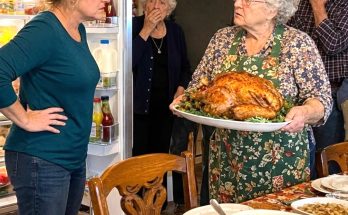
When I arrived, I carried it inside.
The dining room looked different from the way it usually did.
A white tablecloth covered the table.
Fresh flowers stood in a vase at the center.
The chairs had been arranged neatly, and the plates were already set out.
Gerald and Elaine were sitting together.
They looked comfortable and ready to eat.
I smiled and greeted them.
"Hello, both of you. It's nice to see you."
They returned the greeting.
I carried the ham toward the dining room, expecting someone to make room for it.
Instead, Christa stepped in front of me.
For a moment, I thought she was about to help me carry it.
She glanced at the dish in my hands, then pointed toward the kitchen.
"Dorothy, there's food in the refrigerator if you're hungry."
I waited for her to explain.
She didn't.
I looked at the table.
Then I looked back at her.
She spoke as if she were telling me where to put an empty box.
"This dinner is for my parents. You can get something for yourself from the fridge."
I couldn't quite understand the words at first.
I knew what each word meant.
I simply couldn't make them fit the room I was standing in.
Her parents were sitting at the table.
The meal was ready.
And I was the person who had cooked the main dish.
I looked toward Owen.
He was standing near the kitchen doorway.
His hands were at his sides, and his eyes were lowered toward the floor.
He knew I was looking at him.
I could tell.
He still didn't raise his head.
I waited for him to say something.
Even a simple question would have helped.
Why would you say that to Mom?
Or perhaps, Mom cooked the ham. Of course she's eating with us.
He said nothing.
That silence hurt more than Christa's words.
She was the one who had spoken to me cruelly.
Owen was the one who knew exactly what I had done for him over the years, and he still allowed it to happen.
I carried the ham into the kitchen.
My hands felt strangely steady.
I opened the refrigerator.
Inside were leftover noodles, a partly used block of cheese, and several plastic containers holding food from an earlier takeout meal.
I stood there with the refrigerator light shining against my face.
It was such a small, ordinary scene.
That was what made it so humiliating.
There was no shouting.
No argument.
Nobody had to tell me twice.
The message had been delivered clearly enough.
My food was welcome.
I was not.
I closed the refrigerator.
Then I turned toward Christa.
"All right. I understand."
She didn't try to stop me.
I picked up the ham again and carried it toward the front door.
Behind me, I heard a chair move against the floor.
I didn't turn around to see who had moved it.
I walked outside, opened my car, and set the dish on the passenger seat.
The ham was heavy.
I adjusted it until it sat flat, then fastened the seat belt around it so it wouldn't slide during the drive.
I remember looking at that seat belt.
I had buckled food into my car more carefully than my own son had protected my feelings.
The thought came so suddenly that I almost laughed.
Almost.
I got behind the wheel and started the engine.
Then I drove away.
I had not raised my voice.
I had not insulted Christa.
I had not demanded an explanation from Owen.
I had simply taken home the meal I had made.
For the first few minutes, I concentrated on the road.
My face felt hot, and my throat had tightened.
I kept swallowing, trying to make the feeling pass.
I was sixty-three years old.
I had raised a child on my own, worked for decades, and paid off a house.
Yet I had just been sent to search through leftovers in a refrigerator while my own son watched.
The shame was followed by something harder.
Anger.
I was angry with Christa for treating me that way.
I was angry with Owen for letting her.
But most of all, I was angry with myself for having spent years pretending that the way they treated me didn't matter.
My phone vibrated before I reached the highway.
It was Owen.
I pulled into a safe place and read his message.
"Mom, why did you leave? Christa's parents are sitting here waiting for the food."
I read it again.
Then I read it a third time.
He hadn't asked if I was all right.
He hadn't asked why I had left the ham.
He hadn't said he was sorry.
His concern was that Gerald and Elaine were waiting for dinner.
I put the phone facedown.
I didn't answer.
The forty-minute drive home gave me plenty of time to remember things I had spent years trying not to count.
The phone plan.
The insurance.
The groceries.
The money I sent every month.
All those expenses I had taken on because I loved my son and wanted his family to have an easier life.
I had never expected repayment.
I had never expected gifts.
I had only wanted to feel that I belonged when I walked through their door.
That afternoon, I finally understood that I had been confusing financial usefulness with affection.
I drove the rest of the way home with the ham beside me.
And for the first time in years, I began to wonder what would happen if I stopped making it so easy for everyone to take me for granted.
Click here to continue reading: PART 2: The Ham Went Back Into My Oven, but the Bills on My Computer Screen Made Me See My Family Differently
I Thought Being a Good Mother Meant Always Saying Yes, Until One Sunday Dinner Showed Me What My Family Really Expected
Part 1 of 4